Rural Health Research Institute, Charles Sturt University, Orange, NSW 2800, Australia.
Translational Health Research Institute, Western Sydney University, Campbelltown, Locked Bag 1797, Penrith, NSW 2751, Australia.
Int J Environ Res Public Health. 2023 Feb 13;20(4):3250. doi: 10.3390/ijerph20043250.
Understanding the specific geospatial variations in childhood stunting is essential for aligning appropriate health services to where new and/or additional nutritional interventions are required to achieve the Sustainable Development Goals (SDGs) and national targets.
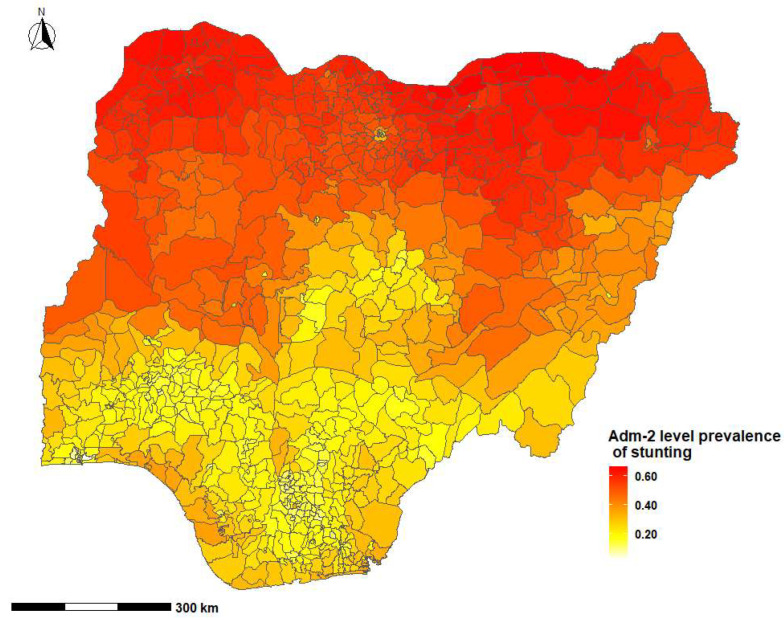
We described local variations in the prevalence of childhood stunting at the second administrative level and its determinants in Nigeria after accounting for the influence of geospatial dependencies.
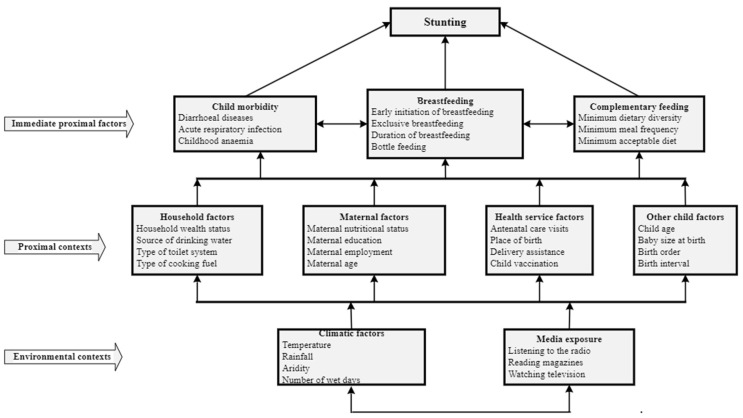
This study used the 2018 national Nigeria Demographic and Health Survey datasets (NDHS; N = 12,627). We used a Bayesian geostatistical modelling approach to investigate the prevalence of stunting at the second administrative level and its proximal and contextual determinants among children under five years of age in Nigeria.
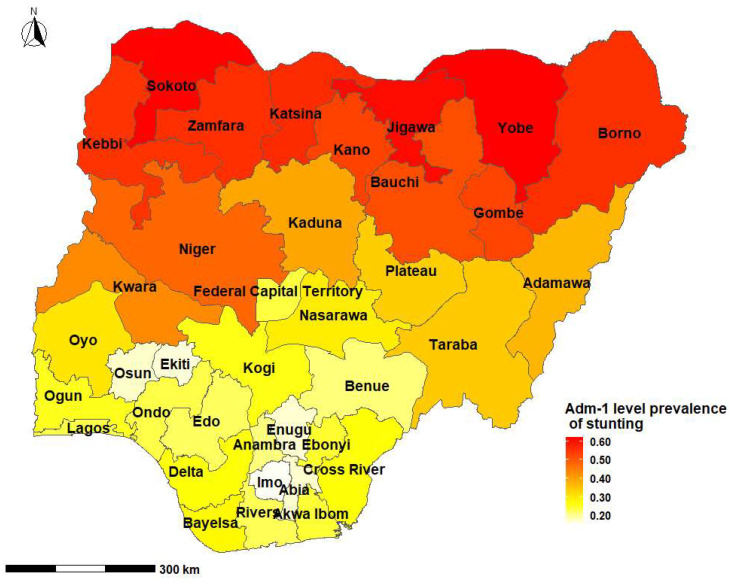
In 2018, the overall prevalence of childhood stunting in Nigeria was 41.5% (95% credible interval (CrI) from 26.4% to 55.7%). There were striking variations in the prevalence of stunting that ranged from 2.0% in Shomolu in Lagos State, Southern Nigeria to 66.4% in Biriniwa in Jigawa State, Northern Nigeria. Factors positively associated with stunting included being perceived as small at the time of birth and experience of three or more episodes of diarrhoea in the two weeks before the survey. Children whose mothers received a formal education and/or were overweight or obese were less likely to be stunted compared to their counterparts. Children who were from rich households, resided in households with improved cooking fuel, resided in urban centres, and lived in medium-rainfall geographic locations were also less likely to be stunted.
The study findings showed wide variations in childhood stunting in Nigeria, suggesting the need for a realignment of health services to the poorest regions of Northern Nigeria.
了解儿童发育迟缓在特定地理空间上的变化对于将适当的卫生服务与需要新的和/或额外营养干预的地区相匹配至关重要,以实现可持续发展目标(SDGs)和国家目标。
我们描述了尼日利亚二级行政区儿童发育迟缓的流行情况及其在考虑到地理空间依赖性影响后的决定因素。
本研究使用了 2018 年尼日利亚全国人口与健康调查数据集(NDHS;N=12627)。我们使用贝叶斯地统计建模方法来调查尼日利亚五岁以下儿童发育迟缓的流行情况及其在二级行政区的近因和背景决定因素。
2018 年,尼日利亚儿童发育迟缓的总体流行率为 41.5%(95%可信区间(CrI)为 26.4%至 55.7%)。发育迟缓的流行率存在显著差异,从南部拉各斯州 Shomolu 的 2.0%到北部吉加瓦州 Biriniwa 的 66.4%不等。与发育迟缓正相关的因素包括出生时被认为体型较小以及在调查前两周内经历了三次或更多次腹泻。与没有接受过正规教育的母亲相比,其子女接受过正规教育和/或超重或肥胖的母亲,其子女发育迟缓的可能性较小。来自富裕家庭、居住在使用改良燃料的家庭、居住在城市中心和生活在中降雨量地区的儿童也不太可能发育迟缓。
研究结果表明,尼日利亚儿童发育迟缓存在广泛的差异,这表明需要重新调整卫生服务,以满足北部尼日利亚最贫困地区的需求。