Chao C C, Bird P, Gething M J, Sambrook J
Department of Biochemistry, University of Texas Health Science Center, Dallas 75235.
Mol Cell Biol. 1987 Oct;7(10):3842-5. doi: 10.1128/mcb.7.10.3842-3845.1987.
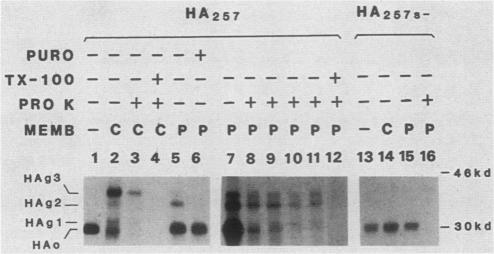
The biosynthesis of influenza virus hemagglutinin (HA) and its translocation across microsomal membranes were studied in a mammalian cell-free system. All forms of HA could be cotranslationally translocated with high efficiency. However, only truncated forms of HA were translocated after protein synthesis has been terminated. The efficiency of this posttranslational translocation was dependent on the extent of the truncation. Posttranslational translocation was ribosome dependent and occurred only in the presence of a functional N-terminal signal sequence. The molecular mechanism of protein targeting and translocation across the membrane of the endoplasmic reticulum is discussed.
在一个无细胞哺乳动物系统中研究了流感病毒血凝素(HA)的生物合成及其跨微粒体膜的转运。所有形式的HA都能高效地进行共翻译转运。然而,只有HA的截短形式在蛋白质合成终止后才会转运。这种翻译后转运的效率取决于截短的程度。翻译后转运依赖于核糖体,并且仅在功能性N端信号序列存在时发生。本文讨论了蛋白质靶向及跨内质网膜转运的分子机制。