Department of Neurology, Chang Gung Memorial Hospital Linkou Medical Center, College of Medicine, Chang Gung University, Taoyuan 33302, Taiwan.
Dementia Center, Taoyuan Chang Gung Memorial Hospital, Taoyuan 33378, Taiwan.
Int J Mol Sci. 2023 Feb 17;24(4):4085. doi: 10.3390/ijms24044085.
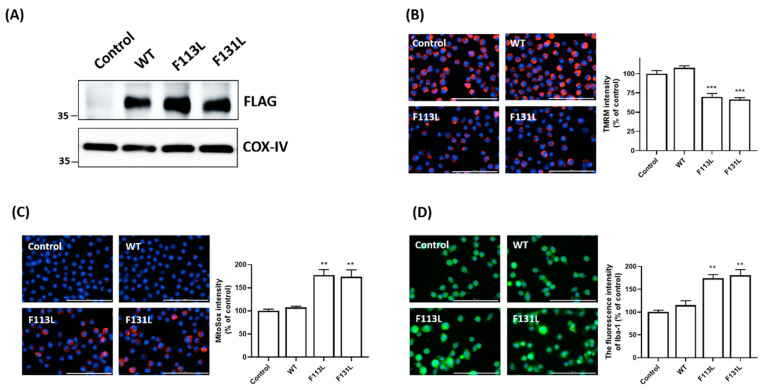
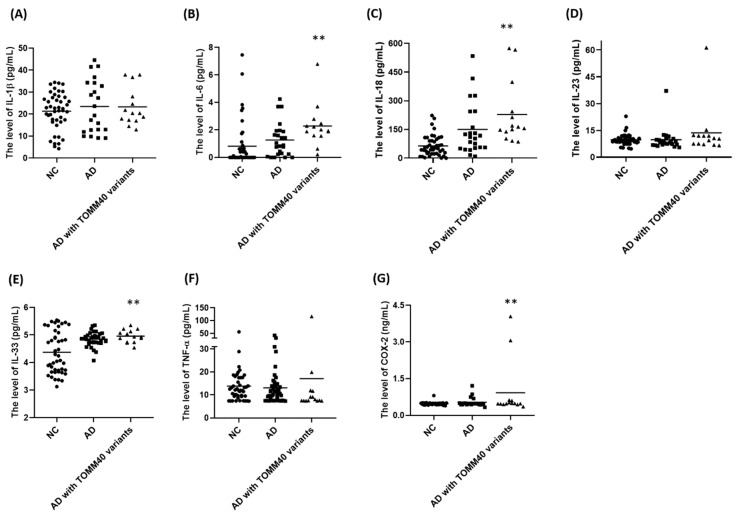
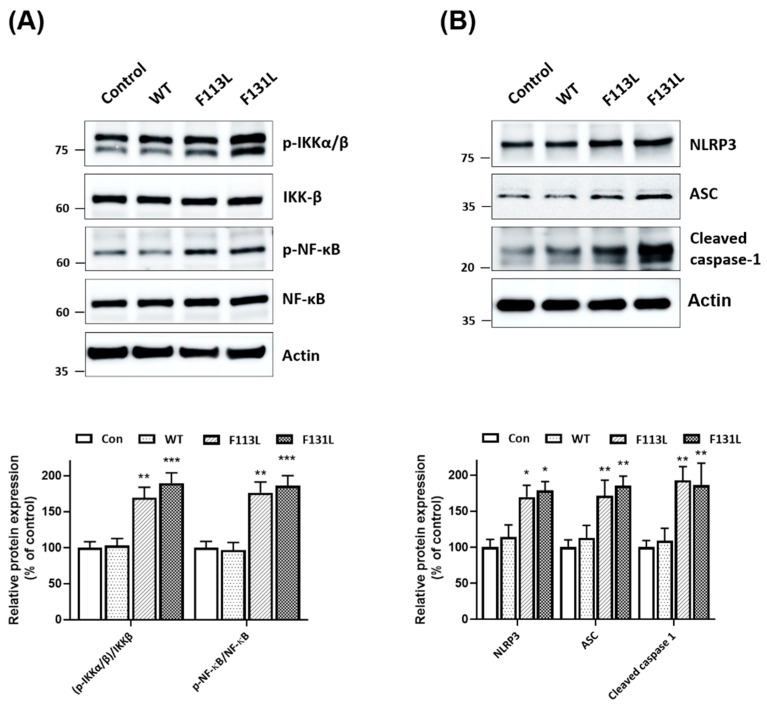
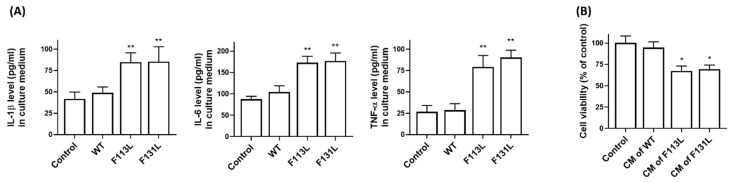
Translocase of outer mitochondrial membrane 40 () is located in the outer membrane of mitochondria. is essential for protein import into mitochondria. genetic variants are believed to increase the risk of Alzheimer's disease (AD) in different populations. In this study, three exonic variants (rs772262361, rs157581, and rs11556505) and three intronic variants (rs157582, rs184017, and rs2075650) of the gene were identified from Taiwanese AD patients using next-generation sequencing. Associations between the three exonic variants and AD susceptibility were further evaluated in another AD cohort. Our results showed that rs157581 (c.339T > C, p.Phe113Leu, F113L) and rs11556505 (c.393C > T, p.Phe131Leu, F131L) were associated with an increased risk of AD. We further utilized cell models to examine the role of TOMM40 variation in mitochondrial dysfunction that causes microglial activation and neuroinflammation. When expressed in BV2 microglial cells, the AD-associated mutant (F113L) or (F131L) TOMM40 induced mitochondrial dysfunction and oxidative stress-induced activation of microglia and NLRP3 inflammasome. Pro-inflammatory TNF-α, IL-1β, and IL-6 released by mutant (F113L) or (F131L) TOMM40-activated BV2 microglial cells caused cell death of hippocampal neurons. Taiwanese AD patients carrying TOMM40 missense (F113L) or (F131L) variants displayed an increased plasma level of inflammatory cytokines IL-6, IL-18, IL-33, and COX-2. Our results provide evidence that TOMM40 exonic variants, including rs157581 (F113L) and rs11556505 (F131L), increase the AD risk of the Taiwanese population. Further studies suggest that AD-associated mutant (F113L) or (F131L) TOMM40 cause the neurotoxicity of hippocampal neurons by inducing the activation of microglia and NLRP3 inflammasome and the release of pro-inflammatory cytokines.
外膜转位酶 40()位于线粒体的外膜中。它对于蛋白质进入线粒体是必不可少的。遗传变异被认为会增加不同人群患阿尔茨海默病(AD)的风险。在这项研究中,使用下一代测序技术从台湾 AD 患者中鉴定出基因的三个外显子变异(rs772262361、rs157581 和 rs11556505)和三个内含子变异(rs157582、rs184017 和 rs2075650)。进一步在另一个 AD 队列中评估了三个 外显子变异与 AD 易感性的关联。我们的结果表明,rs157581(c.339T>C,p.Phe113Leu,F113L)和 rs11556505(c.393C>T,p.Phe131Leu,F131L)与 AD 风险增加相关。我们进一步利用细胞模型研究了 TOMM40 变异在引起小胶质细胞激活和神经炎症的线粒体功能障碍中的作用。当在 BV2 小胶质细胞中表达时,与 AD 相关的突变(F113L)或(F131L)TOMM40 诱导线粒体功能障碍和氧化应激诱导的小胶质细胞和 NLRP3 炎性体激活。由突变(F113L)或(F131L)TOMM40 激活的 BV2 小胶质细胞释放的促炎 TNF-α、IL-1β 和 IL-6 导致海马神经元死亡。携带 TOMM40 错义(F113L)或(F131L)变体的台湾 AD 患者表现出炎症细胞因子 IL-6、IL-18、IL-33 和 COX-2 的血浆水平升高。我们的结果提供了证据,表明外显子变异包括 rs157581(F113L)和 rs11556505(F131L),增加了台湾人群的 AD 风险。进一步的研究表明,与 AD 相关的突变(F113L)或(F131L)TOMM40 通过诱导小胶质细胞和 NLRP3 炎性体的激活以及促炎细胞因子的释放,导致海马神经元的神经毒性。