Israël Maurice, Berg Eric, Tenenbaum Guy
Institut Alfred Fessard, CNRS, 2 Av. Terrasse, 91190 Gif-sur-Yvette, France.
Independent Researcher, 4501 Ford Ave., Alexandria, VA 22302, USA.
J Clin Med. 2023 Feb 17;12(4):1589. doi: 10.3390/jcm12041589.
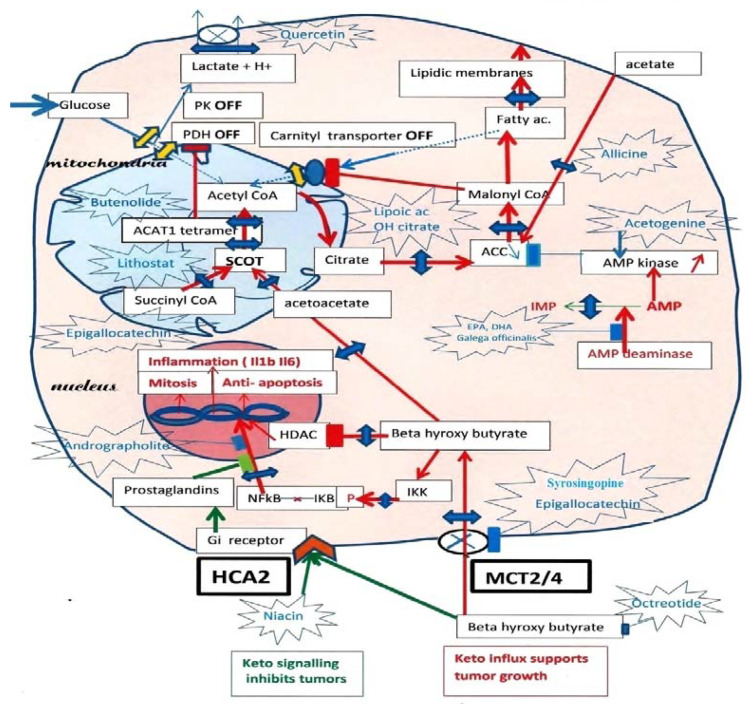
In tumor cells, ketolysis "via" succinyl-CoA: 3-oxoacid-CoAtransferase (SCOT) and acetyl-CoA acetyltransferase 1 (ACAT1) is a major source of mitochondrial acetyl-CoA. Active ACAT1 tetramers stabilize by tyrosine phosphorylation, which facilitates the SCOT reaction and ketolysis. Tyrosine phosphorylation of pyruvate kinase PK M2 has the opposite effect, stabilizing inactive dimers, while pyruvate dehydrogenase (PDH), which is already inhibited by phosphorylation, is acetylated by ACAT1 and is doubly locked. This closes the glycolytic supply of acetyl-CoA. In addition, since tumor cells must synthesize fatty acids to create new membranes, they automatically turn off the degradation of fatty acids into acetyl-CoA ("via" the malonyl-CoA brake for the fatty acid carnityl transporter). Thus, inhibiting SCOT the specific ketolytic enzyme and ACAT1 should hold back tumor progression. However, tumor cells are still able to take up external acetate and convert it into acetyl-CoA in their cytosol "via" an acetyl-CoA synthetase, which feeds the lipogenic pathway; additionally, inhibiting this enzyme would make it difficult for tumor cells to form new lipid membrane and survive.
在肿瘤细胞中,通过琥珀酰辅酶A:3-氧代酸辅酶A转移酶(SCOT)和乙酰辅酶A乙酰转移酶1(ACAT1)进行的酮体分解是线粒体乙酰辅酶A的主要来源。活性ACAT1四聚体通过酪氨酸磷酸化而稳定,这促进了SCOT反应和酮体分解。丙酮酸激酶PK M2的酪氨酸磷酸化具有相反的作用,使无活性的二聚体稳定,而已经被磷酸化抑制的丙酮酸脱氢酶(PDH)则被ACAT1乙酰化并被双重锁定。这关闭了乙酰辅酶A的糖酵解供应。此外,由于肿瘤细胞必须合成脂肪酸以形成新的膜,它们会自动关闭脂肪酸降解为乙酰辅酶A的过程(通过脂肪酸肉碱转运体的丙二酰辅酶A制动)。因此,抑制特定的酮体分解酶SCOT和ACAT1应该能够抑制肿瘤进展。然而,肿瘤细胞仍然能够摄取外部乙酸盐,并通过乙酰辅酶A合成酶在其胞质溶胶中将其转化为乙酰辅酶A,这为脂肪生成途径提供原料;此外,抑制这种酶会使肿瘤细胞难以形成新的脂质膜并存活。