Cimmino Giovanni, Bottino Roberta, Formisano Tiziana, Orlandi Massimiliano, Molinari Daniele, Sperlongano Simona, Castaldo Pasquale, D'Elia Saverio, Carbone Andreina, Palladino Alberto, Forte Lavinia, Coppolino Francesco, Torella Michele, Coppola Nicola
Department of Translational Medical Sciences, Section of Cardiology, University of Campania Luigi Vanvitelli, 80131 Naples, Italy.
Cardiology Unit, Azienda Ospedaliera Universitaria Luigi Vanvitelli, 80138 Napoli, Italy.
Life (Basel). 2023 Jan 30;13(2):377. doi: 10.3390/life13020377.
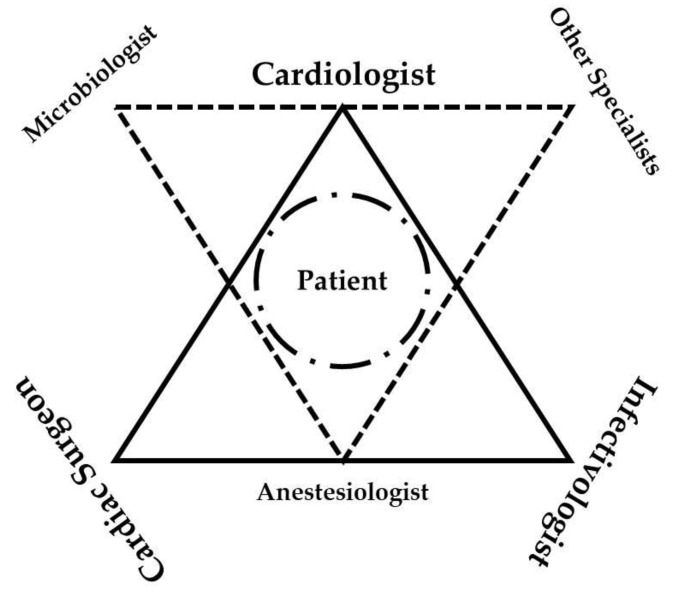
Infective endocarditis (IE) is a rare but potentially life-threatening disease, sometimes with longstanding sequels among surviving patients. The population at high risk of IE is represented by patients with underlying structural heart disease and/or intravascular prosthetic material. Taking into account the increasing number of intravascular and intracardiac procedures associated with device implantation, the number of patients at risk is growing too. If bacteremia develops, infected vegetation on the native/prosthetic valve or any intracardiac/intravascular device may occur as the final result of invading microorganisms/host immune system interaction. In the case of IE suspicion, all efforts must be focused on the diagnosis as IE can spread to almost any organ in the body. Unfortunately, the diagnosis of IE might be difficult and require a combination of clinical examination, microbiological assessment and echocardiographic evaluation. There is a need of novel microbiological and imaging techniques, especially in cases of blood culture-negative. In the last few years, the management of IE has changed. A multidisciplinary care team, including experts in infectious diseases, cardiology and cardiac surgery, namely, the Endocarditis Team, is highly recommended by the current guidelines.
感染性心内膜炎(IE)是一种罕见但可能危及生命的疾病,在存活患者中有时会留下长期后遗症。IE的高危人群包括患有潜在结构性心脏病和/或血管内假体材料的患者。考虑到与设备植入相关的血管内和心脏内手术数量不断增加,高危患者的数量也在增加。如果发生菌血症,天然/人工瓣膜或任何心脏内/血管内设备上的感染性赘生物可能是入侵微生物/宿主免疫系统相互作用的最终结果。在怀疑患有IE的情况下,所有努力都必须集中在诊断上,因为IE可能会扩散到身体的几乎任何器官。不幸的是,IE的诊断可能很困难,需要结合临床检查、微生物学评估和超声心动图评估。需要新的微生物学和成像技术,尤其是在血培养阴性的情况下。在过去几年中,IE的管理方式发生了变化。目前的指南强烈推荐由包括传染病、心脏病学和心脏外科专家在内的多学科护理团队,即心内膜炎团队,来进行治疗。