Angelopoulou Efthalia, Karlafti Eleni, Georgakopoulou Vasiliki E, Papalexis Petros, Papageorgiou Sokratis G, Tegos Thomas, Savopoulos Christos
Department of Neurology, Aiginition University Hospital, National and Kapodistrian University of Athens, 11527 Athens, Greece.
1st Propaedeutic Department of Internal Medicin, AHEPA University General Hospital, Aristotle University of Thessaloniki, 54124 Thessaloniki, Greece.
Life (Basel). 2023 Feb 15;13(2):536. doi: 10.3390/life13020536.
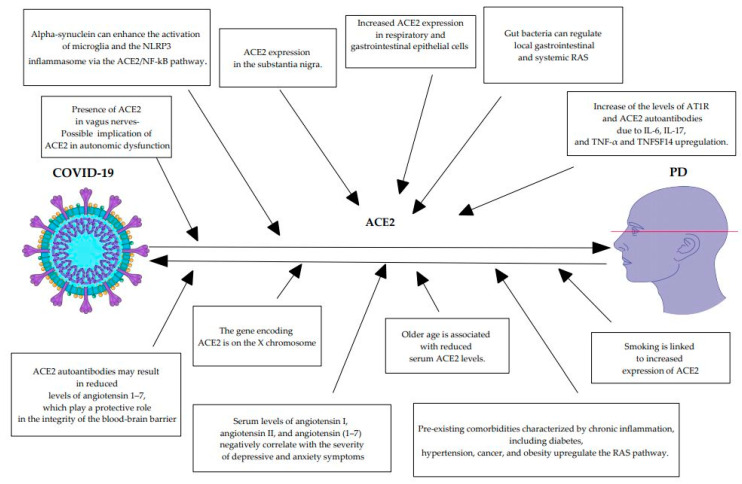
Coronavirus disease 2019 (COVID-19) is frequently accompanied by neurological manifestations such as headache, delirium, and epileptic seizures, whereas ageusia and anosmia may appear before respiratory symptoms. Among the various neurological COVID-19-related comorbidities, Parkinson's disease (PD) has gained increasing attention. Some cases of PD disease have been linked to COVID-19, and both motor and non-motor symptoms in Parkinson's disease patients frequently worsen following SARS-CoV-2 infection. Although it is still unclear whether PD increases the susceptibility to SARS-CoV-2 infection or whether COVID-19 increases the risk of or unmasks future cases of PD, emerging evidence sheds more light on the molecular mechanisms underlying the relationship between these two diseases. Among them, angiotensin-converting enzyme 2 (ACE2), a significant component of the renin-angiotensin system (RAS), seems to play a pivotal role. ACE2 is required for the entry of SARS-CoV-2 to the human host cells, and ACE2 dysregulation is implicated in the severity of COVID-19-related acute respiratory distress syndrome (ARDS). ACE2 imbalance is implicated in core shared pathophysiological mechanisms between PD and COVID-19, including aberrant inflammatory responses, oxidative stress, mitochondrial dysfunction, and immune dysregulation. ACE2 may also be implicated in alpha-synuclein-induced dopaminergic degeneration, gut-brain axis dysregulation, blood-brain axis disruption, autonomic dysfunction, depression, anxiety, and hyposmia, which are key features of PD.
2019冠状病毒病(COVID-19)常伴有头痛、谵妄和癫痫发作等神经症状,而嗅觉减退和嗅觉丧失可能在呼吸道症状出现之前就已出现。在各种与COVID-19相关的神经合并症中,帕金森病(PD)越来越受到关注。一些帕金森病病例与COVID-19有关,并且帕金森病患者的运动和非运动症状在感染SARS-CoV-2后常常恶化。虽然目前尚不清楚帕金森病是否会增加对SARS-CoV-2感染的易感性,或者COVID-19是否会增加未来帕金森病病例的风险或使其显现出来,但新出现的证据为这两种疾病之间关系的分子机制提供了更多线索。其中,肾素-血管紧张素系统(RAS)的重要组成部分血管紧张素转换酶2(ACE2)似乎起着关键作用。ACE2是SARS-CoV-2进入人类宿主细胞所必需的,并且ACE2失调与COVID-19相关急性呼吸窘迫综合征(ARDS)的严重程度有关。ACE2失衡与帕金森病和COVID-19之间共同的核心病理生理机制有关,包括异常的炎症反应、氧化应激、线粒体功能障碍和免疫失调。ACE2还可能与α-突触核蛋白诱导的多巴胺能神经元变性、肠-脑轴失调、血-脑轴破坏、自主神经功能障碍、抑郁、焦虑和嗅觉减退有关,这些都是帕金森病的关键特征。