2nd Department of Neurology, AHEPA University Hospital, School of Medicine, Faculty of Health Sciences, Aristotle University of Thessaloniki, 54636 Thessaloniki, Greece.
Laboratory of Experimental Neurology and Neuroimmunology, 2nd Department of Neurology, AHEPA University Hospital, 54636 Thessaloniki, Greece.
Medicina (Kaunas). 2023 Jan 30;59(2):266. doi: 10.3390/medicina59020266.
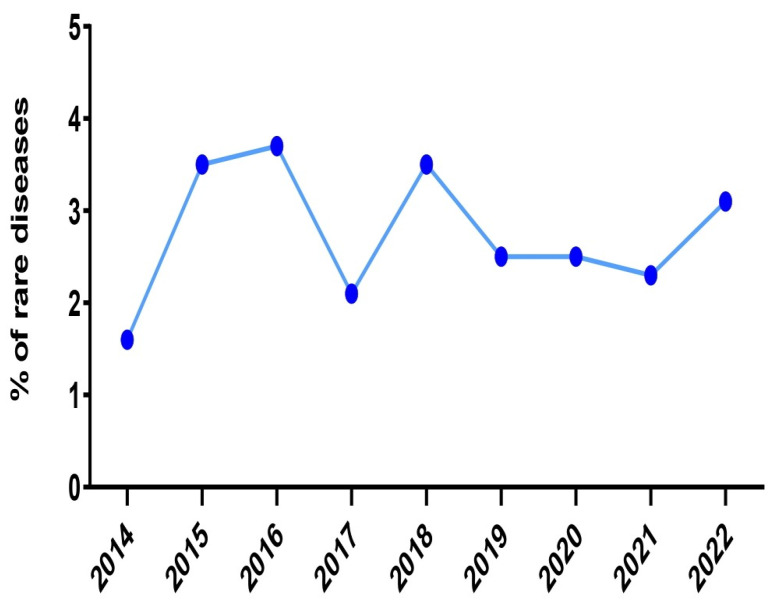
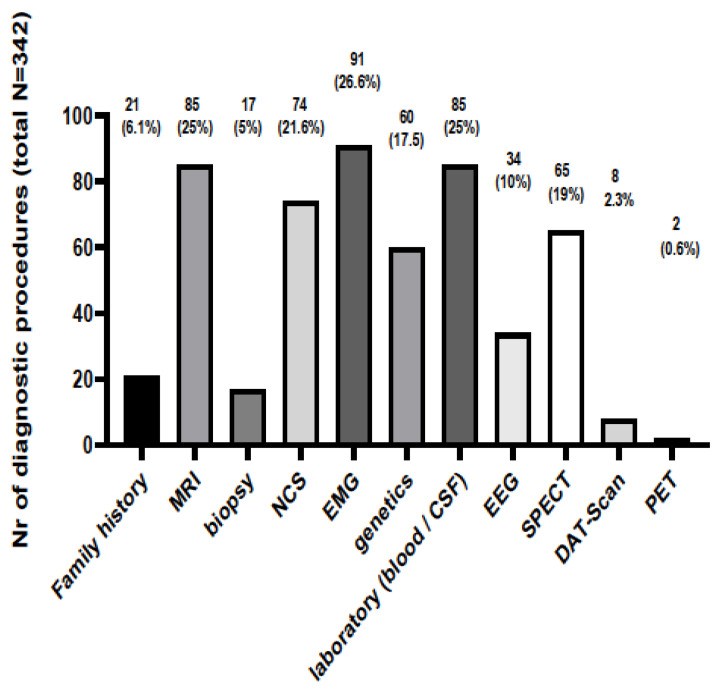
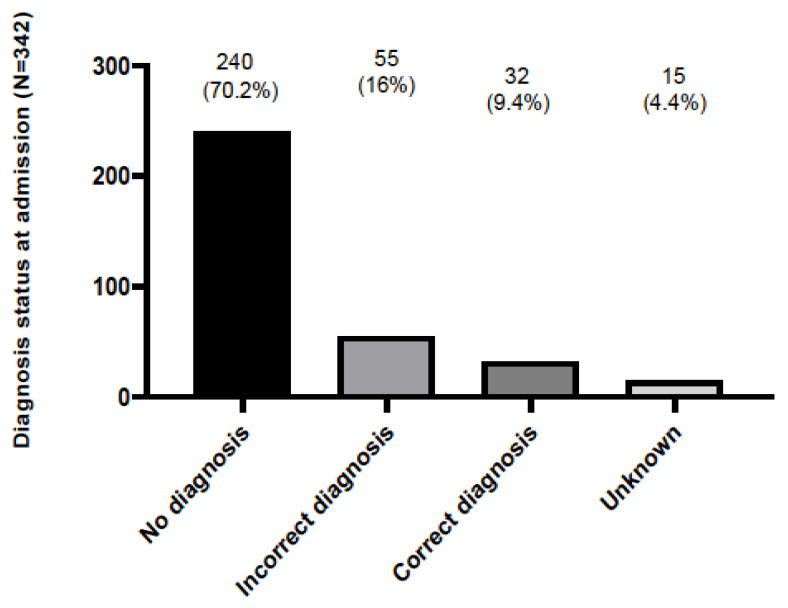
Rare diseases (RDs) are life-threatening or chronically impairing conditions that affect about 6% of the world's population. RDs are often called 'orphan' diseases, since people suffering from them attract little support from national health systems. The aim of this study is to describe the clinical characteristics of, and the available laboratory examinations for, patients who were hospitalized in a tertiary referral center and finally received a diagnosis associated with a Rare Neurological Disease (RND). Patients that were hospitalized in our clinic from 1 January 2014 to 31 March 2022 and were finally diagnosed with an RND were consecutively included. The RND classification was performed according to the ORPHAcode system. A total of 342 out of 11.850 (2.9%) adult patients admitted to our department during this period received a diagnosis associated with an RND. The most common diagnosis (N = 80, 23%) involved an RND presenting with dementia, followed by a motor neuron disease spectrum disorder (N = 64, 18.7%). Family history indicative of an RND was present in only 21 patients (6.1%). Fifty-five (16%) people had previously been misdiagnosed with another neurological condition. The mean time delay between disease onset and diagnosis was 4.24 ± 0.41 years. Our data indicate that a broad spectrum of RNDs may reach a tertiary Neurological Center after a significant delay. Moreover, our data underline the need for a network of reference centers, both at a national and international level, expected to support research on the diagnosis and treatment of RND.
罕见病(RDs)是危及生命或慢性致残的疾病,影响全球约 6%的人口。RDs 通常被称为“孤儿病”,因为患有这些疾病的人很少得到国家卫生系统的支持。本研究旨在描述在三级转诊中心住院并最终诊断为罕见神经疾病(RND)的患者的临床特征和可用的实验室检查。从 2014 年 1 月 1 日至 2022 年 3 月 31 日,连续纳入在我们诊所住院且最终诊断为 RND 的患者。RND 分类按照 ORPHAcode 系统进行。在此期间,我院共收治 11850 名成年患者中的 342 名(2.9%)被诊断为与 RND 相关的疾病。最常见的诊断(N=80,23%)为以痴呆为表现的 RND,其次是运动神经元疾病谱障碍(N=64,18.7%)。仅有 21 名患者(6.1%)存在提示 RND 的家族史。55 名患者(16%)曾被误诊为另一种神经疾病。从发病到确诊的平均时间延迟为 4.24±0.41 年。我们的数据表明,广泛的 RND 可能会在显著延迟后到达三级神经科中心。此外,我们的数据强调了需要建立一个包括国家和国际层面的参考中心网络,以支持 RND 的诊断和治疗研究。