Experimental Trauma Surgery, Faculty of Medicine, Justus Liebig University of Giessen, 35392 Giessen, Germany.
Department of Trauma, Hand and Reconstructive Surgery, Faculty of Medicine, Justus Liebig University of Giessen, 35392 Giessen, Germany.
Medicina (Kaunas). 2023 Feb 14;59(2):365. doi: 10.3390/medicina59020365.
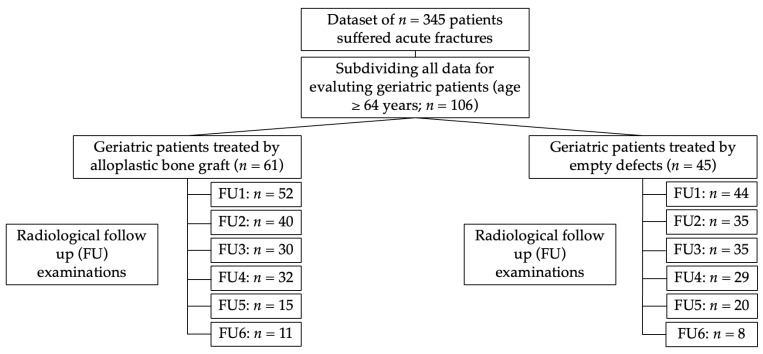
he treatment of large bone defects in geriatric patients often presents a major surgical challenge because of age-related bone loss. In such patients, the scarcity of healthy makes autologous grafting techniques hard to perform. On the one hand, clinicians' fear of possible infections limits using bone substitute materials (BSM). On the other hand, BSM is limitless and spares patients another surgery to harvest autologous material. : To address the aptness of BSM in geriatric patients, we performed a retrospective analysis of all patients over the age of 64 years who visited our clinic between the years 2011-2018. The study assessed postoperative complications clinically and healing results radiologically. The study included 83 patients with bone defects at the distal radius, proximal humerus, and proximal tibia. The defect zones were filled with BSM based on either nanocrystalline hydroxyapatite (NHA) or calcium phosphate (CP). For comparison, a reference group (empty defect, ED) without the void filling with a BSM was also included. : 106 patients sustained traumatic fractures of the distal radius (71.7%), proximal humerus (5.7%), and proximal tibia (22.6%). No difference was found between the BSM groups in infection occurrence ( = 1.0). Although not statistically significant, the BSM groups showed a lower rate of pseudarthrosis ( = 0.09) compared with the ED group. Relative risk (RR) of complications was 32.64% less in the BSM groups compared with the ED group. The additional beneficial outcome of BSM was demonstrated by calculating the number needed to treat (NNT). The calculation showed that with every six patients treated, at least one complication could be avoided. Radiological assessment of bone healing showed significant improvement in the bridging of the defect zone ( < 0.001) when BSM was used. : In contrast to previous studies, the study showed that BSM could support bone healing and does not present an infection risk in geriatric patients. The NNT calculation indicates a wider potential benefit of BSM.
在老年患者中,治疗大的骨缺损常常是一个主要的外科挑战,因为与年龄相关的骨质流失。在这些患者中,健康的骨质稀少使得自体移植物技术难以实施。一方面,临床医生担心可能的感染会限制使用骨替代材料(BSM)。另一方面,BSM 是无限的,可以避免患者再次进行自体材料采集手术。为了评估 BSM 在老年患者中的适用性,我们对 2011 年至 2018 年间在我们诊所就诊的所有 64 岁以上患者进行了回顾性分析。该研究通过临床评估术后并发症和放射学评估愈合结果。该研究纳入了 83 例桡骨远端、肱骨近端和胫骨近端骨缺损患者。缺损区根据纳米晶羟基磷灰石(NHA)或磷酸钙(CP)填充 BSM。为了比较,还纳入了一个无 BSM 空洞填充的参考组(ED)。106 例患者为桡骨远端(71.7%)、肱骨近端(5.7%)和胫骨近端(22.6%)外伤性骨折。BSM 组与感染发生率( = 1.0)无差异。虽然没有统计学意义,但 BSM 组与 ED 组相比,假关节发生率较低( = 0.09)。BSM 组并发症的相对风险(RR)比 ED 组低 32.64%。通过计算需要治疗的人数(NNT),显示了 BSM 的额外有益结果。计算表明,每治疗 6 例患者,至少可以避免 1 例并发症。使用 BSM 时,骨缺损区桥接的放射学评估显示出显著改善( < 0.001)。与以往的研究相比,该研究表明 BSM 可以支持骨愈合,并且不会给老年患者带来感染风险。NNT 计算表明 BSM 的潜在益处更大。