Chergaoui Sara, Debecker Damien P, Leyssens Tom, Luis Patricia
Institute of Mechanics, Materials and Civil Engineering-Materials & Process Engineering (iMMC-IMAP), Université Catholique de Louvain (UCLouvain), Place Sainte Barbe 2, 1348 Louvain-la-Neuve, Belgium.
Research & Innovation Centre for Process Engineering (ReCIPE), Université Catholique de Louvain (UCLouvain), Place Sainte Barbe, 2 bte L5.02.02-B, 1348 Louvain-la-Neuve, Belgium.
Membranes (Basel). 2023 Jan 21;13(2):140. doi: 10.3390/membranes13020140.
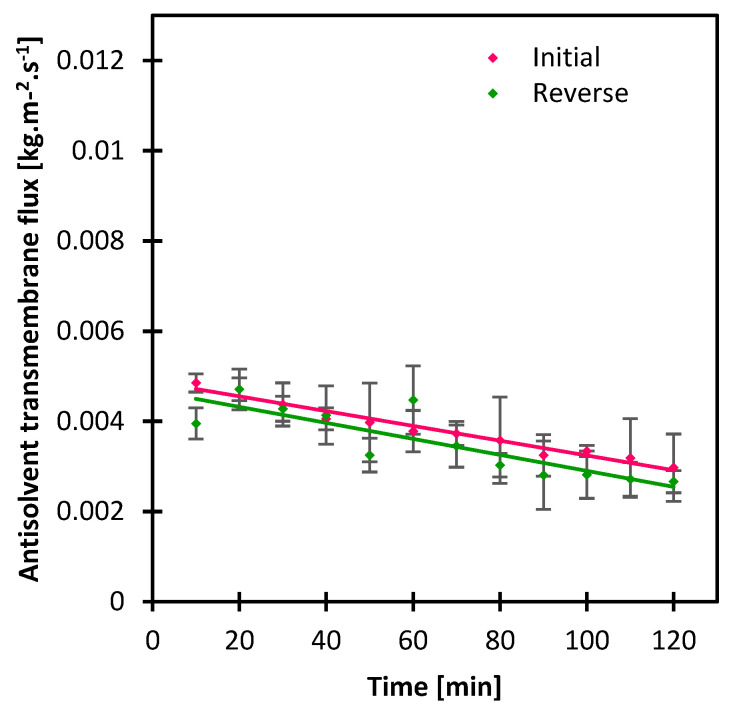
Antisolvent crystallization is commonly used in the formation of heat-sensitive compounds as it is the case for most active pharmaceutical ingredients. Membranes have the ability to control the antisolvent mass transfer to the reaction medium, providing excellent mixing that inhibits the formation of local supersaturations responsible for the undesired properties of the resulting crystals. Still, optimization of the operating conditions is required. This work investigates the impact of solution velocity, the effect of antisolvent composition, the temperature and gravity, using glycine-water-ethanol as a model crystallization system, and polypropylene flat sheet membranes. Results proved that in any condition, membranes were consistent in providing a narrow crystal size distribution (CSD) with coefficient of variation (CV) in the range of 0.5-0.6 as opposed to 0.7 obtained by batch and drop-by-drop crystallization. The prism-like shape of glycine crystals was maintained as well, but slightly altered when operating at a temperature of 35 °C with the appearance of smoother crystal edges. Finally, the mean crystal size was within 23 to 40 µm and did not necessarily follow a clear correlation with the solution velocities or antisolvent composition, but increased with the application of higher temperature or gravity resistance. Besides, the monoclinic form of α-glycine was perfectly maintained in all conditions. The results at each condition correlated directly with the antisolvent transmembrane flux that ranged between 0.0002 and 0.001 kg/m. s. In conclusion, membrane antisolvent crystallization is a robust solution offering consistent crystal properties under optimal operating conditions.
反溶剂结晶法常用于热敏性化合物的制备,大多数活性药物成分的制备都是如此。膜具有控制反溶剂向反应介质传质的能力,能提供出色的混合效果,抑制局部过饱和现象的形成,而局部过饱和会导致所得晶体出现不理想的性质。即便如此,仍需要对操作条件进行优化。本研究以甘氨酸 - 水 - 乙醇为模型结晶体系,使用聚丙烯平板膜,考察了溶液流速、反溶剂组成、温度和重力的影响。结果表明,在任何条件下,膜都能始终提供窄的晶体尺寸分布(CSD),变异系数(CV)在0.5 - 0.6范围内,而分批结晶和逐滴结晶的变异系数为0.7。甘氨酸晶体的棱柱形状也得以保持,但在35℃操作时,晶体边缘会变平滑,形状略有改变。最后,平均晶体尺寸在23至40μm之间,不一定与溶液流速或反溶剂组成有明显的相关性,但会随着温度升高或重力增加而增大。此外,α - 甘氨酸的单斜晶型在所有条件下都能完美保持。每个条件下的结果都与反溶剂跨膜通量直接相关,反溶剂跨膜通量在0.0002至0.001 kg/m·s之间。总之,膜反溶剂结晶法是一种可靠的方法,在最佳操作条件下能提供一致的晶体性质。