Petriček Igor, Tomić Martina, Bulum Tomislav, Lešin Gaćina Dina, Vidas Pauk Sania
Department of Ophthalmology, Zagreb University Hospital Center, 10000 Zagreb, Croatia.
School of Medicine, University of Zagreb, 10000 Zagreb, Croatia.
Metabolites. 2023 Jan 20;13(2):157. doi: 10.3390/metabo13020157.
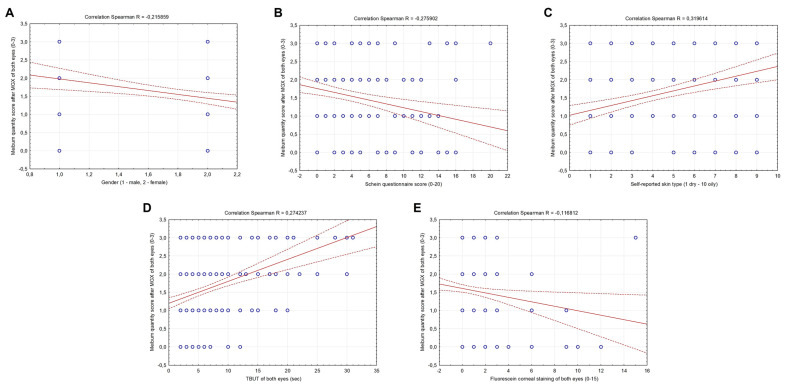
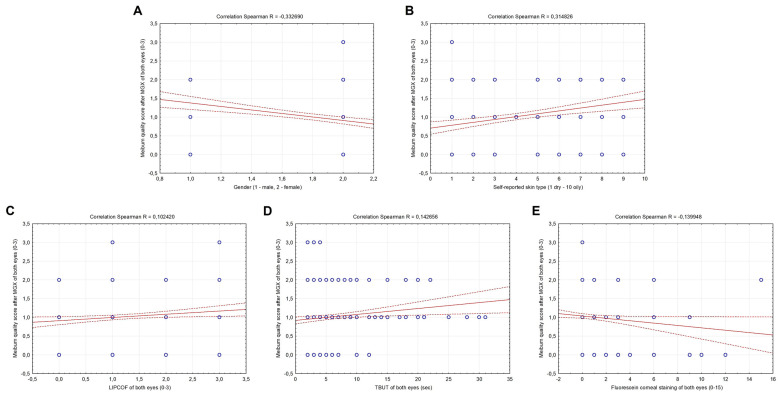
This cross-sectional study aimed to investigate the connection between meibomian gland (MG) excreta quantity and quality after MG expression (MGX), dry eye disease (DED) symptoms, and objective DED signs and to clarify the relationship between dry eye and MG function in DED pathophysiology. The study included 200 subjects, 100 with and 100 without dry eye symptoms. Schein questionnaire was used to determine the severity of dry eye symptoms and self-reported skin type for facial skin dryness self-evaluation. Objective dry eye signs were assessed by monitoring conjunctival hyperemia, lid parallel conjunctival folds (LIPCOF), tear break-up time (TBUT), fluorescein surface staining and digital MGX. Subjects with DED symptoms had significantly lower MG quantity scores than healthy controls ( < 0.001). Meibum quality and quantity scores significantly correlated with female gender ( = 0.002), Schein questionnaire score ( < 0.001), fluorescein corneal staining score ( = 0.019), self-reported skin type ( < 0.001), TBUT ( < 0.001) and LIPCOF ( = 0.041). After adjustment for age and gender in a logistic regression analysis, dry eye was independently and significantly associated with self-reported skin type (OR 0.73, < 0.001), LIPCOF (OR 1.04, < 0.001), fluorescein corneal staining (OR 1.05, = 0.019), TBUT (OR 0.77, < 0.001) and meibum quantity score (OR 0.59, < 0.001). Dry eye symptoms and objective signs correlated well in this study. MGX discriminated between the subjects with and without DED symptoms and was associated with other objective DED signs. Results showed a significant association between meibum quality and quantity, MG function, DED and facial skin dryness self-perception. This paper established a correlation between dry eye symptoms caused by MG dysfunction and dry skin, which can help general health practitioners consider dry eye as a cause of chronic eye complaints with patients who report dry skin.
这项横断面研究旨在调查睑板腺(MG)挤压后睑板腺分泌物的数量和质量、干眼疾病(DED)症状以及客观干眼体征之间的联系,并阐明在DED病理生理学中干眼与MG功能之间的关系。该研究纳入了200名受试者,其中100名有干眼症状,100名无干眼症状。使用Schein问卷来确定干眼症状的严重程度,并通过自我报告皮肤类型来进行面部皮肤干燥的自我评估。通过监测结膜充血、睑结膜皱褶(LIPCOF)、泪膜破裂时间(TBUT)、荧光素表面染色和数字化睑板腺挤压来评估客观干眼体征。有DED症状的受试者的MG数量评分显著低于健康对照组(<0.001)。睑脂质量和数量评分与女性性别(=0.002)、Schein问卷评分(<0.001)、荧光素角膜染色评分(=0.019)、自我报告皮肤类型(<0.001)、TBUT(<0.001)和LIPCOF(=0.041)显著相关。在逻辑回归分析中对年龄和性别进行调整后,干眼与自我报告皮肤类型(OR 0.73,<0.001)、LIPCOF(OR 1.04,<0.001)、荧光素角膜染色(OR 1.05,=0.019)、TBUT(OR 0.77,<0.001)和睑脂数量评分(OR 0.59,<0.001)独立且显著相关。在本研究中,干眼症状与客观体征相关性良好。睑板腺挤压能够区分有无DED症状的受试者,并且与其他客观干眼体征相关。结果显示睑脂质量和数量、MG功能、DED和面部皮肤干燥自我认知之间存在显著关联。本文建立了MG功能障碍引起的干眼症状与皮肤干燥之间的相关性,这有助于全科医生将干眼视为报告有皮肤干燥的患者慢性眼部不适的一个原因。