Kapoor Divya, Shukla Deepak
Department of Ophthalmology and Visual Sciences, College of Medicine, University of Illinois at Chicago, 1905 W. Taylor St., Chicago, IL 60612, USA.
Department of Microbiology and Immunology, College of Medicine, University of Illinois at Chicago, 835 S. Wolcott, Chicago, IL 60612, USA.
Pathogens. 2023 Jan 29;12(2):209. doi: 10.3390/pathogens12020209.
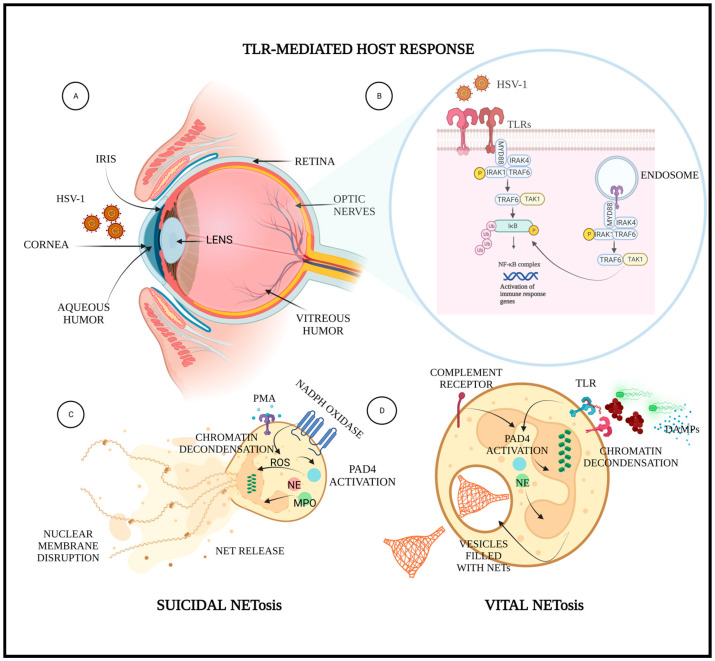
Neutrophil extracellular traps (NETs) are net-like structures released from neutrophils. NETs predominantly contain cell-free deoxyribonucleic acid (DNA) decorated with histones and neutrophil granule proteins. Numerous extrinsic and intrinsic stimuli can induce the formation of NETs such as pathogens, cytokines, immune complexes, microcrystals, antibodies, and other physiological stimuli. The mechanism of NETosis induction can either be ROS-dependent or independent based on the catalase producing activity of the pathogen. NADPH is the source of ROS production, which in turn depends on the upregulation of Ca2+ production in the cytoplasm. ROS-independent induction of NETosis is regulated through toll-like receptors (TLRs). Besides capturing and eliminating pathogens, NETs also aggravate the inflammatory response and thus act as a double-edged sword. Currently, there are growing reports of NETosis induction during bacterial and fungal ocular infections leading to different pathologies, but there is no direct report suggesting its role during herpes simplex virus (HSV) infection. There are innumerable independent reports showing that the major effectors of NETosis are also directly affected by HSV infection, and thus, there is a strong possibility that HSV interacts with these facilitators that can either result in virally mediated modulation of NETosis or NETosis-mediated suppression of ocular HSV infection. This review focuses on the mechanism of NETs formation during different ocular pathologies, with its prime focus on highlighting their potential implications during HSV ocular infections and acting as prospective targets for the treatment of ocular diseases.
中性粒细胞胞外诱捕网(NETs)是从中性粒细胞释放的网状结构。NETs主要包含装饰有组蛋白和中性粒细胞颗粒蛋白的游离脱氧核糖核酸(DNA)。许多外在和内在刺激可诱导NETs形成,如病原体、细胞因子、免疫复合物、微晶、抗体和其他生理刺激。根据病原体的过氧化氢酶产生活性,NETosis的诱导机制可以是ROS依赖性或非依赖性的。NADPH是ROS产生的来源,而ROS的产生又依赖于细胞质中Ca2+产生的上调。NETosis的非ROS依赖性诱导通过Toll样受体(TLRs)调节。除了捕获和消除病原体外,NETs还会加剧炎症反应,因此起到双刃剑的作用。目前,越来越多的报道表明,在细菌和真菌性眼部感染期间会诱导NETosis,导致不同的病理状况,但尚无直接报道表明其在单纯疱疹病毒(HSV)感染中的作用。有无数独立报道表明,NETosis的主要效应物也直接受到HSV感染的影响,因此,HSV极有可能与这些促进因子相互作用,这可能导致病毒介导的NETosis调节或NETosis介导的眼部HSV感染抑制。本综述重点关注不同眼部病理状况下NETs形成的机制,主要侧重于突出其在HSV眼部感染期间的潜在影响,并作为眼部疾病治疗的潜在靶点。