Tun Zaw Htet, Htike Nang Thinn Thinn, Kyi-Tha-Thu Chaw, Lee Wing-Hin
Faculty of Medicine, Royal College of Medicine Perak, Universiti Kuala Lumpur (UniKL RCMP), Ipoh 30450, Perak, Malaysia.
Department of Immunology, Graduate School of Medicine, International University of Health and Welfare, Narita 286-8686, Japan.
Pathogens. 2023 Feb 11;12(2):301. doi: 10.3390/pathogens12020301.
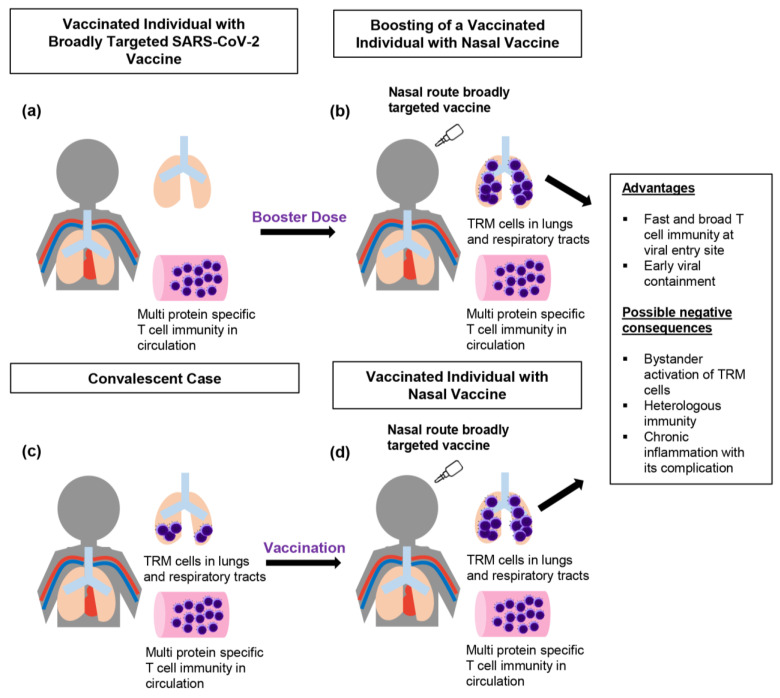
Well-trained T-cell immunity is needed for early viral containment, especially with the help of an ideal vaccine. Although most severe acute respiratory syndrome coronavirus 2 (SARS-CoV-2)-infected convalescent cases have recovered with the generation of virus-specific memory T cells, some cases have encountered T-cell abnormalities. The emergence of several mutant strains has even threatened the effectiveness of the T-cell immunity that was established with the first-generation vaccines. Currently, the development of next-generation vaccines involves trying several approaches to educate T-cell memory to trigger a broad and fast response that targets several viral proteins. As the shaping of T-cell immunity in its fast and efficient form becomes important, this review discusses several interesting vaccine approaches to effectively employ T-cell memory for efficient viral containment. In addition, some essential facts and future possible consequences of using current vaccines are also highlighted.
早期控制病毒需要训练有素的T细胞免疫,尤其是在理想疫苗的帮助下。尽管大多数感染严重急性呼吸综合征冠状病毒2(SARS-CoV-2)的康复病例通过产生病毒特异性记忆T细胞而康复,但仍有一些病例出现了T细胞异常。几种突变株的出现甚至威胁到第一代疫苗所建立的T细胞免疫的有效性。目前,下一代疫苗的研发涉及尝试多种方法来培育T细胞记忆,以引发针对多种病毒蛋白的广泛而快速的反应。随着以快速高效形式塑造T细胞免疫变得至关重要,本综述讨论了几种有趣的疫苗方法,以有效利用T细胞记忆实现有效的病毒控制。此外,还强调了使用当前疫苗的一些基本事实和未来可能产生的后果。