Dias Daniel Silva, Machado Juliana Martins, Ribeiro Patrícia Aparecida Fernandes, Machado Amanda Sanchez, Ramos Fernanda Fonseca, Nogueira Lais Moreira, Gonçalves Ana Alice Maia, Ramos Luana de Sousa, Gandra Isadora Braga, Coutinho Flaviane Silva, Santos Michelli Dos, Silva Jonatas Oliveira da, Chávez-Fumagalli Miguel Angel, Teixeira-Neto Rafael Gonçalves, Chaves Ana Thereza, Campos-da-Paz Mariana, Souza Amanda A, Giunchetti Rodolfo Cordeiro, Freitas Sonia Maria, Lyon Sandra, de Magalhães-Soares Danielle Ferreira, Silveira Julia Angelica Gonçalves, Silva Eduardo Sergio, Coelho Eduardo Antonio Ferraz, Galdino Alexsandro Sobreira
Laboratório de Biotecnologia de Microrganismos, Universidade Federal de São João Del-Rei (UFSJ), Campus Centro Oeste, Divinópolis 35501-296, MG, Brazil.
Programa de Pós-Graduação em Ciências da Saúde: Infectologia e Medicina Tropical, Faculdade de Medicina, Universidade Federal de Minas Gerais, Av. Prof. Alfredo Balena, 190, Belo Horizonte 30130-100, MG, Brazil.
Pathogens. 2023 Feb 11;12(2):302. doi: 10.3390/pathogens12020302.
visceral leishmaniasis (VL) is a critical public health problem in over ninety countries. The control measures adopted in Brazil have been insufficient when it comes to preventing the spread of this overlooked disease. In this context, a precise diagnosis of VL in dogs and humans could help to reduce the number of cases of this disease. Distinct studies for the diagnosis of VL have used single recombinant proteins in serological assays; however, the results have been variable, mainly in relation to the sensitivity of the antigens. In this context, the development of multiepitope-based proteins could be relevant to solving such problem.
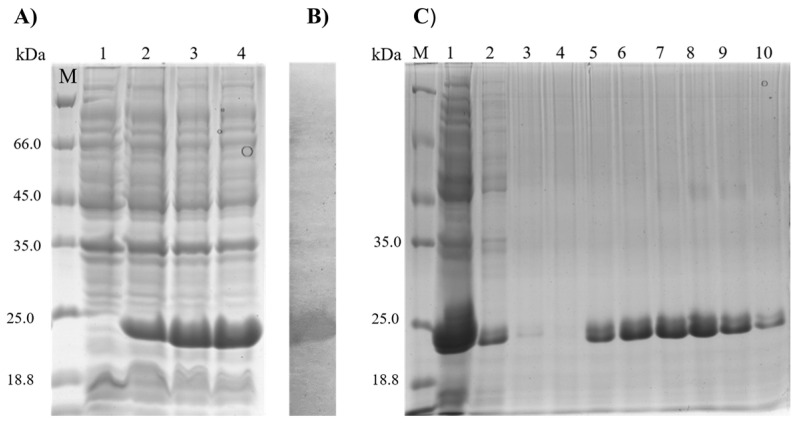
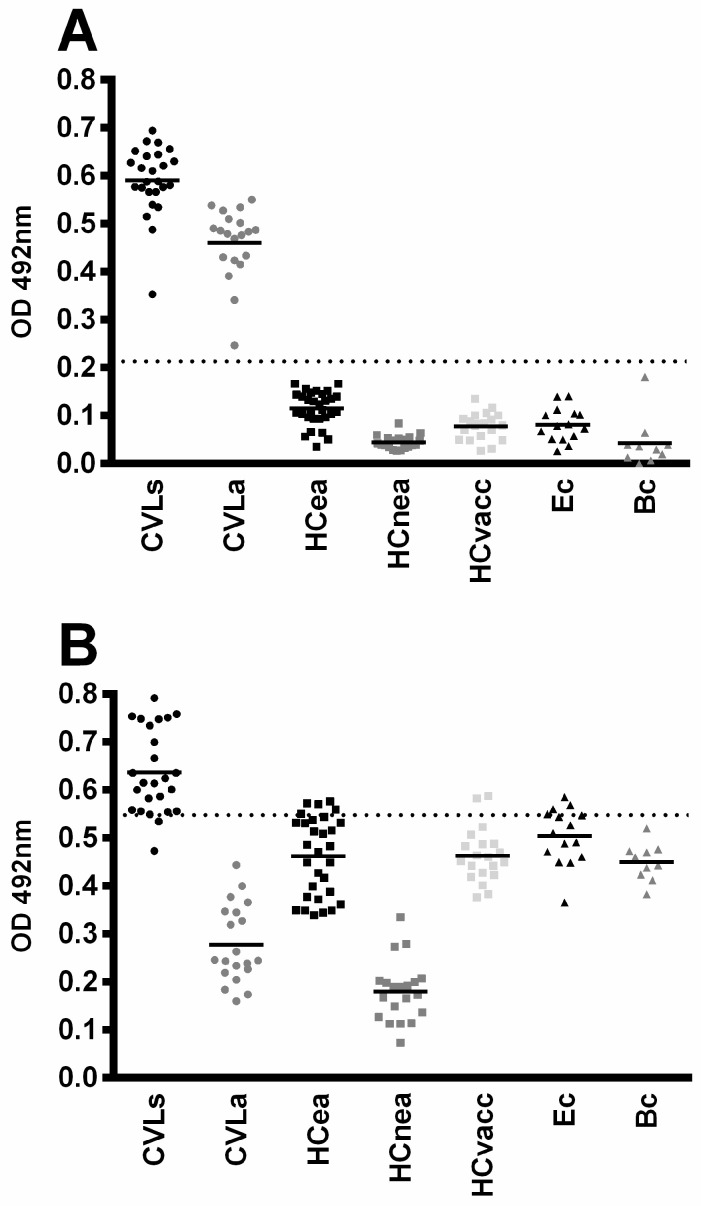
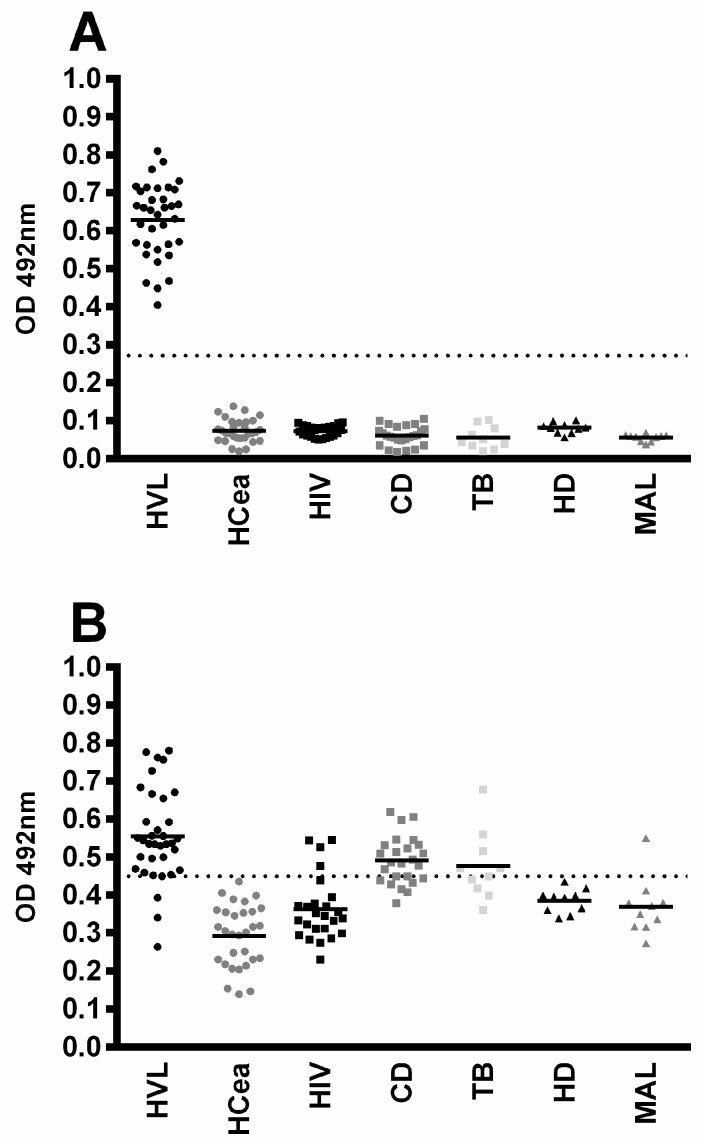
a chimeric protein (rMELEISH) was constructed based on amino acid sequences from kinesin 39 (k39), alpha-tubulin, and heat-shock proteins HSP70 and HSP 83.1, and tested in enzyme-linked immunosorbent (ELISA) for the detection of infection using canine ( = 140) and human ( = 145) sera samples.
in the trials, rMELEISH was able to discriminate between VL cases and cross-reactive diseases and healthy samples, with sensitivity and specificity values of 100%, as compared to the use of a soluble Leishmania antigenic extract (SLA).
the preliminary data suggest that rMELEISH has the potential to be tested in future studies against a larger serological panel and in field conditions for the diagnosis of canine and human VL.
内脏利什曼病(VL)是90多个国家面临的重大公共卫生问题。巴西所采取的控制措施在预防这种被忽视疾病的传播方面一直不够充分。在此背景下,对犬类和人类的VL进行精确诊断有助于减少该疾病的病例数量。不同的VL诊断研究在血清学检测中使用了单一重组蛋白;然而,结果存在差异,主要体现在抗原的敏感性方面。在此背景下,基于多表位的蛋白的开发可能与解决此类问题相关。
基于驱动蛋白39(k39)、α-微管蛋白以及热休克蛋白HSP70和HSP 83.1的氨基酸序列构建了一种嵌合蛋白(rMELEISH),并在酶联免疫吸附测定(ELISA)中使用犬类(n = 140)和人类(n = 145)血清样本检测感染情况。
在试验中,与使用可溶性利什曼原虫抗原提取物(SLA)相比,rMELEISH能够区分VL病例与交叉反应性疾病以及健康样本,敏感性和特异性值均为100%。
初步数据表明,rMELEISH有潜力在未来的研究中针对更大规模的血清学样本组以及在现场条件下用于犬类和人类VL的诊断测试。