Sunic Katarina, D'Auria John Charles, Sarkanj Bojan, Spanic Valentina
Department for Breeding and Genetics of Small Cereal Crops, Agricultural Institute Osijek, Juzno Predgradje 17, 31000 Osijek, Croatia.
Department of Molecular Genetics Leibniz, Institute of Plant Genetics and Crop Plant Research (IPK Gatersleben), OT Gatersleben Corrensstraße 3, 06466 Seeland, Germany.
Plants (Basel). 2023 Feb 17;12(4):911. doi: 10.3390/plants12040911.
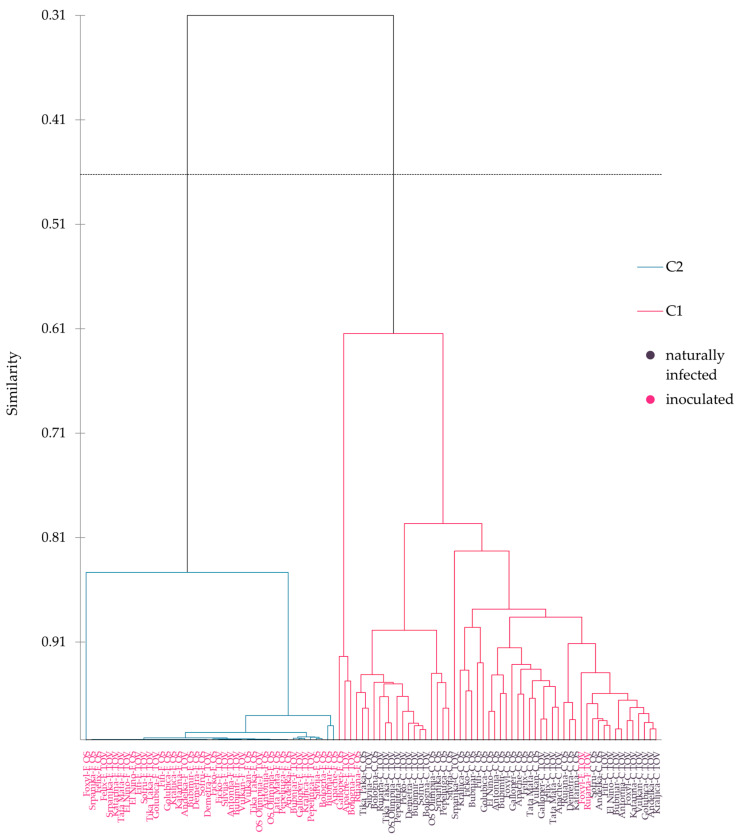
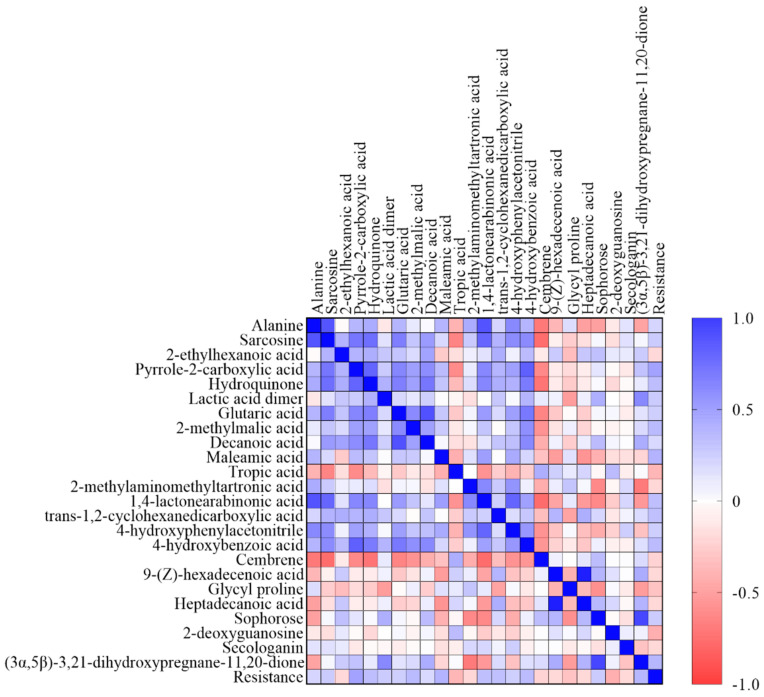
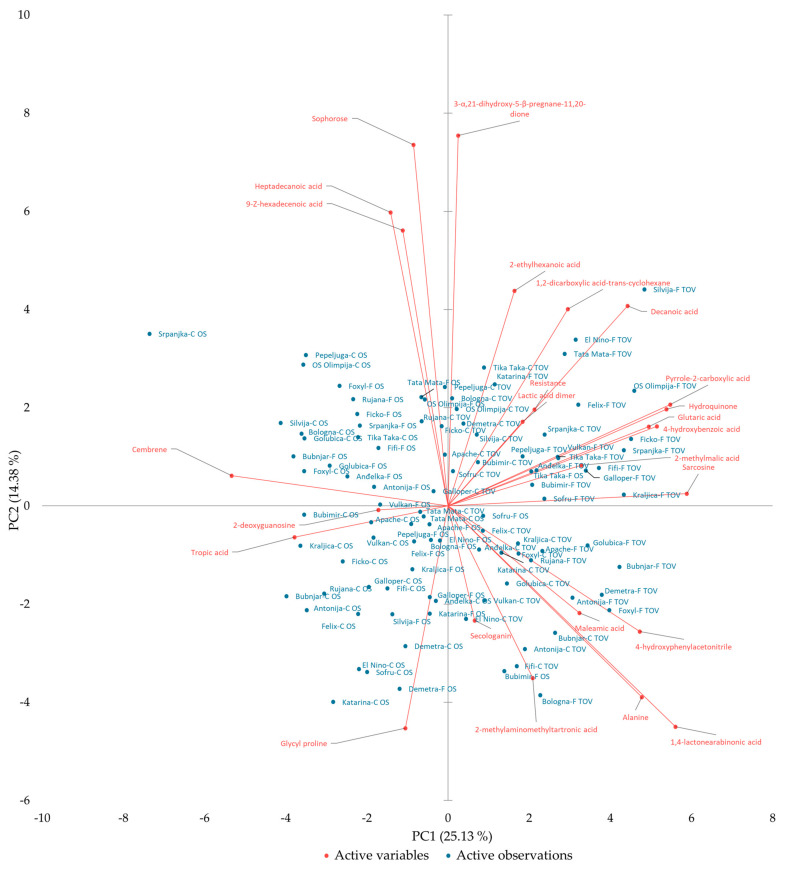
Fusarium head blight (FHB) is one of the most dangerous diseases of winter wheat, resulting in reduced grain yield and quality, and production of mycotoxins by the fungi. In the present study, changes in the grain metabolomics of winter wheat samples infected with spp. and corresponding non-infected samples from two locations in Croatia were investigated by GC-MS. A Mann-Whitney test revealed that 24 metabolites detected were significantly separated between -inoculated and non-infected samples during the variety by treatment interactions. The results confirmed that in grains of six FHB-resistant varieties, ten metabolites were identified as possible resistance-related metabolites. These metabolites included heptadecanoic acid, 9-(Z)-hexadecenoic acid, sophorose, and secolaganin in grains of FHB-resistant varieties at the Osijek location, as well as 2-methylaminomethyltartronic acid, maleamic acid, 4-hydroxyphenylacetonitrile, 1,4-lactonearabinonic acid, secolaganin, and alanine in grains of FHB-resistant varieties at the Tovarnik location. Moreover, on the PCA bi-plot, FHB-susceptible wheat varieties were closer to glycyl proline, decanoic acid, and lactic acid dimer that could have affected other metabolites, and thus, suppressed resistance to FHB. Although defense reactions were genetically conditioned and variety specific, resulting metabolomics changes may give insight into defense-related pathways that could be manipulated to engineer plants with improved resistance to the pathogen.
镰刀菌穗腐病(FHB)是冬小麦最危险的病害之一,会导致谷物产量和品质下降,以及真菌产生霉菌毒素。在本研究中,通过气相色谱 - 质谱联用(GC-MS)对来自克罗地亚两个地点感染了镰刀菌的冬小麦样本及其相应的未感染样本的谷物代谢组学变化进行了研究。曼 - 惠特尼检验显示,在品种与处理的相互作用中,检测到的24种代谢物在接种和未感染样本之间有显著差异。结果证实,在六个抗FHB品种的谷物中,有十种代谢物被鉴定为可能与抗性相关的代谢物。这些代谢物包括奥西耶克地区抗FHB品种谷物中的十七烷酸、9-(Z)-十六碳烯酸、槐糖和裂环马钱苷,以及托瓦尔尼克地区抗FHB品种谷物中的2-甲基氨基甲基酒石酸、马来酰胺酸、4-羟基苯乙腈、1,4-阿拉伯糖酸内酯、裂环马钱苷和丙氨酸。此外,在主成分分析双标图上,感FHB的小麦品种更接近甘氨酰脯氨酸、癸酸和乳酸二聚体,这些物质可能影响了其他代谢物,从而抑制了对FHB的抗性。尽管防御反应是由基因决定的且具有品种特异性,但由此产生的代谢组学变化可能有助于深入了解与防御相关的途径,这些途径可被操纵以培育对病原体具有更高抗性的植物。