Xu Xiaolin, Mishra Gita D, Holt-Lunstad Julianne, Jones Mark
School of Public Health, The University of Queensland, Brisbane, Queensland, Australia.
Departments of Psychology and Neuroscience, Brigham Young University, Provo, Utah, USA.
Gen Psychiatr. 2023 Jan 17;36(1):e100925. doi: 10.1136/gpsych-2022-100925. eCollection 2023.
Social relationships are associated with mortality and chronic conditions. However, little is known about the effects of social relationship satisfaction on multiple chronic conditions (multimorbidity).
To examine whether social relationship satisfaction is associated with the accumulation of multimorbidity.
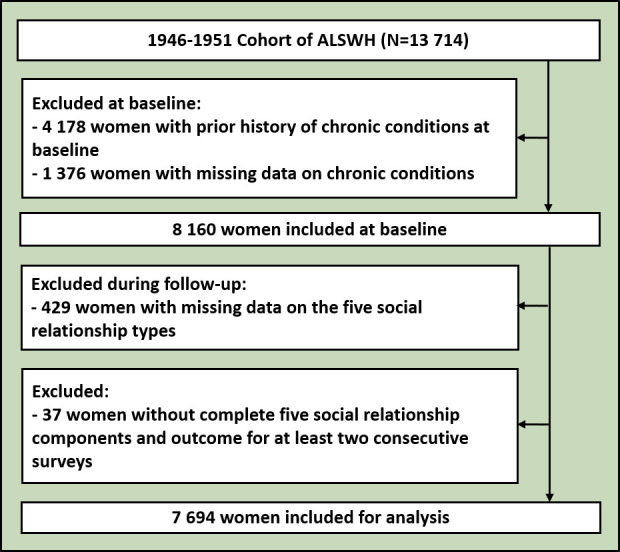
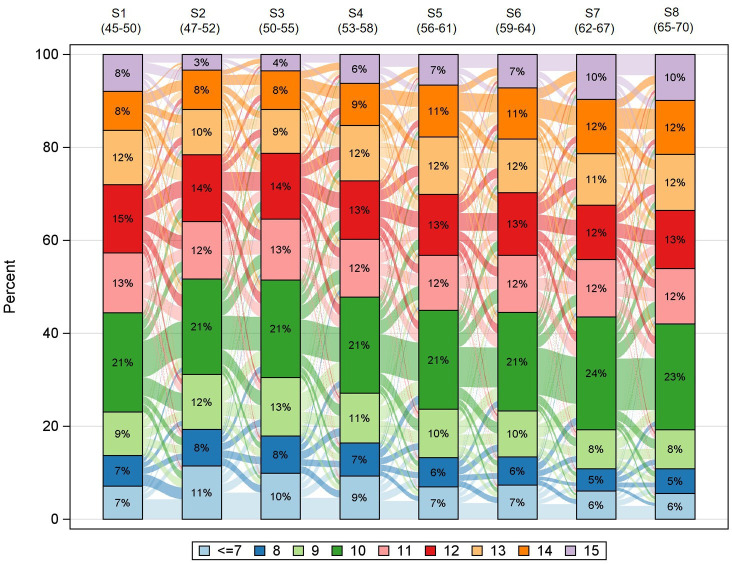
Data from 7 694 Australian women who were free from 11 chronic conditions at 45-50 years of age in 1996 were analysed. Five types of social relationship satisfaction (partner, family members, friends, work and social activities) were measured approximately every 3 years and scored from 0 (very dissatisfied) to 3 (very satisfied). Scores from each relationship type were summed to provide an overall satisfaction score (range: ≤5-15). The outcome of interest was the accumulation of multimorbidity in 11 chronic conditions.
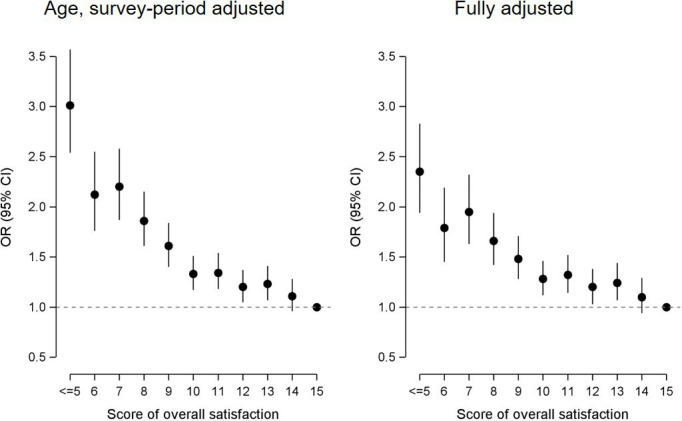
Over a 20-year period, 4 484 (58.3%) women reported multimorbidities. Overall, the level of social relationship satisfaction had a dose-response relationship with the accumulation of multimorbidities. Compared with women reporting the highest satisfaction (score 15), women with the lowest satisfaction (score ≤5) had the highest odds of accumulating multimorbidity (odds ratio (OR)= 2.35, 95% confidence interval (CI): 1.94 to 2.83) in the adjusted model. Similar results were observed for each social relationship type. Other risk factors, such as socioeconomic, behavioural and menopausal status, together explained 22.72% of the association.
Social relationship satisfaction is associated with the accumulation of multimorbidity, and the relationship is only partly explained by socioeconomic, behavioural and reproductive factors. Social connections (eg, satisfaction with social relationships) should be considered a public health priority in chronic disease prevention and intervention.
社会关系与死亡率和慢性病相关。然而,关于社会关系满意度对多种慢性病(共病)的影响知之甚少。
研究社会关系满意度是否与共病的累积有关。
分析了1996年45至50岁时无11种慢性病的7694名澳大利亚女性的数据。大约每3年测量一次五种社会关系满意度(伴侣、家庭成员、朋友、工作和社交活动),评分从0(非常不满意)到3(非常满意)。将每种关系类型的得分相加,得出总体满意度得分(范围:≤5 - 15)。感兴趣的结果是11种慢性病中共病的累积情况。
在20年期间,4484名(58.3%)女性报告患有共病。总体而言,社会关系满意度水平与共病的累积呈剂量反应关系。在调整模型中,与报告满意度最高(得分15)的女性相比,满意度最低(得分≤5)的女性累积共病的几率最高(优势比(OR)= 2.35,95%置信区间(CI):1.94至2.83)。每种社会关系类型均观察到类似结果。其他风险因素,如社会经济、行为和绝经状态,共同解释了该关联的22.72%。
社会关系满意度与共病的累积有关,且这种关系仅部分由社会经济、行为和生殖因素解释。社会联系(如对社会关系的满意度)应被视为慢性病预防和干预中的公共卫生重点。