The University of Queensland, School of Public Health, Centre for Longitudinal and Life Course Research, Brisbane, Australia.
PLoS Med. 2018 Mar 13;15(3):e1002516. doi: 10.1371/journal.pmed.1002516. eCollection 2018 Mar.
The prevalence of diabetes, heart disease, and stroke multimorbidity (co-occurrence of two or three of these conditions) has increased rapidly. Little is known about how the three conditions progress from one to another sequentially through the life course. We aimed to delineate this progression in middle-aged women and to determine the roles of common risk factors in the accumulation of diabetes, heart disease, and stroke multimorbidity.
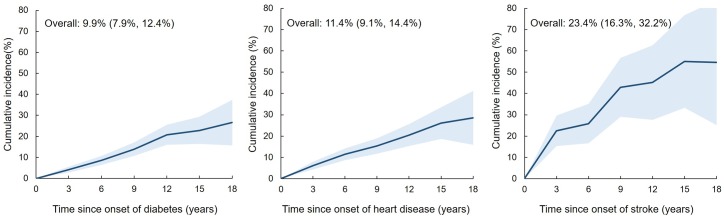
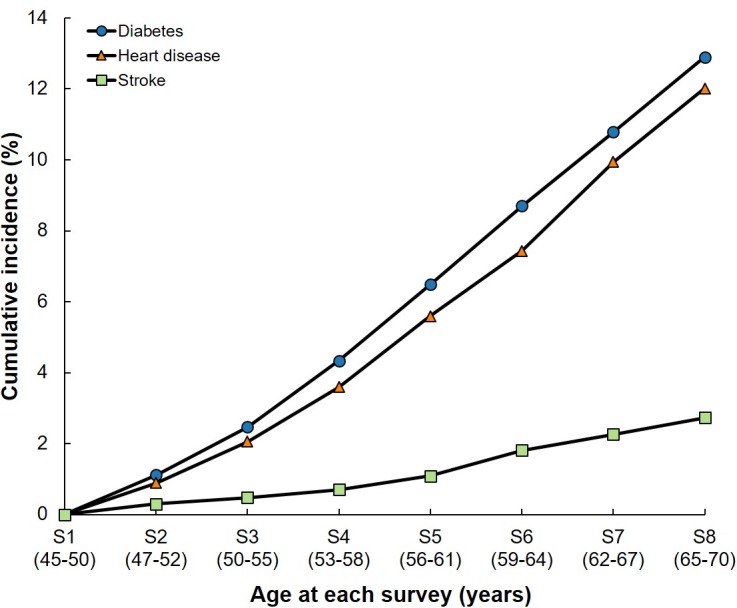
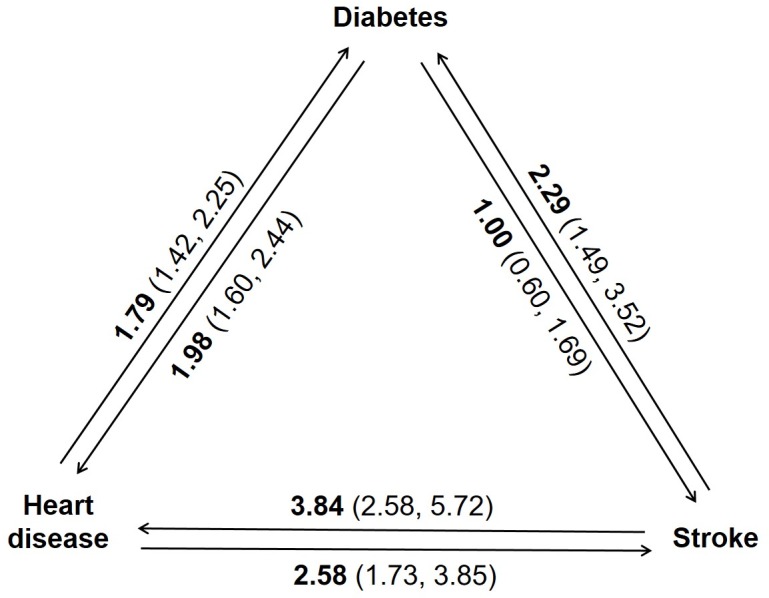
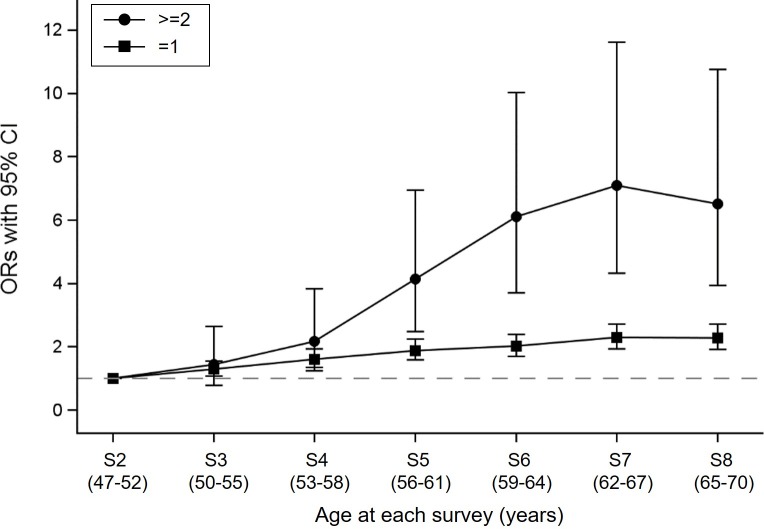
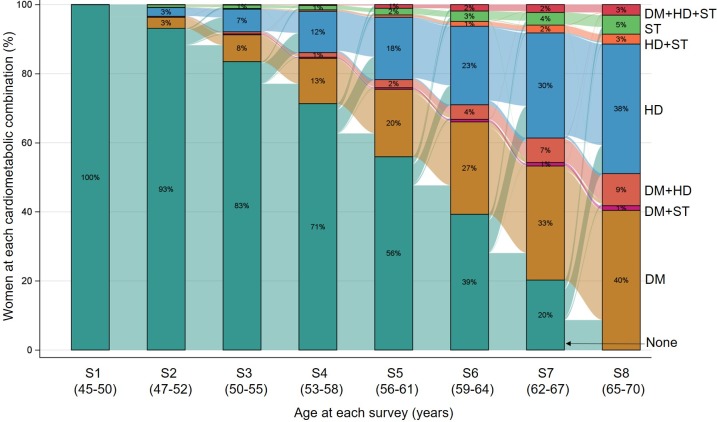
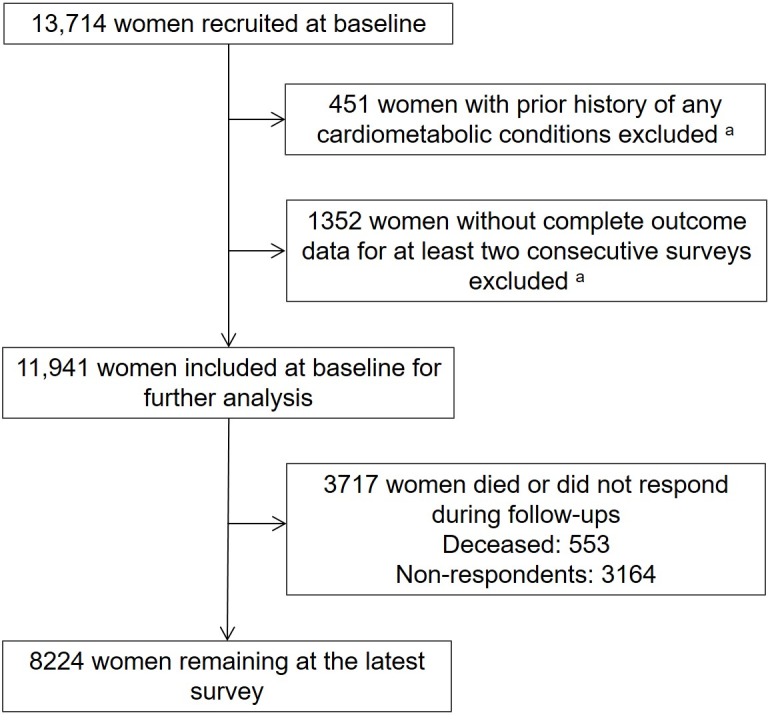
We used data from 13,714 women aged 45-50 years without a history of any of the three conditions. They were participants in the Australian Longitudinal Study on Women's Health (ALSWH), enrolled in 1996, and surveyed approximately every 3 years to 2016. We characterized the longitudinal progression of the three conditions and multimorbidity. We estimated the accumulation of multimorbidity over 20 years of follow-up and investigated their association with both baseline and time-varying predictors (sociodemographic factors, lifestyle factors, and other chronic conditions). Over 20 years, 2,511 (18.3%) of the women progressed to at least one condition, of whom 1,420 (56.6%) had diabetes, 1,277 (50.9%) had heart disease, and 308 (12.3%) had stroke; 423 (16.8%) had two or three of these conditions. Over a 3-year period, the age-adjusted odds of two or more conditions was approximately twice that of developing one new condition compared to women who did not develop any new conditions. For example, the odds for developing one new condition between Surveys 7 and 8 were 2.29 (95% confidence interval [CI], 1.93-2.72), whereas the odds for developing two or more conditions was 6.51 (95% CI, 3.95-10.75). The onset of stroke was more strongly associated with the progression to the other conditions (i.e., 23.4% [95% CI, 16.3%-32.2%] of women after first onset of stroke progressed to other conditions, whereas the percentages for diabetes and heart disease were 9.9% [95% CI, 7.9%-12.4%] and 11.4% [95% CI, 9.1%-14.4%], respectively). Being separated, divorced, or widowed; being born outside Australia; having difficulty managing on their available income; being overweight or obese; having hypertension; being physically inactive; being a current smoker; and having prior chronic conditions (i.e., mental disorders, asthma, cancer, osteoporosis, and arthritis) were significantly associated with increased odds of accumulation of diabetes, heart disease, and stroke multimorbidity. The main limitations of this study were the use of self-reported data and the low number of events.
Stroke was associated with increased risk of progression to diabetes or heart disease. Social inequality, obesity, hypertension, physical inactivity, smoking, or having other chronic conditions were also significantly associated with increased odds of accumulating multimorbidity. Our findings highlight the importance of awareness of the role of diabetes, heart disease, and stroke multimorbidity among middle-aged women for clinicians and health-promotion agencies.
糖尿病、心脏病和中风的多重病症(两种或三种病症同时发生)的患病率迅速上升。人们对这三种病症如何在生命过程中依次从一种病症发展到另一种病症知之甚少。我们旨在描述中年女性中这种进展,并确定共同风险因素在糖尿病、心脏病和中风多重病症的积累中的作用。
我们使用了来自 13714 名年龄在 45-50 岁之间且没有任何三种病症的女性的数据。她们是澳大利亚女性健康纵向研究(ALSWH)的参与者,于 1996 年参加研究,并且每隔 3 年进行一次调查,直到 2016 年。我们描述了三种病症和多重病症的纵向进展。我们估计了在 20 年的随访中多重病症的积累,并调查了它们与基线和时变预测因素(社会人口因素、生活方式因素和其他慢性疾病)的关联。在 20 年期间,2511 名(18.3%)女性至少出现了一种病症,其中 1420 名(56.6%)患有糖尿病,1277 名(50.9%)患有心脏病,308 名(12.3%)患有中风;423 名(16.8%)患有两种或三种这些病症。在 3 年期间,与未出现任何新病症的女性相比,出现两种或更多病症的女性新出现一种病症的年龄调整比值比大约是其两倍。例如,在第 7 次和第 8 次调查之间,新出现一种病症的可能性为 2.29(95%置信区间 [CI],1.93-2.72),而出现两种或更多病症的可能性为 6.51(95% CI,3.95-10.75)。中风的发病与向其他病症的进展有更强的关联(即首次中风发病后,23.4%(95% CI,16.3%-32.2%)的女性进展到其他病症,而糖尿病和心脏病的百分比分别为 9.9%(95% CI,7.9%-12.4%)和 11.4%(95% CI,9.1%-14.4%))。分居、离婚或丧偶;在澳大利亚境外出生;难以维持其现有收入;超重或肥胖;患有高血压;身体不活动;当前吸烟;以及有先前的慢性疾病(即精神障碍、哮喘、癌症、骨质疏松症和关节炎)与糖尿病、心脏病和中风的多重病症的积累几率增加显著相关。这项研究的主要局限性是使用自我报告的数据和事件数量低。
中风与向糖尿病或心脏病发展的风险增加相关。社会不平等、肥胖、高血压、身体不活动、吸烟或患有其他慢性疾病也与多种病症的积累几率增加显著相关。我们的研究结果强调了临床医生和促进健康机构在中年女性中认识糖尿病、心脏病和中风的多重病症的重要性。