Shamloo Soraya Elizabeth, Cocco Veronica Margherita, Faccini Martina, Benet-Martínez Verónica, Trifiletti Elena
Faculty of Medicine, University of Modena and Reggio Emila, Viale A. Allegri 9, 42121 Reggio Emilia, Italy.
Department of Humanities, Social Sciences and Cultural Industries, University of Parma, Borgo Carissimi, 10, 43121 Parma, Italy.
Int J Intercult Relat. 2023 Mar;93:101781. doi: 10.1016/j.ijintrel.2023.101781. Epub 2023 Feb 22.
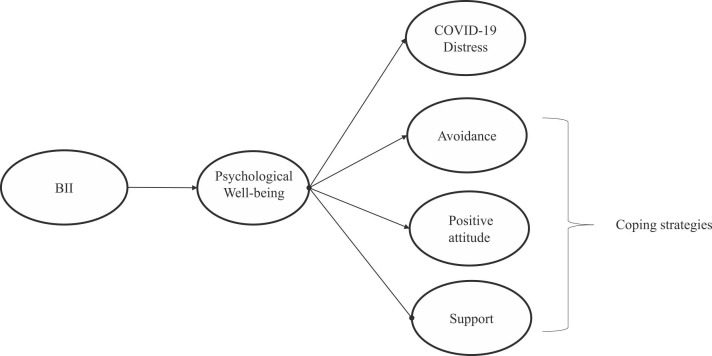
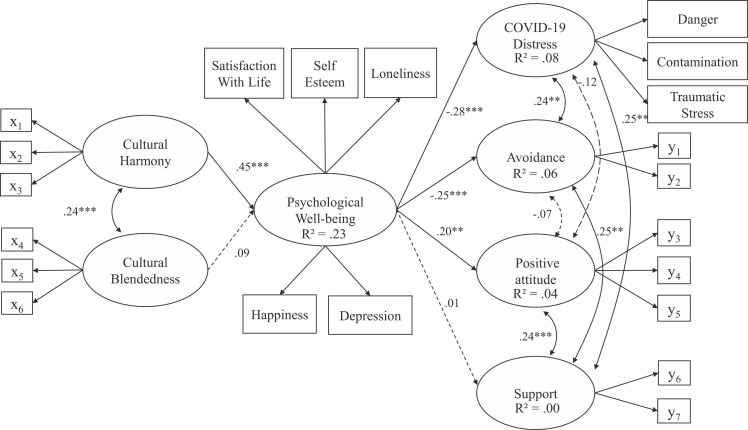
Unexpected and sudden emergency situations such as COVID-19 may render ethnic minorities particularly vulnerable to experiencing negative outcomes. Yet, we put forward that Bicultural Identity Integration (BII) - the degree to which bicultural individuals perceive their cultural identities as compatible and overlapping - may represent a resource in times of emergencies, since it may positively influence, through enhancement of psychological well-being, how bicultural individuals respond in terms of distress and coping strategies. Based on this assumption, the present study aimed at examining the relationship between BII and responses to COVID-19. = 370 bicultural individuals ( = 26.83, = 8.74) from different cultural backgrounds were recruited online and completed measures of BII, psychological well-being, COVID-19 distress and coping strategies (positive attitudes, avoidance, social support seeking) during the second wave of the COVID-19 pandemic in Italy. We tested a model in which BII was the predictor, psychological well-being was the mediator and reactions to the COVID-19 emergency (distress, use of coping) were the outcomes. This model was tested against two alternative models. The proposed model showed a better fit to the data compared to the alternative models. In this model, psychological well-being mediated the relationship between BII (harmony) and coping strategies, except social support seeking. These findings highlight the important role played by BII in emergency situations, as it may indirectly, through enhancement of psychological well-being, contribute to enhance biculturals' adaptive reactions in terms of distress as well as affect coping strategies during highly stressful events.
诸如新冠疫情这样意想不到的突发紧急情况可能会使少数族裔特别容易遭遇负面结果。然而,我们提出,双文化身份整合(BII)——即双文化个体认为其文化身份相互兼容和重叠的程度——在紧急情况下可能是一种资源,因为它可能通过提升心理健康,积极影响双文化个体在痛苦和应对策略方面的反应方式。基于这一假设,本研究旨在考察双文化身份整合与对新冠疫情的反应之间的关系。在意大利新冠疫情第二波期间,通过网络招募了370名来自不同文化背景的双文化个体(年龄均值=26.83,标准差=8.74),他们完成了双文化身份整合、心理健康、新冠疫情痛苦及应对策略(积极态度、回避、寻求社会支持)的测量。我们检验了一个模型,其中双文化身份整合是预测变量,心理健康是中介变量,对新冠疫情紧急情况的反应(痛苦、应对方式的使用)是结果变量。该模型与另外两个替代模型进行了比较检验。与替代模型相比,所提出的模型对数据的拟合度更好。在这个模型中,心理健康介导了双文化身份整合(和谐)与应对策略之间的关系,但不包括寻求社会支持这一应对策略。这些发现凸显了双文化身份整合在紧急情况下所起的重要作用,因为它可能通过提升心理健康,间接地有助于增强双文化个体在痛苦方面的适应性反应,并在压力极大的事件中影响应对策略。