Muthukumaran Rajendra Bose, Bhattacharjee Pritha, Bhowmick Priya, Zote Lalrinawma, Kumar Nachimuthu Senthil, Jahau Lalrintluanga, Cooke Marcus S, Hu Chiung-Wen, Chao Mu-Rong
Department of Chemistry, Mizoram University, Aizawl 796004, India.
Department of Environmental Science, University of Calcutta, Kolkata 700073, India.
Toxicol Rep. 2023 Feb 4;10:223-234. doi: 10.1016/j.toxrep.2023.02.001. eCollection 2023.
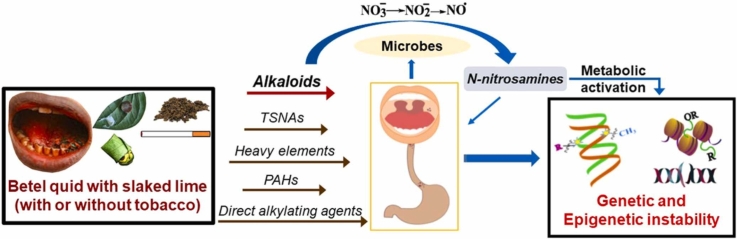
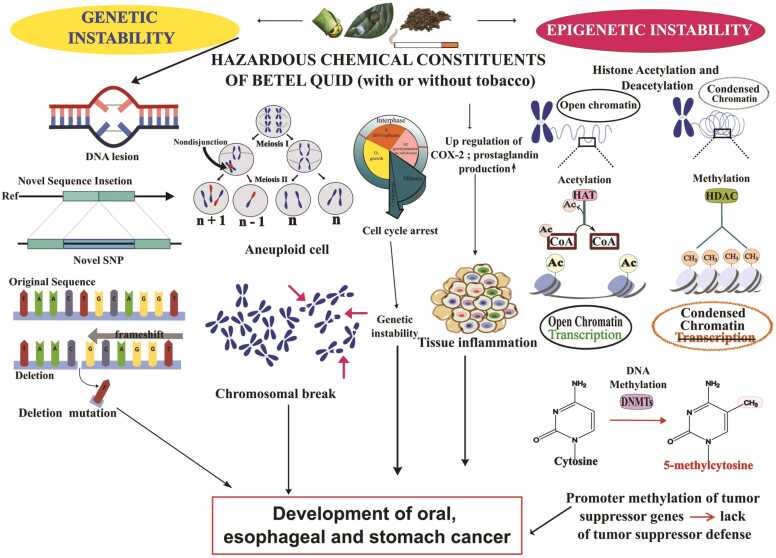
Over the years, betel quid chewing and tobacco use have attracted considerable interest as they are implicated as the most likely causative risk factors of oral and esophageal cancers. Although areca nut use and betel quid chewing may lead to apoptosis, chronic exposure to areca nut and slaked lime may promote pre-malignant and malignant transformation of oral cells. The putative mutagenic and carcinogenic mechanisms may involve endogenous nitrosation of areca and tobacco alkaloids as well as the presence of direct alkylating agents in betel quid and smokeless tobacco. Metabolic activation of carcinogenic -nitrosamines by phase-I enzymes is required not only to elicit the genotoxicity the reactive intermediates but also to potentiate the mutagenicity with the sporadic alkylations of nucleotide bases, resulting in the formation of diverse DNA adducts. Persistent DNA adducts provides the impetus for genetic and epigenetic lesions. The genetic and epigenetic factors cumulatively influence the development and progression of disorders such as cancer. Accumulation of numerous genetic and epigenetic aberrations due to long-term betel quid (with or without tobacco) chewing and tobacco use culminates into the development of head and neck cancers. We review recent evidence that supports putative mechanisms for mutagenicity and carcinogenicity of betel quid chewing along with tobacco (smoking and smokeless) use. The detailed molecular mechanisms of the extent of accumulation and patterns of genetic alterations, indicative of the prior exposure to carcinogens and alkylating agents because of BQ chewing and tobacco use, have not yet been elucidated.
多年来,嚼食槟榔和使用烟草引发了广泛关注,因为它们被认为是口腔癌和食管癌最可能的致病危险因素。尽管食用槟榔和嚼食槟榔可能导致细胞凋亡,但长期接触槟榔和熟石灰可能会促进口腔细胞的癌前病变和恶性转化。推测的诱变和致癌机制可能涉及槟榔和烟草生物碱的内源性亚硝化作用,以及槟榔和无烟烟草中直接烷基化剂的存在。致癌性亚硝胺通过I相酶的代谢活化不仅需要引发反应性中间体的遗传毒性,还需要通过核苷酸碱基的零星烷基化增强诱变作用,从而导致形成多种DNA加合物。持续的DNA加合物为遗传和表观遗传损伤提供了动力。遗传和表观遗传因素累积影响诸如癌症等疾病的发生和发展。长期嚼食槟榔(无论是否含烟草)和使用烟草导致大量遗传和表观遗传异常的积累,最终发展为头颈癌。我们综述了近期的证据,这些证据支持嚼食槟榔以及使用烟草(吸烟和无烟)的诱变和致癌机制。由于嚼食槟榔和使用烟草而导致的遗传改变的积累程度和模式的详细分子机制,表明先前接触过致癌物和烷基化剂,尚未阐明。