Kohlhepp Marlene Sophia, Liu Hanyang, Tacke Frank, Guillot Adrien
Department of Hepatology and Gastroenterology, Charité Universitätsmedizin Berlin, Campus Virchow-Klinikum and Campus Charité Mitte, Berlin, Germany.
Front Mol Biosci. 2023 Feb 10;10:1129831. doi: 10.3389/fmolb.2023.1129831. eCollection 2023.
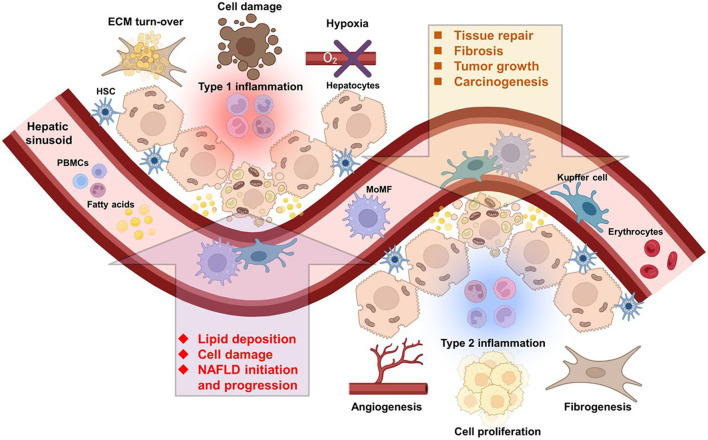
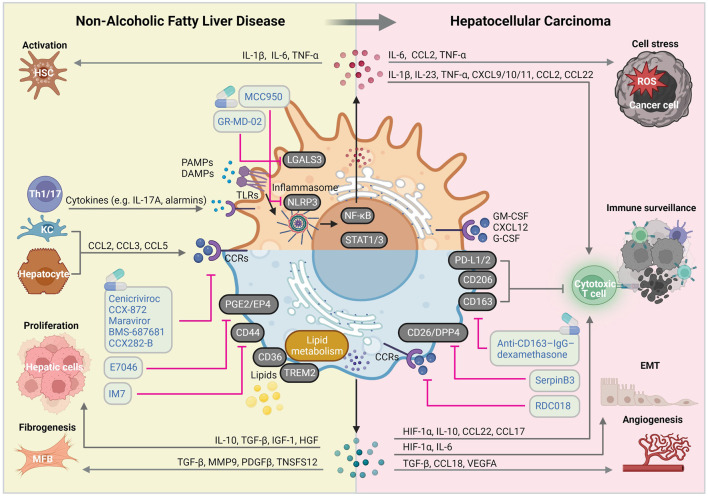
Chronic liver diseases from varying etiologies generally lead to liver fibrosis and cirrhosis. Among them, non-alcoholic fatty liver disease (NAFLD) affects roughly one-quarter of the world population, thus representing a major and increasing public health burden. Chronic hepatocyte injury, inflammation (non-alcoholic steatohepatitis, NASH) and liver fibrosis are recognized soils for primary liver cancer, particularly hepatocellular carcinoma (HCC), being the third most common cause for cancer-related deaths worldwide. Despite recent advances in liver disease understanding, therapeutic options on pre-malignant and malignant stages remain limited. Thus, there is an urgent need to identify targetable liver disease-driving mechanisms for the development of novel therapeutics. Monocytes and macrophages comprise a central, yet versatile component of the inflammatory response, fueling chronic liver disease initiation and progression. Recent proteomic and transcriptomic studies performed at singular cell levels revealed a previously overlooked diversity of macrophage subpopulations and functions. Indeed, liver macrophages that encompass liver resident macrophages (also named Kupffer cells) and monocyte-derived macrophages, can acquire a variety of phenotypes depending on microenvironmental cues, and thus exert manifold and sometimes contradictory functions. Those functions range from modulating and exacerbating tissue inflammation to promoting and exaggerating tissue repair mechanisms (i.e., parenchymal regeneration, cancer cell proliferation, angiogenesis, fibrosis). Due to these central functions, liver macrophages represent an attractive target for the treatment of liver diseases. In this review, we discuss the multifaceted and contrary roles of macrophages in chronic liver diseases, with a particular focus on NAFLD/NASH and HCC. Moreover, we discuss potential therapeutic approaches targeting liver macrophages.
各种病因引起的慢性肝病通常会导致肝纤维化和肝硬化。其中,非酒精性脂肪性肝病(NAFLD)影响着全球约四分之一的人口,因此是一个日益严重的主要公共卫生负担。慢性肝细胞损伤、炎症(非酒精性脂肪性肝炎,NASH)和肝纤维化被认为是原发性肝癌,尤其是肝细胞癌(HCC)的发病基础,肝细胞癌是全球癌症相关死亡的第三大常见原因。尽管近年来对肝病的认识有所进展,但针对癌前和恶性阶段的治疗选择仍然有限。因此,迫切需要确定可靶向的肝病驱动机制,以开发新的治疗方法。单核细胞和巨噬细胞是炎症反应的核心且具有多种功能的组成部分,推动着慢性肝病的起始和进展。最近在单细胞水平上进行的蛋白质组学和转录组学研究揭示了巨噬细胞亚群和功能的多样性,而这一点此前一直被忽视。事实上,肝脏巨噬细胞包括肝脏驻留巨噬细胞(也称为库普弗细胞)和单核细胞衍生的巨噬细胞,它们可以根据微环境线索获得多种表型,从而发挥多种有时甚至相互矛盾的功能。这些功能包括调节和加剧组织炎症,以及促进和夸大组织修复机制(即实质再生、癌细胞增殖、血管生成、纤维化)。由于这些核心功能,肝脏巨噬细胞成为肝病治疗的一个有吸引力的靶点。在这篇综述中,我们讨论了巨噬细胞在慢性肝病中的多方面和相反的作用,特别关注NAFLD/NASH和HCC。此外,我们还讨论了针对肝脏巨噬细胞的潜在治疗方法。