Bhusal Amrit, Shrestha Anu, Muskan Vitasta, Bhattarai Sashank, Subedi Priza, Yadav Ajay K
BP Koirala Institute of Health Sciences, Dharan, Sunsari, Nepal.
Department of Basic and Clinical Physiology, BP Koirala Institute of Health Sciences, Dharan, Sunsari, Nepal.
Ann Med Surg (Lond). 2023 Feb 6;85(2):191-194. doi: 10.1097/MS9.0000000000000142. eCollection 2023 Feb.
Guillain-Barré syndrome (GBS) is an immune-mediated disorder of the central nervous system presenting as symmetrical, progressive weakness and areflexia. The incidence of GBS is very low during pregnancy, but the risk increases in the postpartum period. The management is done by intravenous immunoglobulin or conservatively.
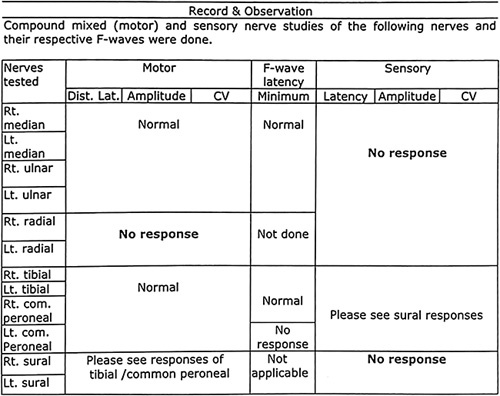
Case of 27 years female with parity 1, living 1, on postpartum day 20 presented to the emergency department (ED) with weakness over legs and hands since 20 days following emergency lower segment cesarean section for her delivery. The weakness prevailed over the lower extremities and progressed to the upper extremities in 4-5 days, affecting her grip strength and ability to stand alone. No history of prior diarrheal or respiratory illness. Cerebrospinal fluid analysis revealed albuminocytologic dissociation. A nerve conduction study showed in-excitable bilateral radial, median, ulnar, and sural nerves. Intravenous immunoglobulin was administered at the rate of 0.4 g/kg once daily for 5 days. Patient was discharged after 2 weeks with regular physiotherapy follow-up.
GBS in the postpartum period is very rare. There must be a high degree of suspicion among physicians for GBS if a pregnant female or a woman during her postpartum period presents with ascending muscle paralysis, even if there is no recent antecedent history of diarrheal episodes or respiratory illness. An early diagnosis with multidisciplinary supportive measures helps improve the prognosis for both the mother and the fetus.
吉兰-巴雷综合征(GBS)是一种免疫介导的中枢神经系统疾病,表现为对称性、进行性肌无力和腱反射消失。GBS在孕期的发病率很低,但产后风险增加。治疗方法为静脉注射免疫球蛋白或保守治疗。
一名27岁经产妇,孕1产1,产后20天因急诊下段剖宫产术后20天出现双下肢及双手无力就诊于急诊科。肌无力以下肢为主,并在4-5天内进展至上肢,影响其握力和独自站立能力。既往无腹泻或呼吸道疾病史。脑脊液分析显示蛋白细胞分离。神经传导研究显示双侧桡神经、正中神经、尺神经和腓肠神经无兴奋性。以0.4g/kg的剂量每日静脉注射免疫球蛋白1次,共5天。患者在接受2周规律物理治疗随访后出院。
产后GBS非常罕见。如果孕妇或产后妇女出现进行性肌肉麻痹,即使近期无腹泻发作或呼吸道疾病史,医生也必须高度怀疑GBS。早期诊断并采取多学科支持措施有助于改善母婴预后。