Toffoli Simone, Lunardini Francesca, Parati Monica, Gallotta Matteo, De Maria Beatrice, Longoni Luca, Dell'Anna Maria Elisabetta, Ferrante Simona
Nearlab, Department of Electronics, Information and Bioengineering, Politecnico di Milano, Milano, Italy.
Child Neuropsychiatry Unit, Department of Child Neurology, Fondazione IRCCS Istituto Neurologico Carlo Besta, Milano, Italy.
Front Neurol. 2023 Feb 10;14:1093690. doi: 10.3389/fneur.2023.1093690. eCollection 2023.
Since the uptake of digitizers, quantitative spiral drawing assessment allowed gaining insight into motor impairments related to Parkinson's disease. However, the reduced naturalness of the gesture and the poor user-friendliness of the data acquisition hamper the adoption of such technologies in the clinical practice. To overcome such limitations, we present a novel smart ink pen for spiral drawing assessment, intending to better characterize Parkinson's disease motor symptoms. The device, used on paper as a normal pen, is enriched with motion and force sensors.
Forty-five indicators were computed from spirals acquired from 29 Parkinsonian patients and 29 age-matched controls. We investigated between-group differences and correlations with clinical scores. We applied machine learning classification models to test the indicators ability to discriminate between groups, with a focus on model interpretability.
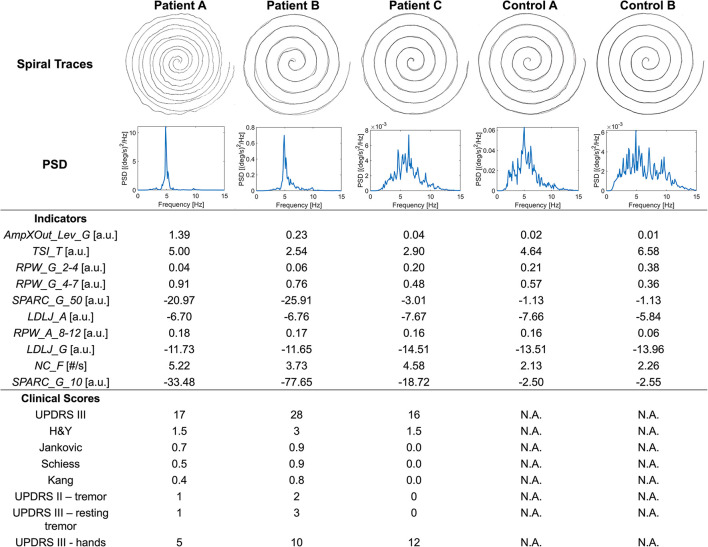
Compared to control, patients' drawings were characterized by reduced fluency and lower but more variable applied force, while tremor occurrence was reflected in kinematic spectral peaks selectively concentrated in the 4-7 Hz band. The indicators revealed aspects of the disease not captured by simple trace inspection, nor by the clinical scales, which, indeed, correlate moderately. The classification achieved 94.38% accuracy, with indicators related to fluency and power distribution emerging as the most important.
Indicators were able to significantly identify Parkinson's disease motor symptoms. Our findings support the introduction of the smart ink pen as a time-efficient tool to juxtapose the clinical assessment with quantitative information, without changing the way the classical examination is performed.
自从采用数字化仪以来,定量螺旋绘图评估有助于深入了解与帕金森病相关的运动障碍。然而,绘图手势的自然度降低以及数据采集的用户友好性较差,阻碍了此类技术在临床实践中的应用。为了克服这些限制,我们提出了一种用于螺旋绘图评估的新型智能墨水笔,旨在更好地表征帕金森病的运动症状。该设备在纸上使用时就像一支普通的笔,但配备了运动和力传感器。
从29名帕金森病患者和29名年龄匹配的对照者绘制的螺旋图中计算出45个指标。我们研究了组间差异以及与临床评分的相关性。我们应用机器学习分类模型来测试这些指标区分组别的能力,重点关注模型的可解释性。
与对照组相比,患者的绘图特点是流畅性降低,施加的力较小但变化更大,而震颤的出现表现为运动学频谱峰值选择性地集中在4 - 7赫兹频段。这些指标揭示了该疾病的一些方面,这些方面既未被简单的轨迹检查所捕捉,也未被临床量表所反映,而临床量表实际上与这些指标的相关性一般。分类准确率达到了94.38%,其中与流畅性和功率分布相关的指标最为重要。
这些指标能够显著识别帕金森病的运动症状。我们的研究结果支持引入智能墨水笔作为一种高效的工具,将临床评估与定量信息相结合,而无需改变传统检查的方式。