School of Agricultural Technology and Food Industry, Walailak University, Thasala, Nakhon Si Thammarat, Thailand.
Department of Agronomy, Hajee Mohammad Danesh Science and Technology University, Basherhat, Bangladesh.
PeerJ. 2023 Feb 21;11:e14900. doi: 10.7717/peerj.14900. eCollection 2023.
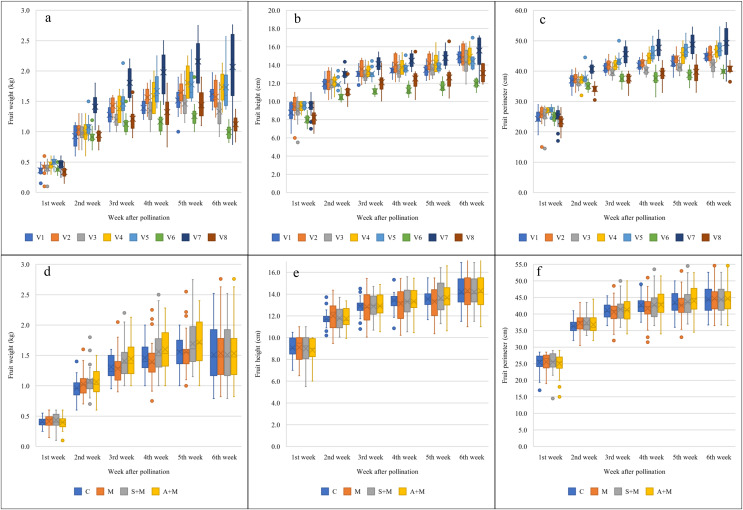
Several factors influence the quality of melon fruits and foliar fertilizer application is one method for improving their quality. The objectives of this study were: (1) to investigate the response of commercial melon varieties to a soilless culture system in Nakhon Si Thammarat Province, Thailand, and (2) to evaluate the quality of melon fruit under various foliar fertilizer treatments. The experiment was arranged as a completely randomized block design with four replications. Eight commercial melon varieties, including four orange pulp melons (Sandee, Baramee, Sanwan, and Melon cat 697) and four green pulp melons (Kissme, Snowgreen, Melon Princess, and Kimoji), were used in this study. At 1-5 weeks after planting, the growth of the melons was measured using agronomic traits. Four foliar fertilizers (distilled water, micronutrients, secondary nutrients + micronutrients, and amino acid + micronutrients) were sprayed on the melon leaves at 1-5 weeks after pollination, and the growth of the melons, using fruit traits, was recorded. After harvesting, the melons were assessed for the quality of the fruit. This study was conducted at the School of Agricultural Technology and Food Industry's greenhouse and the Food Chemistry Laboratory of the Center for Scientific and Technological Equipment, Walailak University. In nearly all of the observed growth weeks, the data demonstrate that most agronomic and fruit traits were significantly different between the melon varieties. Sandee, Baramee, Melon cat 697, and Melon Princess are recommended for planting under Nakhon Si Thammarat's climate, based on fruit size and quality. Foliar fertilizer application impacted the shape, skin color, and quality of the melon. Melons treated with micronutrients, secondary nutrients and micronutrients, and amino acids and micronutrients exhibited better measures of fruit quality than those treated with non-foliar treatments. There was also an interaction observed between melon variety and foliar fertilizer application. Based on measures of fruit quality, Baramee, Melon cat 697, Kissme, and Melon Princess were more responsive to foliar fertilizer application than other melon varieties tested.
几种因素会影响瓜类果实的品质,叶面肥的施用是提高其品质的一种方法。本研究的目的是:(1)调查泰国那空是贪玛叻府商业甜瓜品种对无土栽培系统的反应,(2)评估各种叶面肥处理下甜瓜果实的品质。试验采用完全随机区组设计,设 4 次重复。本研究使用了 8 个商业甜瓜品种,包括 4 个橙色果肉甜瓜(Sandee、Baramee、Sanwan 和 Melon cat 697)和 4 个绿色果肉甜瓜(Kissme、Snowgreen、Melon Princess 和 Kimoji)。在种植后 1-5 周,使用农艺性状测量甜瓜的生长情况。在授粉后 1-5 周,向甜瓜叶片喷施 4 种叶面肥(蒸馏水、微量元素、中量元素+微量元素和氨基酸+微量元素),并记录甜瓜的生长情况,使用果实性状进行记录。收获后,对甜瓜果实的品质进行评估。本研究在瓦莱拉差大学农业技术与食品工业温室和食品化学实验室的中心进行。在几乎所有观察到的生长周中,数据表明,大多数农艺和果实性状在甜瓜品种之间存在显著差异。根据果实大小和品质,推荐在那空是贪玛叻府的气候条件下种植 Sandee、Baramee、Melon cat 697 和 Melon Princess。叶面肥的施用影响了甜瓜的形状、果皮颜色和品质。用微量元素、中量元素和微量元素以及氨基酸和微量元素处理的甜瓜比未用叶面肥处理的甜瓜具有更好的果实品质指标。还观察到甜瓜品种和叶面肥施用之间存在相互作用。根据果实品质指标,Baramee、Melon cat 697、Kissme 和 Melon Princess 对叶面肥的反应比其他测试的甜瓜品种更敏感。