
HIV感染者中的新型冠状病毒2型免疫及疫苗策略
SARS-CoV-2 immunity and vaccine strategies in people with HIV.
作者信息
Mullender Claire, da Costa Kelly A S, Alrubayyi Aljawharah, Pett Sarah L, Peppa Dimitra
机构信息
Centre for Clinical Research in Infection and Sexual Health, Institute for Global Health, University College London Institute for Global Health, London, UK.
Division of Infection and Immunity, University College London, London, UK.
出版信息
Oxf Open Immunol. 2022 Aug 17;3(1):iqac005. doi: 10.1093/oxfimm/iqac005. eCollection 2022.
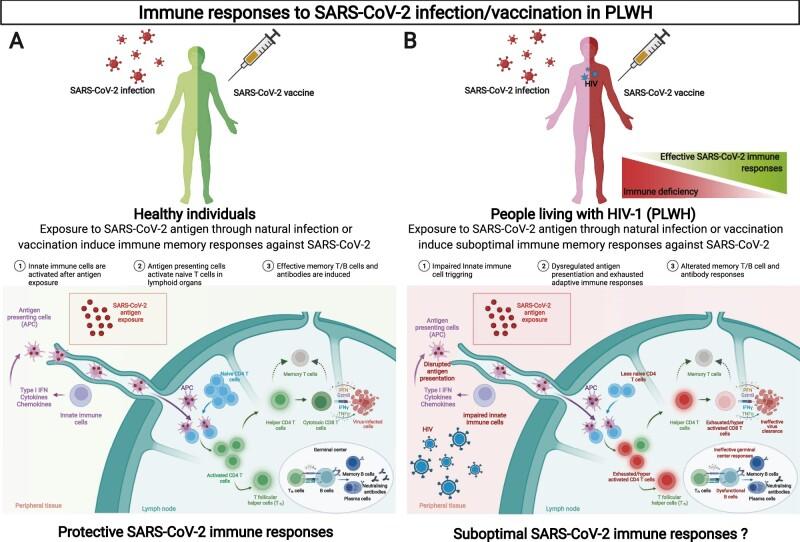
Current severe acute respiratory syndrome coronavirus-2 (SARS-CoV-2) vaccines, based on the ancestral Wuhan strain, were developed rapidly to meet the needs of a devastating global pandemic. People living with Human Immunodeficiency Virus (PLWH) have been designated as a priority group for SARS-CoV-2 vaccination in most regions and varying primary courses (two- or three-dose schedule) and additional boosters are recommended depending on current CD4+ T cell count and/or detectable HIV viraemia. From the current published data, licensed vaccines are safe for PLWH, and stimulate robust responses to vaccination in those well controlled on antiretroviral therapy and with high CD4+ T cell counts. Data on vaccine efficacy and immunogenicity remain, however, scarce in PLWH, especially in people with advanced disease. A greater concern is a potentially diminished immune response to the primary course and subsequent boosters, as well as an attenuated magnitude and durability of protective immune responses. A detailed understanding of the breadth and durability of humoral and T cell responses to vaccination, and the boosting effects of natural immunity to SARS-CoV-2, in more diverse populations of PLWH with a spectrum of HIV-related immunosuppression is therefore critical. This article summarizes focused studies of humoral and cellular responses to SARS-CoV-2 infection in PLWH and provides a comprehensive review of the emerging literature on SARS-CoV-2 vaccine responses. Emphasis is placed on the potential effect of HIV-related factors and presence of co-morbidities modulating responses to SARS-CoV-2 vaccination, and the remaining challenges informing the optimal vaccination strategy to elicit enduring responses against existing and emerging variants in PLWH.
目前基于原始武汉毒株研发的严重急性呼吸综合征冠状病毒2(SARS-CoV-2)疫苗迅速问世,以满足一场毁灭性全球大流行的需求。在大多数地区,人类免疫缺陷病毒感染者(PLWH)被指定为SARS-CoV-2疫苗接种的优先群体,根据当前的CD4+T细胞计数和/或可检测到的HIV病毒血症,建议采用不同的基础免疫程序(两剂或三剂方案)并接种额外的加强针。从目前已发表的数据来看,获批的疫苗对PLWH是安全的,并且能在接受抗逆转录病毒治疗且CD4+T细胞计数高、病情得到良好控制的人群中激发强烈的疫苗接种反应。然而,关于PLWH的疫苗效力和免疫原性的数据仍然很少,尤其是在疾病晚期患者中。更令人担忧的是,对基础免疫程序和后续加强针的免疫反应可能会减弱,以及保护性免疫反应的强度和持续时间会减弱。因此,详细了解不同HIV相关免疫抑制程度的PLWH群体对疫苗接种的体液和T细胞反应的广度和持续时间,以及SARS-CoV-2自然免疫的加强作用至关重要。本文总结了对PLWH中SARS-CoV-2感染的体液和细胞反应的重点研究,并对有关SARS-CoV-2疫苗反应的新文献进行了全面综述。重点关注HIV相关因素和合并症的存在对SARS-CoV-2疫苗接种反应的潜在影响,以及为制定最佳疫苗接种策略以引发PLWH对现有和新出现变体的持久反应所面临的剩余挑战。
 Zotero 插件