
长新冠:对新冠病毒感染临床后果的叙述性综述,重点关注假定的病理生理学和身体活动方面。
Long COVID: a narrative review of the clinical aftermaths of COVID-19 with a focus on the putative pathophysiology and aspects of physical activity.
作者信息
Haunhorst Simon, Bloch Wilhelm, Wagner Heiko, Ellert Claudia, Krüger Karsten, Vilser Daniel C, Finke Kathrin, Reuken Philipp, Pletz Mathias W, Stallmach Andreas, Puta Christian
机构信息
Department of Sports Medicine and Health Promotion, Friedrich-Schiller-University Jena, Jena 07749, Germany.
Department of Movement Science, University of Münster, Münster 48149, Germany.
出版信息
Oxf Open Immunol. 2022 Sep 16;3(1):iqac006. doi: 10.1093/oxfimm/iqac006. eCollection 2022.
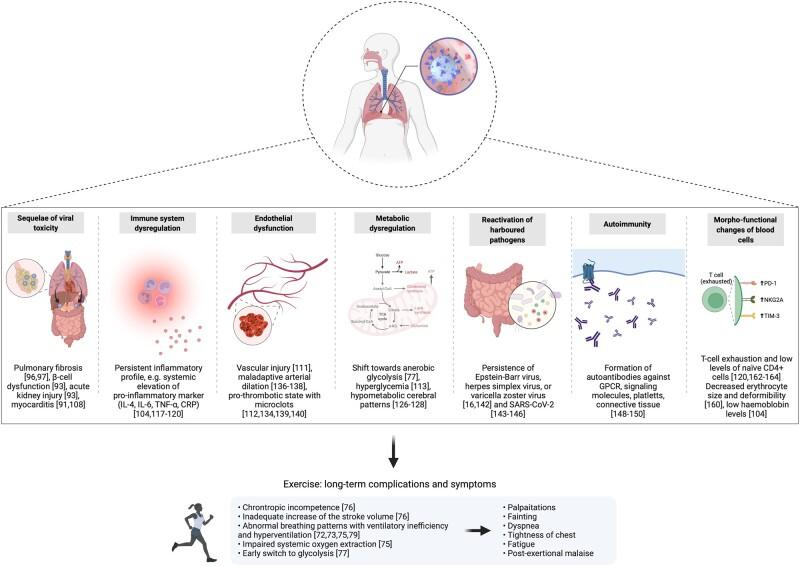
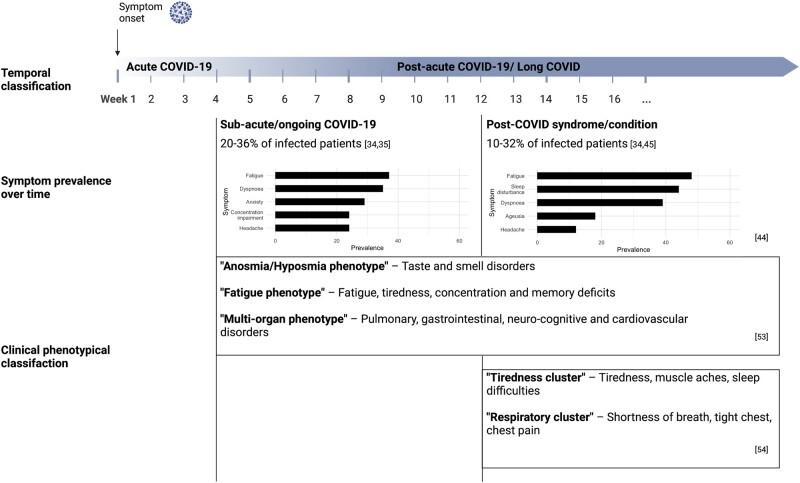
The pandemic coronavirus disease 2019 (COVID-19) can cause multi-systemic symptoms that can persist beyond the acute symptomatic phase. The post-acute sequelae of COVID-19 (PASC), also referred to as long COVID, describe the persistence of symptoms and/or long-term complications beyond 4 weeks from the onset of the acute symptoms and are estimated to affect at least 20% of the individuals infected with SARS-CoV-2 regardless of their acute disease severity. The multi-faceted clinical picture of long COVID encompasses a plethora of undulating clinical manifestations impacting various body systems such as fatigue, headache, attention disorder, hair loss and exercise intolerance. The physiological response to exercise testing is characterized by a reduced aerobic capacity, cardiocirculatory limitations, dysfunctional breathing patterns and an impaired ability to extract and use oxygen. Still, to this day, the causative pathophysiological mechanisms of long COVID remain to be elucidated, with long-term organ damage, immune system dysregulation and endotheliopathy being among the hypotheses discussed. Likewise, there is still a paucity of treatment options and evidence-based strategies for the management of the symptoms. In sum, this review explores different aspects of long COVID and maps the literature on what is known about its clinical manifestations, potential pathophysiological mechanisms, and treatment options.
2019年大流行性冠状病毒病(COVID-19)可导致多系统症状,这些症状可能在急性症状期之后持续存在。COVID-19的急性后遗症(PASC),也称为长期COVID,指急性症状出现4周后症状和/或长期并发症的持续存在,据估计,至少20%的感染严重急性呼吸综合征冠状病毒2(SARS-CoV-2)的个体都会受到影响,无论其急性疾病的严重程度如何。长期COVID的多方面临床表现包括大量影响身体各个系统的起伏不定的临床表现,如疲劳、头痛、注意力障碍、脱发和运动不耐受。运动测试的生理反应表现为有氧运动能力下降、心脏循环受限、呼吸模式功能失调以及提取和利用氧气的能力受损。尽管如此,直到今天,长期COVID的致病病理生理机制仍有待阐明,长期器官损伤、免疫系统失调和内皮病变是讨论的假设之一。同样,对于症状的管理,仍然缺乏治疗选择和循证策略。总之,本综述探讨了长期COVID的不同方面,并梳理了关于其临床表现、潜在病理生理机制和治疗选择的已知文献。
 Zotero 插件