Department of Cardiovascular Medicine, Section of Advanced Heart Failure and Transplant Cardiology Cleveland Clinic Foundation Cleveland OH USA.
Duke University Clinical Research Institute Durham NC USA.
J Am Heart Assoc. 2023 Mar 7;12(5):e026828. doi: 10.1161/JAHA.122.026828. Epub 2023 Feb 27.
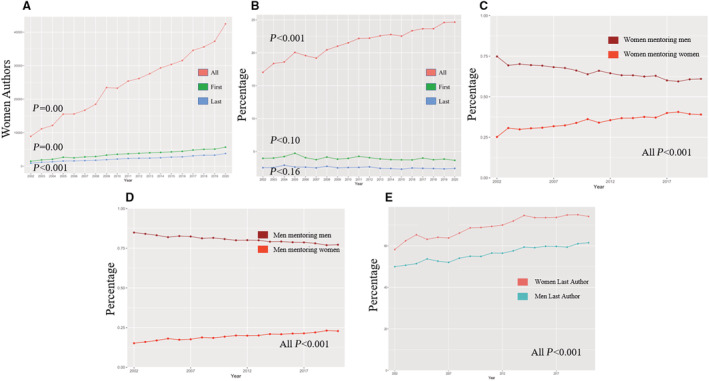
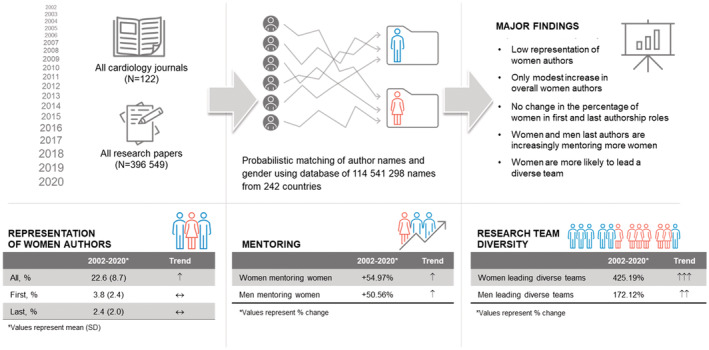
Background Women remain underrepresented in cardiology. We aimed to assess gender trends in research authorship, authorship in leading roles, mentorship, and research team diversity. Methods and Results We identified "cardiac and cardiovascular systems" journals from 2002 to 2020 using Journal Citation Reports 2019 (Web of Science, Clarivate Analytics). Gender authorship, mentorship, research team diversity, and trends were assessed. Associations between author gender and impact factor, journal region, and cardiology subspecialties were analyzed. Analysis of 396 549 research papers from 122 journals showed the percentage of women authors increased from 16.6% to 24.6% (=0.38 [95% CI, 0.29-0.46]; <0.001), whereas the proportion of women first (=-0.03 [95% CI, -0.06 to 0.004]; =0.09) or last authors (=-0.017 [95% CI, -0.04 to 0.006]; =0.15) was unchanged. Compared with men last authors, women last authors were more likely to mentor women first authors and lead more diverse research teams (both <0.001). Journal impact factor was related to percentage of women authors overall (Spearman's correlation coefficient R=0.208 [95% CI, 0.02-0.38]; =0.03) but not first or last women authors (both 0.5). Women comprised 18.4%-25.7% of authors in cardiology subspecialties. Journal region and author gender were unrelated (all 0.4). Conclusions Women's inclusion as authors of cardiology papers increased slightly over the past 2 decades, yet the proportions of women in first and last authorship roles were unchanged. Women are increasingly likely to mentor women first authors and lead diverse research teams. Women last authors are essential to increasing diversity of future independent investigators and inclusive research teams, both of which are associated with innovation and excellence in science.
背景 女性在心脏病学领域的代表性仍然不足。我们旨在评估研究作者、主要角色的作者身份、指导和研究团队多样性方面的性别趋势。
方法和结果 我们使用 2019 年期刊引文报告(Web of Science,Clarivate Analytics)从 2002 年至 2020 年确定了“心脏和心血管系统”期刊。评估了性别作者身份、指导、研究团队多样性和趋势。分析了作者性别与影响因子、期刊区域和心脏病学亚专业之间的关联。对 122 种期刊的 396549 篇研究论文进行了分析,结果表明女性作者的比例从 16.6%增加到 24.6%(=0.38 [95% CI,0.29-0.46];<0.001),而女性第一作者(=-0.03 [95% CI,-0.06 至 0.004];=0.09)或最后作者(=-0.017 [95% CI,-0.04 至 0.006];=0.15)的比例保持不变。与男性最后作者相比,女性最后作者更有可能指导女性第一作者,并领导更多样化的研究团队(均<0.001)。期刊影响因子与女性作者总数相关(Spearman 相关系数 R=0.208 [95% CI,0.02-0.38];=0.03),但与第一或最后女性作者无关(均为 0.5)。女性占心脏病学亚专业作者的 18.4%-25.7%。期刊区域和作者性别之间没有关系(均为 0.4)。
结论 在过去的 20 年中,女性作为心脏病学论文作者的比例略有增加,但女性在第一和最后作者身份中的比例保持不变。女性越来越有可能指导女性第一作者并领导多样化的研究团队。女性最后作者对于增加未来独立研究人员和包容性研究团队的多样性至关重要,这两者都与科学创新和卓越相关。