Palanca Ana, Ampudia-Blasco F Javier, Calderón José Miguel, Sauri Inmaculada, Martinez-Hervás Sergio, Trillo José Luis, Redón Josep, Real José T
Department of Endocrinology and Nutrition, Clinic University Hospital of Valencia, Avda. Blasco Ibáñez nº 17, 46010, Valencia, Spain.
INCLIVA Biomedical Research Institute, Valencia, Spain.
Diabetes Ther. 2023 Apr;14(4):723-736. doi: 10.1007/s13300-023-01382-9. Epub 2023 Feb 27.
In type 2 diabetes (T2D), key barriers to optimal glycaemic control include lack of persistence with treatment, reduced medication adherence and therapeutic inertia. This study aimed to assess the impact of these barriers in obese adults with type 2 diabetes treated with a GLP-1 receptor agonist (GLP-1RA) and compare them against other glucose-lowering agents in a real-world setting.
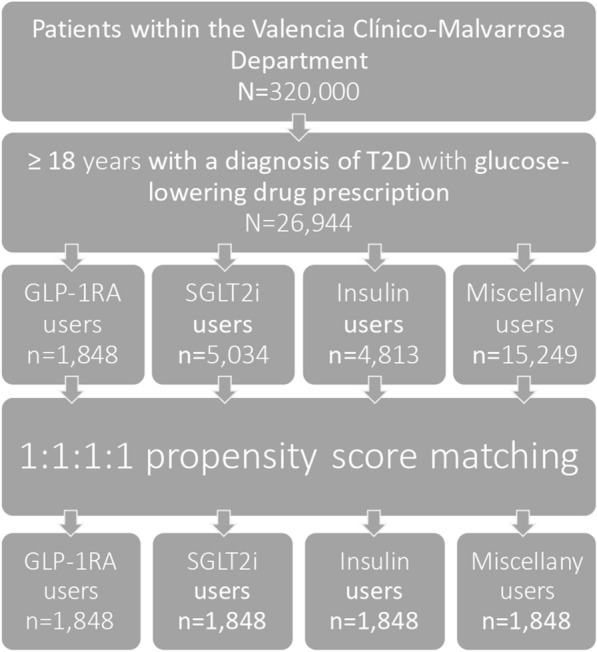
A retrospective study was conducted using electronic medical records from 2014 to 2019 for adults with T2D at the Valencia Clínico-Malvarrosa Department of Health (Valencia, Spain). Four study groups were established: all GLP-1RA users, SGLT2i users, insulin users and other glucose-lowering agent users (miscellany group). To account for imbalance between groups, propensity score matching (PSM) including age, gender and pre-existing cardiovascular disease was performed. Chi-square tests were used for comparisons between groups. Time to first intensification was calculated using competing risk analysis.
Among the 26,944 adults with T2D, 7392 individuals were selected following PSM, with 1848 patients in each group. At 2 years, GLP-1RA users were less persistent than non-users (48.4% versus 72.7%, p < 0.0001) but more adherent (73.8% versus 68.9%, respectively, p < 0.0001). A greater proportion of persistent GLP-1RA users than non-persistent users exhibited reduced HbA1c (40.5% versus 18.6%, respectively, p < 0.0001), but no differences in cardiovascular outcomes and death were found. Overall, therapeutic inertia was observed in 38.0% of the study population. The large majority of GLP-1RA users received treatment intensification, whereas only 50.0% of GLP-1RA non-users were intensified.
Under real-life conditions, obese adults with T2D persistently treated with GLP-1RA showed improved glycaemic control. Despite benefits, persistence with GLP-1RA was limited after 2 years. Additionally, therapeutic inertia occurred in two out of three study participants. Strategies to facilitate medication adherence, persistence and treatment intensification in people with T2D should be made a priority in order to achieve and maintain glycaemic targets and improve outcomes in this population.
Study registered in clinicaltrials.org with the identifier NCT05535322.
在2型糖尿病(T2D)中,实现最佳血糖控制的关键障碍包括治疗依从性差、药物依从性降低和治疗惰性。本研究旨在评估这些障碍对接受胰高血糖素样肽-1受体激动剂(GLP-1RA)治疗的肥胖2型糖尿病成年人的影响,并在现实环境中将其与其他降糖药物进行比较。
利用西班牙巴伦西亚临床-马尔瓦罗萨卫生部2014年至2019年成人T2D患者的电子病历进行了一项回顾性研究。设立了四个研究组:所有GLP-1RA使用者、钠-葡萄糖协同转运蛋白2抑制剂(SGLT2i)使用者、胰岛素使用者和其他降糖药物使用者(杂项组)。为了平衡组间差异,进行了倾向评分匹配(PSM),包括年龄、性别和既往心血管疾病。采用卡方检验进行组间比较。使用竞争风险分析计算首次强化治疗的时间。
在26944例T2D成人中,PSM后选择了7392例个体,每组1848例患者。在2年时,GLP-1RA使用者的治疗依从性低于非使用者(48.4%对72.7%,p<0.0001),但依从性更高(分别为73.8%对68.9%,p<0.0001)。持续使用GLP-1RA的使用者比未持续使用的使用者有更大比例的糖化血红蛋白(HbA1c)降低(分别为40.5%对18.6%,p<0.0001),但在心血管结局和死亡方面未发现差异。总体而言,38.0%的研究人群存在治疗惰性。绝大多数GLP-1RA使用者接受了治疗强化,而只有50.0%的GLP-1RA非使用者得到了强化。
在现实生活条件下,持续接受GLP-1RA治疗的肥胖T2D成人血糖控制得到改善。尽管有这些益处,但2年后GLP-1RA的治疗依从性有限。此外,三分之二的研究参与者存在治疗惰性。应优先制定促进T2D患者药物依从性、治疗依从性和治疗强化的策略以便实现和维持血糖目标并改善该人群的结局。
该研究在clinicaltrials.org注册,标识符为NCT05535322。