Department of Anesthesiology, University Medical Center Göttingen, Göttingen, Germany.
IRCCS San Raffaele Scientific Institute, Milan, Italy.
Am J Respir Crit Care Med. 2023 May 1;207(9):1183-1193. doi: 10.1164/rccm.202212-2194OC.
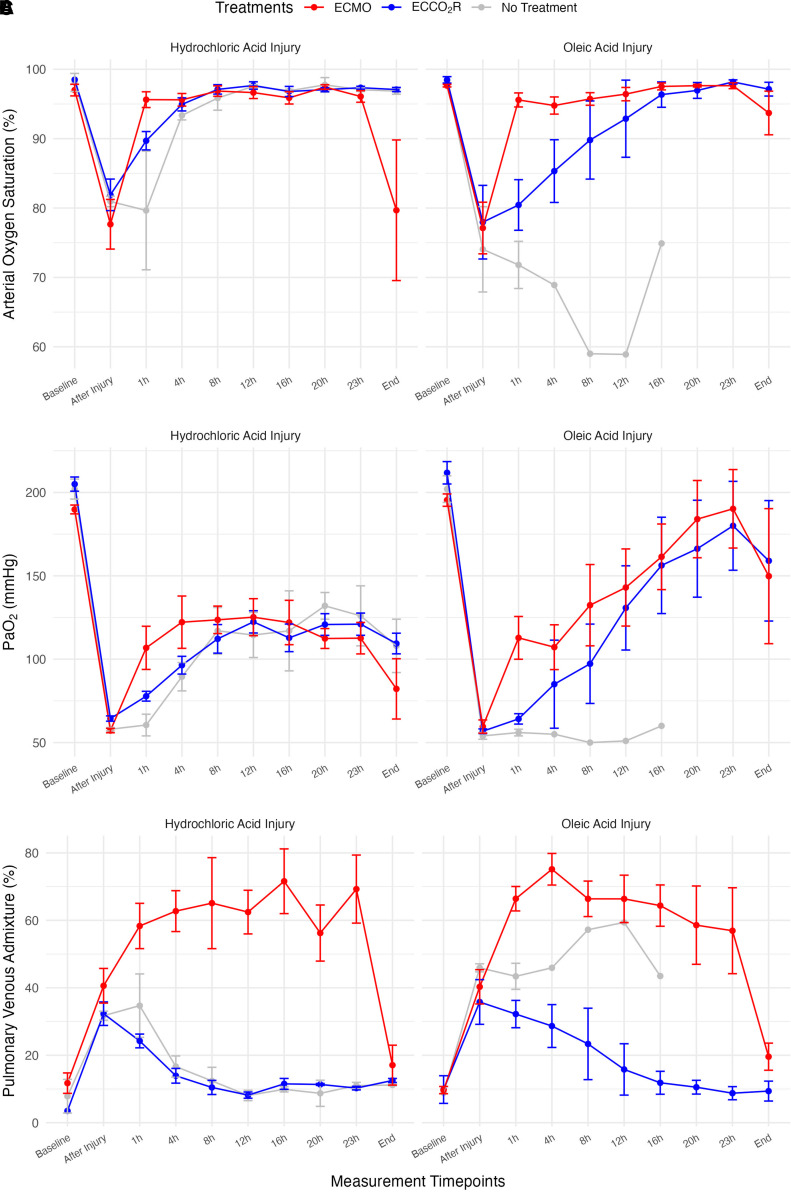
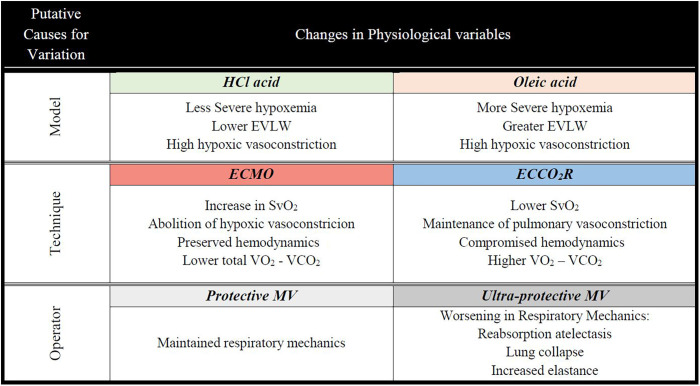
In the EOLIA (ECMO to Rescue Lung Injury in Severe ARDS) trial, oxygenation was similar between intervention and conventional groups, whereas [Formula: see text]e was reduced in the intervention group. Comparable reductions in ventilation intensity are theoretically possible with low-flow extracorporeal CO removal (ECCOR), provided oxygenation remains acceptable. To compare the effects of ECCOR and extracorporeal membrane oxygenation (ECMO) on gas exchange, respiratory mechanics, and hemodynamics in animal models of pulmonary (intratracheal hydrochloric acid) and extrapulmonary (intravenous oleic acid) lung injury. Twenty-four pigs with moderate to severe hypoxemia (Pa:Fi ⩽ 150 mm Hg) were randomized to ECMO (blood flow 50-60 ml/kg/min), ECCOR (0.4 L/min), or mechanical ventilation alone. [Formula: see text]o, [Formula: see text]co, gas exchange, hemodynamics, and respiratory mechanics were measured and are presented as 24-hour averages. Oleic acid versus hydrochloric acid showed higher extravascular lung water (1,424 ± 419 vs. 574 ± 195 ml; < 0.001), worse oxygenation (Pa:Fi = 125 ± 14 vs. 151 ± 11 mm Hg; < 0.001), but better respiratory mechanics (plateau pressure 27 ± 4 vs. 30 ± 3 cm HO; = 0.017). Both models led to acute severe pulmonary hypertension. In both models, ECMO (3.7 ± 0.5 L/min), compared with ECCOR (0.4 L/min), increased mixed venous oxygen saturation and oxygenation, and improved hemodynamics (cardiac output = 6.0 ± 1.4 vs. 5.2 ± 1.4 L/min; = 0.003). [Formula: see text]o and [Formula: see text]co, irrespective of lung injury model, were lower during ECMO, resulting in lower Pa and [Formula: see text]e but worse respiratory elastance compared with ECCOR (64 ± 27 vs. 40 ± 8 cm HO/L; < 0.001). ECMO was associated with better oxygenation, lower [Formula: see text]o, and better hemodynamics. ECCOR may offer a potential alternative to ECMO, but there are concerns regarding its effects on hemodynamics and pulmonary hypertension.
在 EOLIA(体外膜肺氧合治疗严重急性呼吸窘迫综合征中的肺保护)试验中,干预组与常规组的氧合情况相似,而 [Formula: see text]e 在干预组中降低。在理论上,如果氧合保持可接受,低流量体外 CO 去除(ECCOR)可以实现类似的通气强度降低。 比较体外膜肺氧合(ECMO)和体外 CO 去除(ECCOR)对动物模型中肺(气管内盐酸)和肺外(静脉内油酸)肺损伤的气体交换、呼吸力学和血液动力学的影响。 24 头中度至重度低氧血症(Pa:Fi ⩽ 150 mm Hg)的猪被随机分为 ECMO(血流 50-60 ml/kg/min)、ECCOR(0.4 L/min)或单独机械通气。 [Formula: see text]o、[Formula: see text]co、气体交换、血液动力学和呼吸力学进行了测量,并以 24 小时平均值表示。油酸与盐酸比较,肺血管外水更多(1424 ± 419 比 574 ± 195 ml; < 0.001),氧合更差(Pa:Fi = 125 ± 14 比 151 ± 11 mm Hg; < 0.001),但呼吸力学更好(平台压 27 ± 4 比 30 ± 3 cm HO; = 0.017)。两种模型均导致急性严重肺动脉高压。在两种模型中,与 ECCOR(0.4 L/min)相比,ECMO(3.7 ± 0.5 L/min)增加了混合静脉血氧饱和度和氧合,并改善了血液动力学(心输出量= 6.0 ± 1.4 比 5.2 ± 1.4 L/min; = 0.003)。[Formula: see text]o 和 [Formula: see text]co ,无论肺损伤模型如何,在 ECMO 期间均较低,导致 Pa 和 [Formula: see text]e 降低,但与 ECCOR 相比,呼吸弹性阻力更高(64 ± 27 比 40 ± 8 cm HO/L; < 0.001)。 ECMO 与更好的氧合、更低的 [Formula: see text]o 和更好的血液动力学相关。ECCOR 可能是 ECMO 的潜在替代方法,但对其血液动力学和肺动脉高压的影响存在担忧。