Laboratorio de Ictiología e Interacciones Biofísicas (LABITI), Instituto de Biología, Facultad de Ciencias, Universidad de Valparaíso, Valparaíso, Chile.
Millennium Nucleus for the Ecology and Conservation of Temperate Mesophotic Reef Ecosystem (NUTME), Las Cruces, Chile.
PLoS One. 2023 Feb 27;18(2):e0281932. doi: 10.1371/journal.pone.0281932. eCollection 2023.
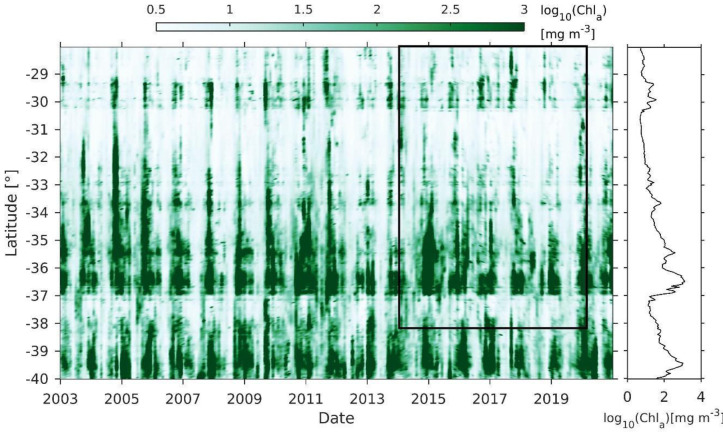
This study summarises six years of spatio-temporal patterns of the discarded demersal community fauna recorded by onboard scientific observer program for both artisanal and industrial crustacean fisheries between 2014 and 2019, from mesophotic to aphotic depths (96 to 650 m) along the southern Humboldt Current System (28-38°S). In this period, one cold and two warm climatic events were observed during the austral summer 2014, 2015-2016 (ENSO Godzilla), and 2016-2017 (coastal ENSO), respectively. Satellite information showed that Chlorophyll-a concentration varied seasonally and latitudinally, associated with upwelling centres, while equatorial wind stress decreased southward of 36°S. Discards were composed of 108 species, dominated by finfish and molluscs. The Chilean hake Merluccius gayi was dominant and ubiquitous (occurrence, 95% of 9104 hauls), being the most vulnerable species of the bycatch. Three assemblages were identified: assemblage 1 (200 m deep), dominated by flounders Hippoglossina macrops and lemon crabs Platymera gaudichaudii, assemblage 2 (260 m deep), dominated by squat lobsters Pleuroncodes monodon and Cervimunida johni and assemblage 3 (~320 m depth), dominated by grenadiers Coelorinchus aconcagua and cardinalfish Epigonus crassicaudus. These assemblages were segregated by depth, and varied by year, and geographic zone. The latter represented changes in the width of the continental shelf, increasing southward of 36°S. Alpha-diversity indexes (richness, Shannon, Simpson, and Pielou) also varied with depth and latitude, with higher diversity in deeper continental waters (>300 m), between 2018-2019. Finally, at a spatial scale of tens of kilometres, and a monthly basis, interannual variations of biodiversity occurred in the demersal community. Surface sea temperature, chlorophyll-a, or wind stress did not correlate with discarded demersal fauna diversity of the crustacean fishery operating along central Chile.
本研究总结了 2014 年至 2019 年间,在南洪堡海流系统(28-38°S),从中层到无光带(96-650 米),科学观察员计划在手工和工业甲壳类渔业中记录的被丢弃的底层社区动物群的六年时空格局。在此期间,在 2014 年、2015-2016 年(ENSO 哥斯拉)和 2016-2017 年(沿海 ENSO)的南半球夏季观察到了一个寒冷和两个温暖的气候事件。卫星信息显示,叶绿素 a 浓度随季节和纬度变化,与上升流中心有关,而赤道风应力在 36°S 以南向南减少。丢弃物由 108 种组成,以鱼类和贝类为主。智利无须鳕 Merluccius gayi 是优势和无处不在的(出现,9104 次拖网捕捞中的 95%),是兼捕中最脆弱的物种。确定了三个组合:组合 1(200 米深),以比目鱼 Hippoglossina macrops 和柠檬蟹 Platymera gaudichaudii 为主,组合 2(260 米深),以短尾龙虾 Pleuroncodes monodon 和 Cervimunida johni 为主,组合 3(~320 米深),以方头鱼科 Coelorinchus aconcagua 和红鲷 Epigonus crassicaudus 为主。这些组合按深度分离,并因年份和地理区域而变化。后者代表了南纬 36°以南大陆架宽度的变化。α多样性指数(丰富度、香农、辛普森和皮埃洛)也随深度和纬度而变化,在较深的大陆水域(>300 米),2018-2019 年的多样性更高。最后,在数十公里的空间尺度和每月的基础上,底层社区的生物多样性发生了年际变化。表层海水温度、叶绿素-a 或风应力与智利中部甲壳类渔业的丢弃底层动物群多样性没有相关性。