Centre for Social and Early Emotional Development, School of Psychology, Faculty of Health, Deakin University, Geelong, Australia.
Centre for Adolescent Health, Murdoch Children's Research Institute, Royal Children's Hospital, Melbourne, Australia.
Sci Rep. 2023 Feb 27;13(1):3332. doi: 10.1038/s41598-023-29139-1.
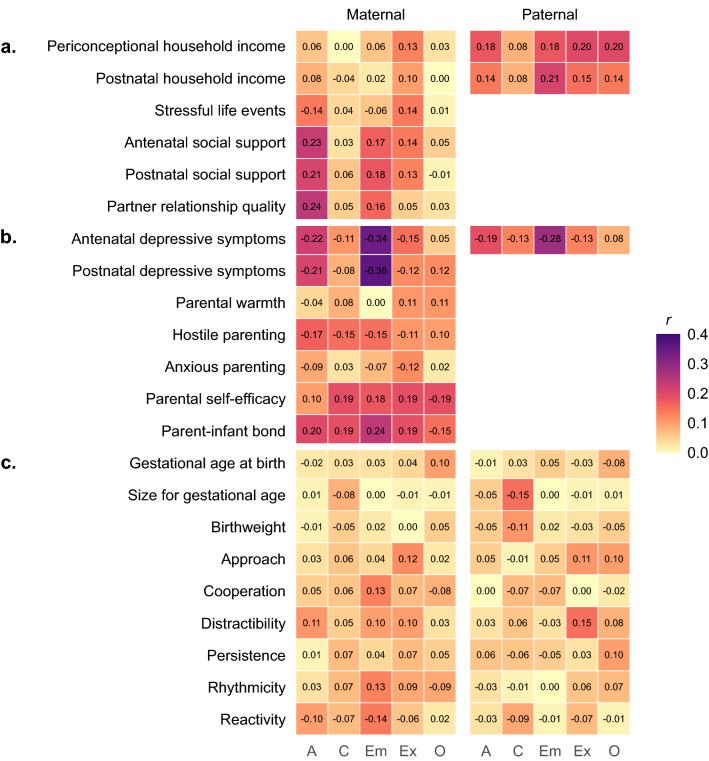
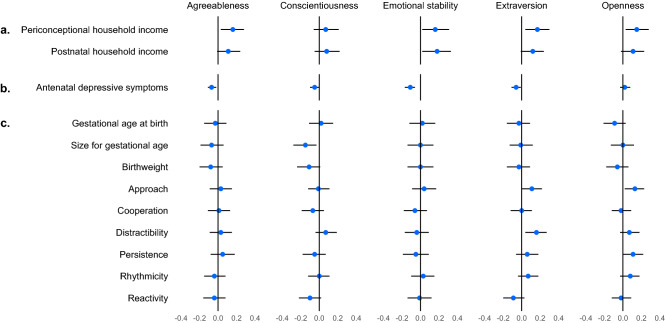
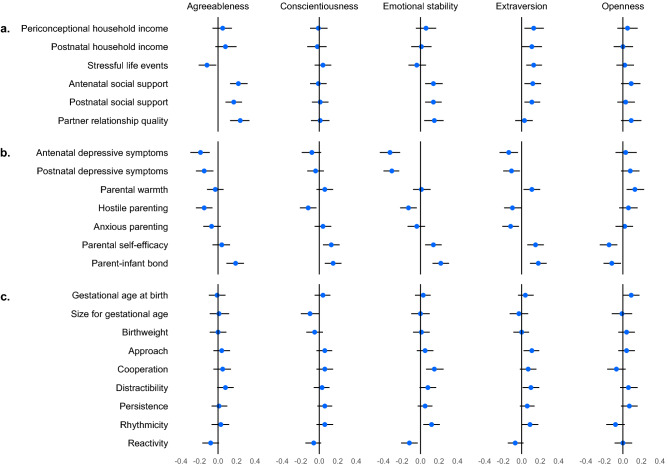
Personality reliably predicts life outcomes ranging from social and material resources to mental health and interpersonal capacities. However, little is known about the potential intergenerational impact of parent personality prior to offspring conception on family resources and child development across the first thousand days of life. We analysed data from the Victorian Intergenerational Health Cohort Study (665 parents, 1030 infants; est. 1992), a two-generation study with prospective assessment of preconception background factors in parental adolescence, preconception personality traits in young adulthood (agreeableness, conscientiousness, emotional stability, extraversion, and openness), and multiple parental resources and infant characteristics in pregnancy and after the birth of their child. After adjusting for pre-exposure confounders, both maternal and paternal preconception personality traits were associated with numerous parental resources and attributes in pregnancy and postpartum, as well as with infant biobehavioural characteristics. Effect sizes ranged from small to moderate when considering parent personality traits as continuous exposures, and from small to large when considering personality traits as binary exposures. Young adult personality, well before offspring conception, is associated with the perinatal household social and financial context, parental mental health, parenting style and self-efficacy, and temperamental characteristics of offspring. These are pivotal aspects of early life development that ultimately predict a child's long-term health and development.
人格特质可靠地预测了从社会和物质资源到心理健康和人际交往能力等生活结果。然而,在后代受孕之前,很少有人知道父母人格特质对家庭资源和生命最初一千天内儿童发展的潜在代际影响。我们分析了来自维多利亚州代际健康队列研究(665 名父母,1030 名婴儿;估计 1992 年)的数据,这是一项两代人研究,前瞻性评估了父母青春期的受孕前背景因素、成年早期的受孕前人格特质(宜人性、尽责性、情绪稳定性、外向性和开放性),以及怀孕和孩子出生后父母的多种资源和婴儿特征。在调整了预暴露混杂因素后,母亲和父亲的受孕前人格特质与怀孕和产后的许多父母资源和特征以及婴儿的生物行为特征有关。当将父母人格特质视为连续暴露时,效应大小从小到中不等,当将人格特质视为二分暴露时,效应大小从小到大都不等。成年早期的人格特质,早在后代受孕之前,就与围产期家庭的社会和经济环境、父母的心理健康、育儿风格和自我效能感以及后代的气质特征有关。这些是儿童早期发展的关键方面,最终预测着孩子的长期健康和发展。