Department of Electrical and Computer Engineering, Princeton University, Princeton, 08544, NJ, USA.
Department of Electrical and Computer Engineering, Queen's University, Kingston, K7L 3N6, ON, Canada.
Nat Commun. 2023 Feb 27;14(1):1107. doi: 10.1038/s41467-023-36814-4.
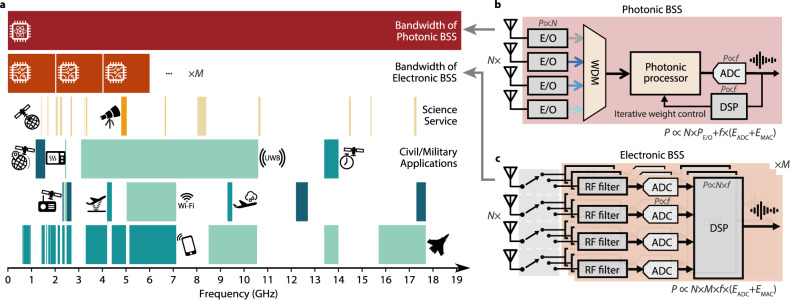
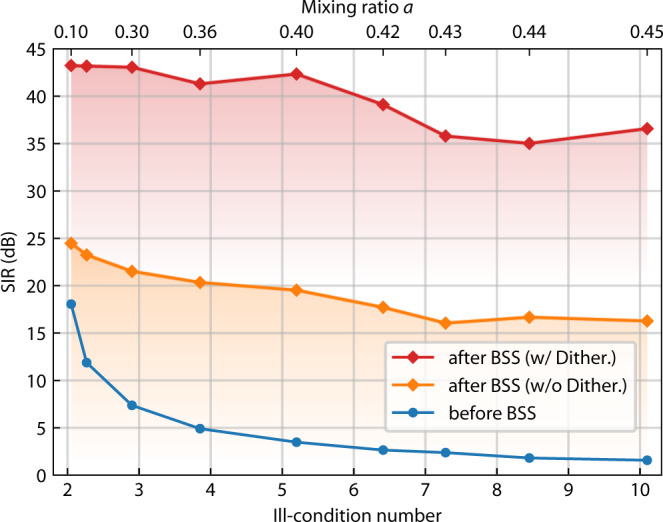
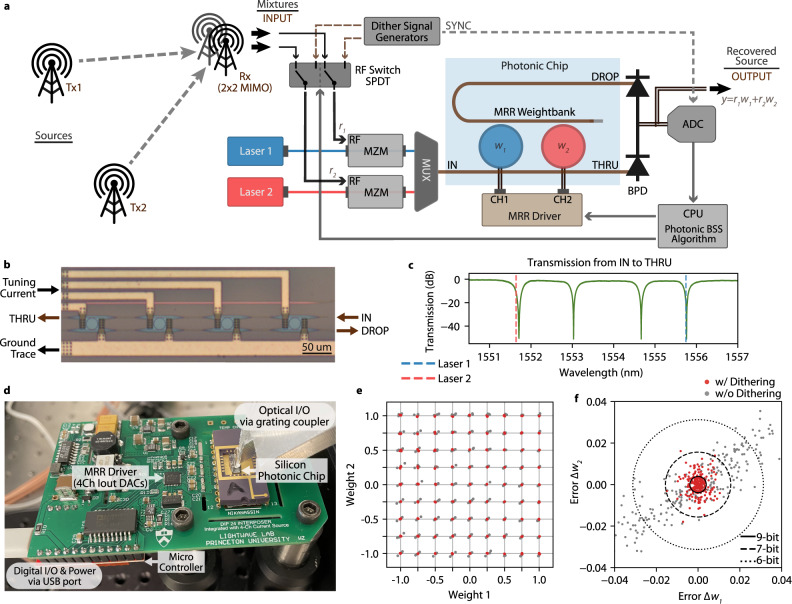
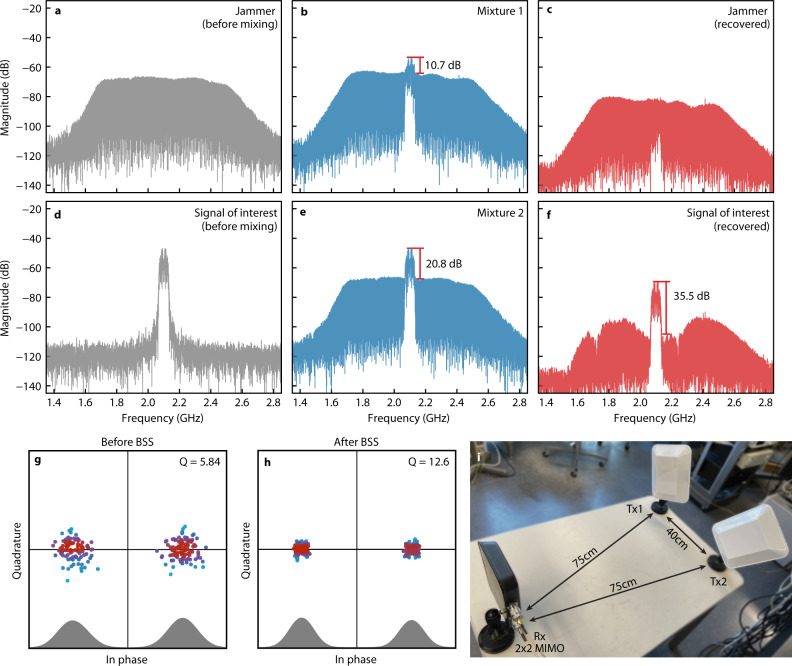
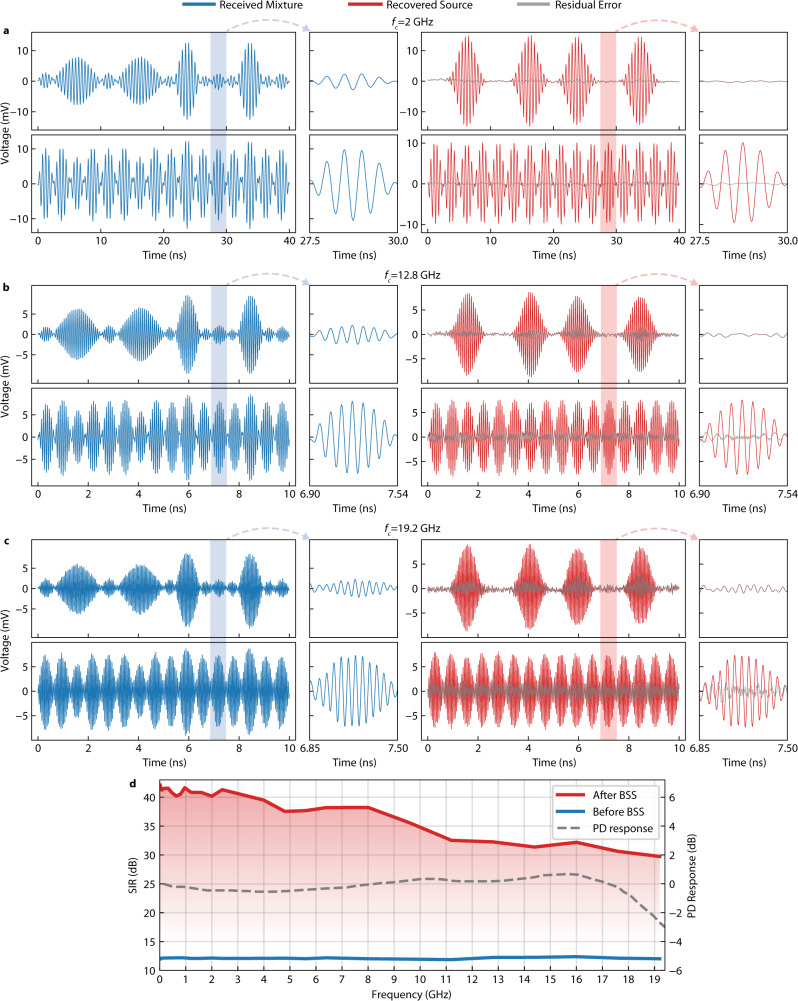
The expansion of telecommunications incurs increasingly severe crosstalk and interference, and a physical layer cognitive method, called blind source separation (BSS), can effectively address these issues. BSS requires minimal prior knowledge to recover signals from their mixtures, agnostic to the carrier frequency, signal format, and channel conditions. However, previous electronic implementations did not fulfil this versatility due to the inherently narrow bandwidth of radio-frequency (RF) components, the high energy consumption of digital signal processors (DSP), and their shared weaknesses of low scalability. Here, we report a photonic BSS approach that inherits the advantages of optical devices and fully fulfils its "blindness" aspect. Using a microring weight bank integrated on a photonic chip, we demonstrate energy-efficient, wavelength-division multiplexing (WDM) scalable BSS across 19.2 GHz processing bandwidth. Our system also has a high (9-bit) resolution for signal demixing thanks to a recently developed dithering control method, resulting in higher signal-to-interference ratios (SIR) even for ill-conditioned mixtures.
电信的扩展导致越来越严重的串扰和干扰,一种称为盲源分离 (BSS) 的物理层认知方法可以有效地解决这些问题。BSS 只需最少的先验知识即可从混合物中恢复信号,对载波频率、信号格式和信道条件均不敏感。然而,由于射频 (RF) 组件的固有带宽较窄、数字信号处理器 (DSP) 的能耗较高以及它们共享的低可扩展性弱点,以前的电子实现无法满足这种多功能性。在这里,我们报告了一种光子 BSS 方法,它继承了光器件的优势,并完全满足其“盲目”方面。我们使用集成在光子芯片上的微环权重库,在 19.2GHz 的处理带宽上演示了节能、波分复用 (WDM) 可扩展的 BSS。由于最近开发的抖动控制方法,我们的系统还具有高(9 位)信号解混分辨率,即使对于条件较差的混合物,也能获得更高的信干比 (SIR)。