Department of Intensive Care and Burn Centre, University Hospital of Liège, University of Liège, Liège, Belgium.
Department of Anaesthesiology, University Hospital of Liège, University of Liège, Liège, Belgium.
Crit Care. 2023 Feb 27;27(1):76. doi: 10.1186/s13054-023-04348-2.
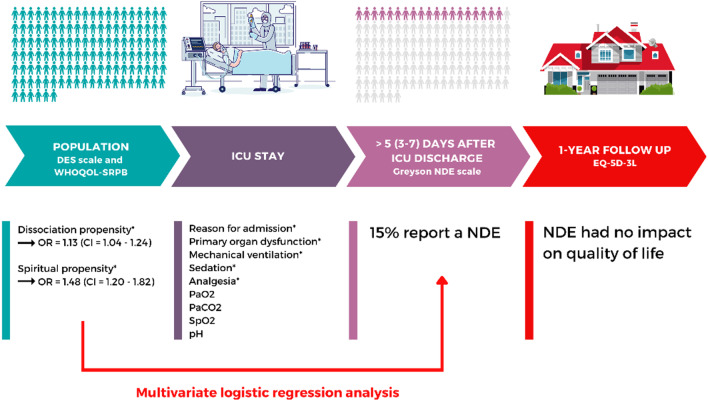
So far, the few prospective studies on near-death experience (NDE) were carried out only in intensive care unit (ICU) patients with homogeneous aetiologies, such as cardiac arrest or trauma survivors. The aims of this 1-year prospective and monocentric study were to investigate the incidence of NDE in ICU survivors (all aetiologies) as well as factors that may affect its frequency, and to assess quality of life up to 1 year after enrolment.
We enrolled adults with a prolonged ICU stay (> 7 days). During the first 7 days after discharge, all eligible patients were assessed in a face-to-face interview for NDE using the Greyson NDE scale, dissociative experiences using the Dissociative Experience Scale, and spirituality beliefs using the WHOQOL-SRPB. Medical parameters were prospectively collected. At 1-year after inclusion, patients were contacted by phone to measure quality of life using the EuroQol five-dimensional questionnaire.
Out of the 126 included patients, 19 patients (15%) reported having experienced a NDE as identified by the Greyson NDE scale (i.e. cut-off score ≥ 7/32). In univariate analyses, mechanical ventilation, sedation, analgesia, reason for admission, primary organ dysfunction, dissociative and spiritual propensities were associated with the emergence of NDE. In multivariate logistic regression analysis, only the dissociative and spiritual propensity strongly predicted the emergence of NDE. One year later (n = 61), the NDE was not significantly associated with quality of life.
The recall of NDE is not so rare in the ICU. In our cohort, cognitive and spiritual factors outweighed medical parameters as predictors of the emergence of NDE. Trial registration This trial was registered in Clinicaltrials.gov in February 2020 ( NCT04279171 ).
到目前为止,为数不多的濒死体验(NDE)前瞻性研究仅在具有同质病因的重症监护病房(ICU)患者中进行,例如心脏骤停或创伤幸存者。本为期 1 年的前瞻性单中心研究的目的是调查 ICU 幸存者(所有病因)中 NDE 的发生率,以及可能影响其频率的因素,并评估入组后 1 年的生活质量。
我们纳入了 ICU 住院时间延长(>7 天)的成年人。在出院后的第 7 天内,所有符合条件的患者均通过 Grayson NDE 量表、分离体验量表(Dissociative Experience Scale)和世界卫生组织生活质量-灵性、宗教和个人信仰量表(WHOQOL-SRPB)进行面对面访谈,以评估 NDE。前瞻性收集医疗参数。入组 1 年后,通过电话联系患者,使用欧洲五维健康量表(EuroQol five-dimensional questionnaire)评估生活质量。
在纳入的 126 名患者中,19 名患者(15%)根据 Grayson NDE 量表(即截距评分≥7/32)报告经历过濒死体验。在单因素分析中,机械通气、镇静、镇痛、入院原因、主要器官功能障碍、分离和精神倾向与 NDE 的发生有关。在多变量逻辑回归分析中,只有分离和精神倾向强烈预测 NDE 的发生。1 年后(n=61),NDE 与生活质量无显著相关性。
在 ICU 中,NDE 的回忆并不罕见。在我们的队列中,认知和精神因素比预测 NDE 发生的医疗参数更为重要。
本试验于 2020 年 2 月在 Clinicaltrials.gov 注册(NCT04279171)。