Multidisciplinary Center for Advanced Research and Studies, Jamia Millia Islamia, Jamia Nagar, New Delhi 110025, India.
Department of Clinical Biochemistry, College of Medicine, King Khalid University, Abha 62529, Saudi Arabia.
Viruses. 2023 Feb 7;15(2):464. doi: 10.3390/v15020464.
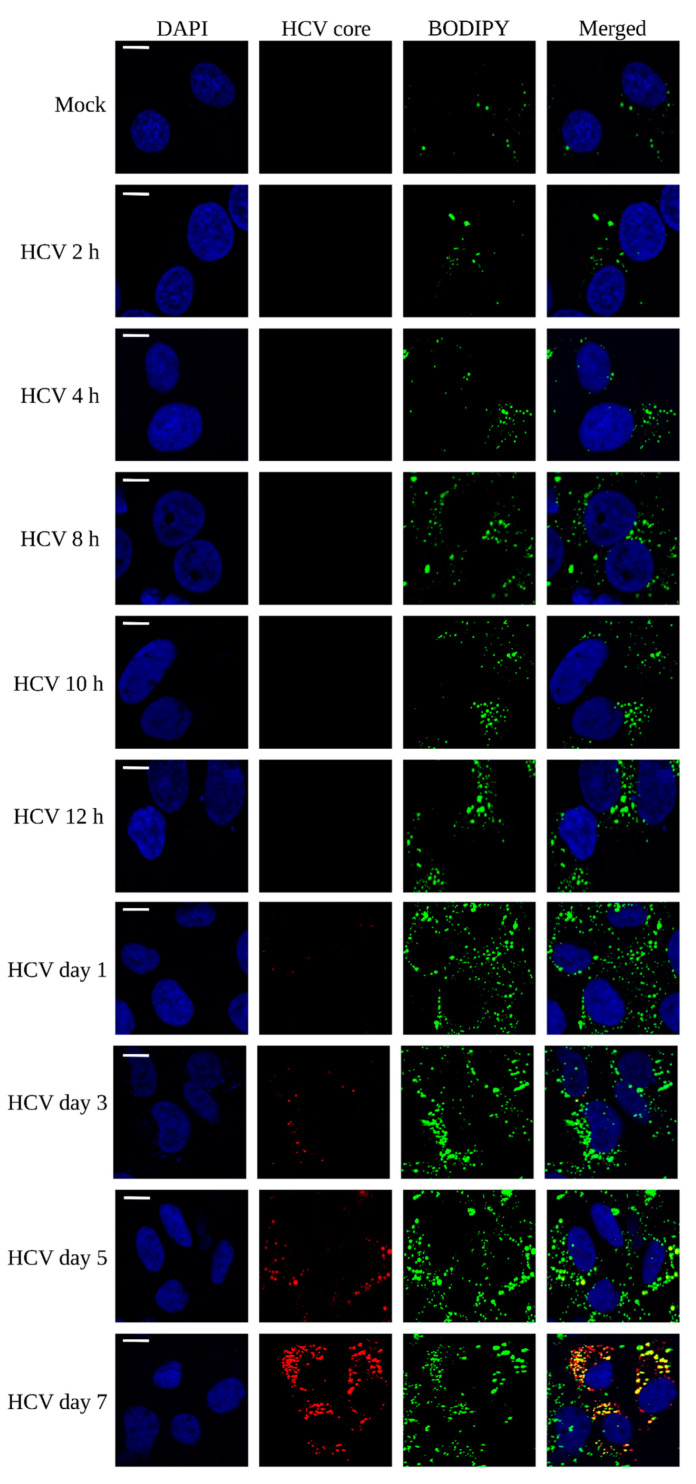
Hepatitis C virus (HCV) is a major human pathogen that requires a better understanding of its interaction with host cells. There is a close association of HCV life cycle with host lipid metabolism. Lipid droplets (LDs) have been found to be crucial organelles that support HCV replication and virion assembly. In addition to their role in replication, LDs also have protein-mediated antiviral properties that are activated during HCV infection. Studies have shown that HCV replicates well in cholesterol and sphingolipid-rich membranes, but the ways in which HCV alters host cell lipid dynamics are not yet known. In this study, we performed a kinetic study to check the enrichment of LDs at different time points of HCV infection. Based on the LD enrichment results, we selected early and later time points of HCV infection for global lipidomic study. Early infection represents the window period for HCV sensing and host immune response while later infection represents the establishment of viral RNA replication, virion assembly, and egress. We identified the dynamic profile of lipid species at early and later time points of HCV infection by global lipidomic study using mass spectrometry. At early HCV infection, phosphatidylinositol phospholipids (PIPs), lysophosphatidic acid (LPA), triacyl glycerols (TAG), phosphatidylcholine (PC), and trihexosylceramides (Hex3Cer) were observed to be enriched. Similarly, free fatty acids (FFA), phosphatidylethanolamine (PE), N-acylphosphatidylethanolamines (NAPE), and tri acylglycerols were enriched at later time points of HCV infection. Lipids enriched at early time of infection may have role in HCV sensing, viral attachment, and immune response as LPA and PIPs are important for immune response and viral attachment, respectively. Moreover, lipid species observed at later infection may contribute to HCV replication and virion assembly as PE, FFA, and triacylglycerols are known for the similar function. In conclusion, we identified lipid species that exhibited dynamic profile across early and later time points of HCV infection compared to mock cells, which could be therapeutically relevant in the design of more specific and effective anti-viral therapies.
丙型肝炎病毒 (HCV) 是一种主要的人类病原体,需要更好地了解其与宿主细胞的相互作用。HCV 生命周期与宿主脂质代谢密切相关。已发现脂滴 (LDs) 是支持 HCV 复制和病毒组装的关键细胞器。除了在复制中的作用外,LDs 还具有蛋白介导的抗病毒特性,这些特性在 HCV 感染时被激活。研究表明,HCV 在富含胆固醇和鞘脂的膜中复制良好,但 HCV 改变宿主细胞脂质动态的方式尚不清楚。在这项研究中,我们进行了一项动力学研究,以检查 HCV 感染不同时间点 LDs 的富集情况。基于 LD 富集结果,我们选择 HCV 感染的早期和晚期时间点进行全局脂质组学研究。早期感染代表 HCV 感应和宿主免疫反应的窗口期,而晚期感染代表病毒 RNA 复制、病毒组装和出芽的建立。我们通过使用质谱法的全局脂质组学研究,在 HCV 感染的早期和晚期时间点确定了脂质种类的动态谱。在早期 HCV 感染时,观察到磷脂酰肌醇磷脂 (PIPs)、溶血磷脂酸 (LPA)、三酰基甘油 (TAG)、磷脂酰胆碱 (PC) 和三己糖神经酰胺 (Hex3Cer) 富集。同样,在 HCV 感染的晚期时间点,游离脂肪酸 (FFA)、磷脂乙醇胺 (PE)、N-酰基磷脂乙醇胺 (NAPE) 和三酰基甘油也被富集。感染早期富集的脂质可能在 HCV 感应、病毒附着和免疫反应中起作用,因为 LPA 和 PIPs 分别对免疫反应和病毒附着很重要。此外,在感染后期观察到的脂质种类可能有助于 HCV 复制和病毒组装,因为 PE、FFA 和三酰基甘油以已知的类似功能而闻名。总之,与 mock 细胞相比,我们鉴定了在 HCV 感染的早期和晚期时间点表现出动态特征的脂质种类,这在设计更特异和有效的抗病毒治疗方面可能具有治疗相关性。