Alt Volker, Walter Nike, Rupp Markus, Begué Thierry, Plecko Michael
Department of Trauma Surgery, University Hospital Regensburg, Germany.
Department of Orthopedics and Trauma Surgery, Antoine Beclere Hospital, University Paris-Saclay, France.
Trauma Case Rep. 2023 Feb 18;44:100805. doi: 10.1016/j.tcr.2023.100805. eCollection 2023 Apr.
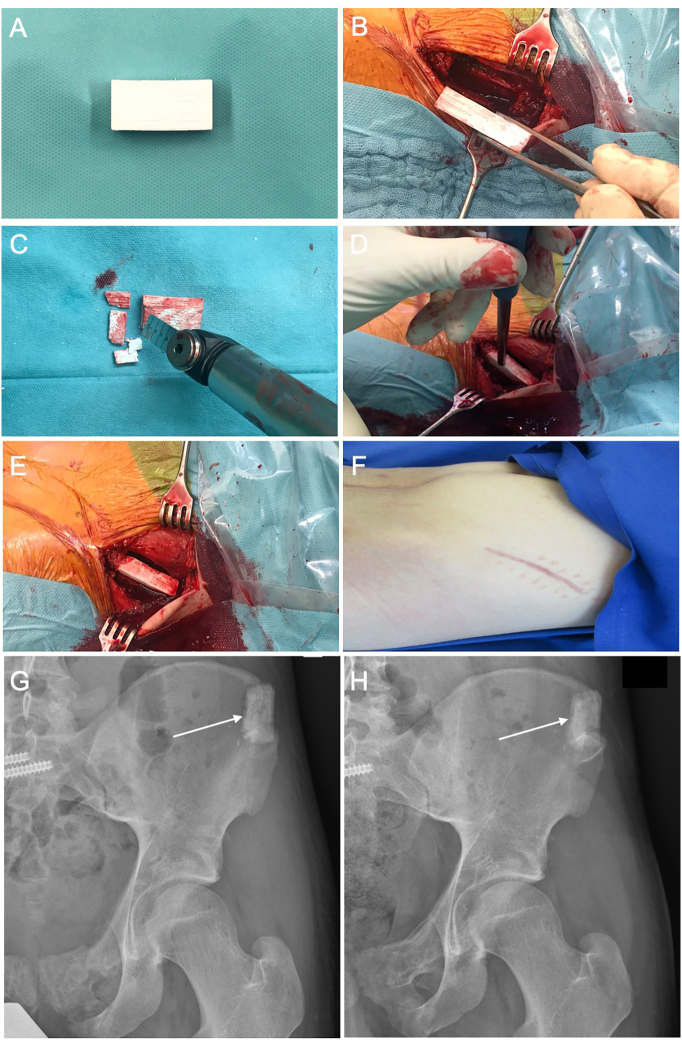
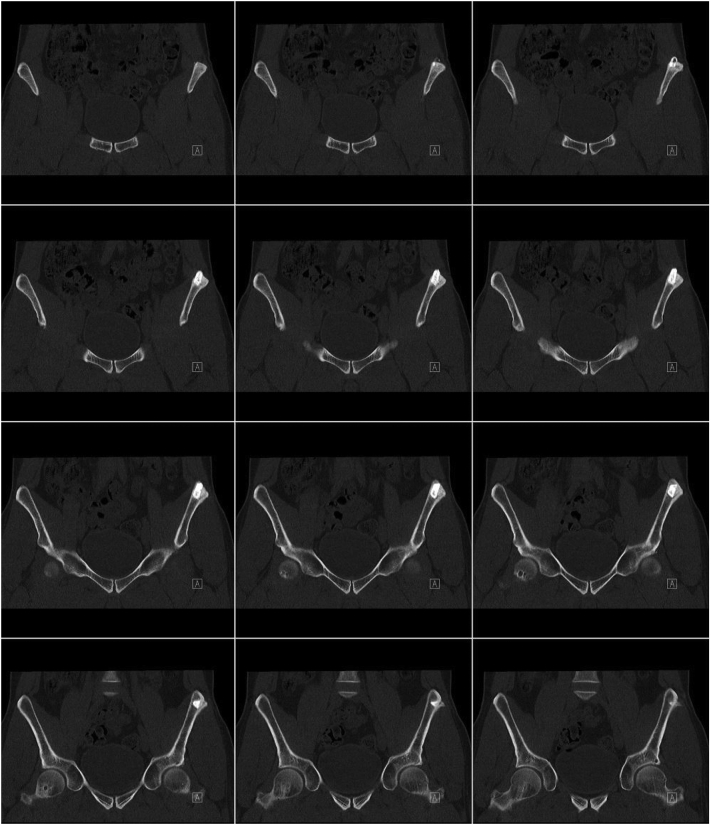
Harvesting of tricortical bone graft from the iliac crest is an integral part of bone defect reconstruction in orthopaedic surgery. There are several options for filling the iliac crest defect area to avoid hematoma, pain, hernias and cosmetic issues, including different gelatin-based and other alternative biomaterials. Recently, a novel rattan-wood based not-sintered hydroxyapatite and beta-tricalcium phosphate material (b.Bone™, GreenBone ORTHO S.p.A Faenza, Italy) was shown to promote bone healing in an experimental setting. The goal of the current work is to report clinical and radiographical outcomes of a consecutive case series of 9 patients with defect filling at the iliac crest with this novel scaffold biomaterial after tricortical bone graft harvesting with a minimum follow-up of 6 months. All 9 patients (8 male, 1 female) with an average age of 42.7 years (range: 18-76 years) had tricortical bone graft harvesting from the iliac crest for different reconstructive procedures at the extremities and received blocks of the biomaterial with an average size of 26.3 × 16.8 × 10 mm (length, height, width; range: 15 × 15 × 10 to 40 × 20 × 10 mm). Intraoperative handling of the biomaterial was easy and the blocks could be customized to the individual size of the defect with standard surgical instruments and were press-fitted into the defect. All 9 patients showed uneventful wound healing at the iliac crest and 7 patients reported no pain (VAS: 0) and two patients only mild pain (VAS:1 and VAS:3) after an average follow-up of 9.8 months (range: 6-16 months). There was no post-operative hematoma, surgical revision or other implant-related complications at the iliac crest. In all patients, good radiographical integration without dislocation of the implant and good bony integration was observed. The use of this novel biomaterial for iliac crest defect filling was associated with good clinical and radiographical outcomes after an average follow-up of 9.8 months.
从髂嵴获取三皮质骨移植是骨科手术中骨缺损重建的重要组成部分。有多种填充髂嵴缺损区域的方法,以避免血肿、疼痛、疝气和美观问题,包括不同的明胶基和其他替代生物材料。最近,一种新型的基于藤木的未烧结羟基磷灰石和β-磷酸三钙材料(b.Bone™,意大利法恩扎的GreenBone ORTHO S.p.A公司)在实验环境中显示出能促进骨愈合。本研究的目的是报告9例连续病例的临床和影像学结果,这些患者在髂嵴进行三皮质骨移植后,使用这种新型支架生物材料填充缺损,随访至少6个月。所有9例患者(8例男性,1例女性)平均年龄42.7岁(范围:18 - 76岁),均因四肢不同重建手术从髂嵴获取三皮质骨移植,并接受了平均尺寸为26.3×16.8×10毫米(长、高、宽;范围:15×15×10至40×20×10毫米)的生物材料块。生物材料的术中操作简便,这些块可以用标准手术器械根据缺损的个体大小进行定制,并压入缺损处。所有9例患者髂嵴伤口愈合顺利,平均随访9.8个月(范围:6 - 16个月)后,7例患者报告无疼痛(视觉模拟评分法[VAS]:0),2例患者仅轻微疼痛(VAS:1和VAS:3)。髂嵴处无术后血肿、手术翻修或其他与植入物相关的并发症。所有患者均观察到良好的影像学整合,植入物无移位,骨整合良好。在平均随访9.8个月后,使用这种新型生物材料填充髂嵴缺损取得了良好的临床和影像学结果。