Mohamed Mafauzy, Zagury Roberto Luis, Bhaskaran Kalpana, Neutel Joel, Mohd Yusof Barakatun Nisak, Mooney Linda, Yeo Lihe, Kirwan Bridget-Anne, Aprikian Olivier, von Eynatten Maximilian, Johansen Odd Erik
Universiti Sains Malaysia, Kota Bharu, Malaysia.
Human Performance Lab, Rio de Janeiro, Brazil.
Diabetes Ther. 2023 Apr;14(4):749-766. doi: 10.1007/s13300-023-01379-4. Epub 2023 Mar 1.
Reducing postprandial (PP) hyperglycemia and PP glucose excursions is important for overall glycemic management. Although most therapeutic lifestyle interventions that reduce caloric intake would affect this, there is no particular nutritional intervention favored.
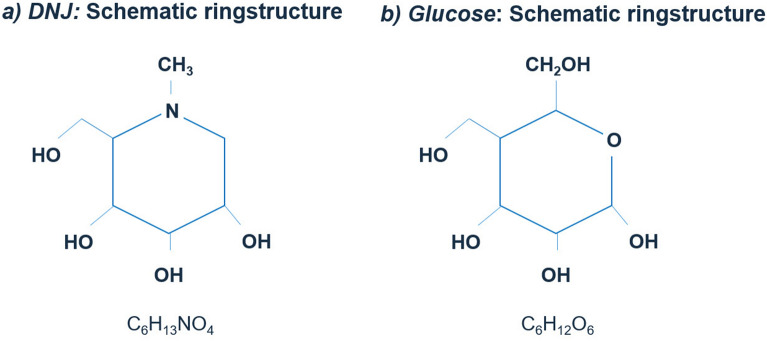
We evaluated the effects of a novel natural food adjuvant combining mulberry leaf extract (MLE) with other bioactive ingredients, in people with type 2 diabetes (T2D) originating from Asia, on improving PP glucometabolic response in a randomized controlled exploratory crossover, two-center study (USA, Singapore). A 2-g blend of 250 mg MLE [containing 12.5 mg of 1-deoxynojirimycin (DNJ)], fiber (1.75 g), vitamin D (0.75 μg), and chromium (75 μg), compared with a similar blend without the MLE, was sprinkled over a 350-kcal breakfast meal (55.4 g carbs) and PP blood glucose (primary exploratory endpoint), insulin, and incretin hormones (GLP-1, GIP) were evaluated in blood samples over 3 h. Changes in incremental areas under the concentration curve (iAUC) and maximum concentrations (C) were compared.
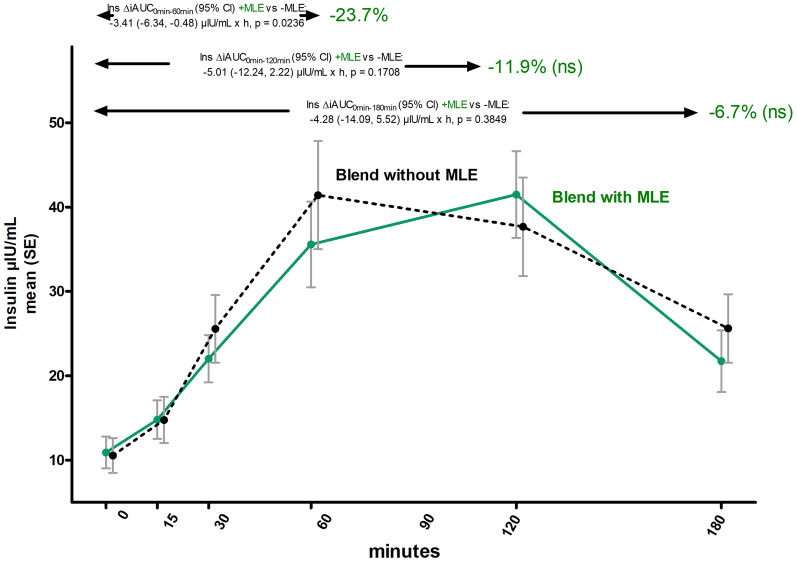
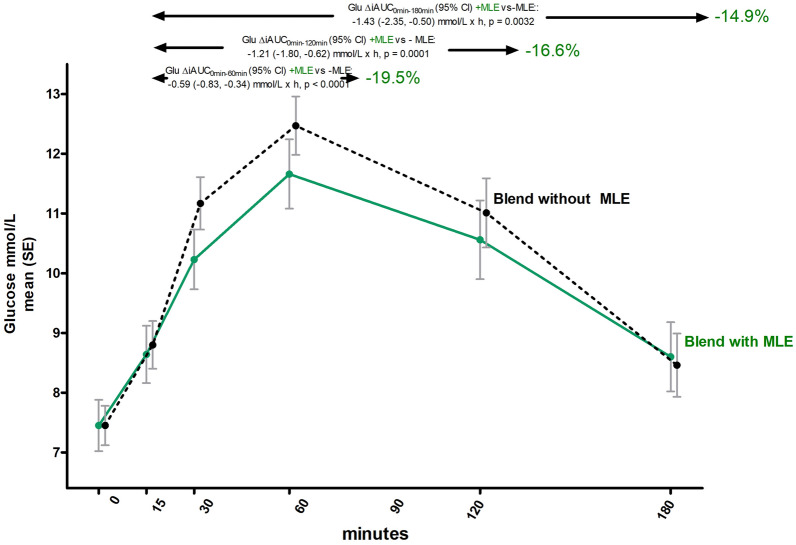
Thirty individuals (12 women, mean age 59 years, HbA1c 7.1%, BMI 26.5 kg/m) were enrolled and the MLE-based blend relative to the blend without MLE significantly reduced glucose iAUC at 1 h (- 20%, p < 0.0001), 2 h (- 17%, p = 0.0001), and 3 h (- 15%, p = 0.0032) and C [mean (95% CI) difference - 0.8 (- 1.2, - 0.3) mmol/L, p = 0.0006]. A statistically significant reduction in 1 h insulin iAUC (- 24%, p = 0.0236) was observed, but this reduction was no longer present at either 2 h or 3 h. No difference in GLP-1 was seen, but GIP response (iAUC and C) was less with the MLE-based blend.
The observation of a significant glucose reduction paralleled with a significant lower insulin response supports a reduced gastrointestinal glucose absorption. These results support the use of a 2-g natural blend of MLE, fiber, vitamin D, and chromium in T2D as a convenient dietary adjuvant to improve PP glucometabolic response.
gov identifier NCT04877366.
降低餐后(PP)高血糖和PP血糖波动对整体血糖管理至关重要。虽然大多数减少热量摄入的治疗性生活方式干预都会对此产生影响,但尚无特别受青睐的营养干预措施。
在一项随机对照探索性交叉双中心研究(美国、新加坡)中,我们评估了一种将桑叶提取物(MLE)与其他生物活性成分相结合的新型天然食品佐剂对改善源自亚洲的2型糖尿病(T2D)患者PP糖代谢反应的影响。将含有250mg MLE[含12.5mg 1-脱氧野尻霉素(DNJ)]、纤维(1.75g)、维生素D(0.75μg)和铬(75μg)的2g混合物与不含MLE的类似混合物相比较,撒在一顿350千卡的早餐(55.4g碳水化合物)上,并在3小时内评估血样中的PP血糖(主要探索性终点)、胰岛素和肠促胰岛素激素(GLP-1、GIP)。比较浓度曲线下增量面积(iAUC)和最大浓度(C)的变化。
招募了30名个体(12名女性,平均年龄59岁,HbA1c 7.1%,BMI 26.5kg/m),相对于不含MLE的混合物,基于MLE的混合物在1小时(-20%,p<0.0001)、2小时(-17%,p=0.0001)和3小时(-15%,p=0.0032)时显著降低了葡萄糖iAUC,且C[平均(95%CI)差异为-0.8(-1.2,-0.3)mmol/L,p=0.0006]。观察到1小时胰岛素iAUC有统计学意义的降低(-24%,p=0.0236),但在2小时或3小时时这种降低不再存在。GLP-1未见差异,但基于MLE的混合物的GIP反应(iAUC和C)较小。
观察到显著的血糖降低与显著较低的胰岛素反应同时出现,支持胃肠道葡萄糖吸收减少。这些结果支持在T2D中使用2g MLE、纤维、维生素D和铬的天然混合物作为方便的饮食佐剂来改善PP糖代谢反应。
gov标识符NCT04877366。