Liu Yanmin, Feng Xinwei, Tang Yongxue, Sun Yanqiu, Pu Xiaoyan, Feng Xiaokai
Department of Cardiology, Qinghai Provincial People's Hospital, 2 Gonghe Road, Chengdong District, Xining, Qinghai Province, 810007, China.
Suzhou Medical College of Soochow University, 199 RenAi Road, Suzhou Industrial Park, Suzhou, Jiangsu Province, 215123, China.
Thromb J. 2023 Feb 28;21(1):22. doi: 10.1186/s12959-023-00469-4.
To investigate venous thromboembolism (VTE) in hospitalized patients with severe high altitude pulmonary edema (HAPE), we performed a single center retrospective study to evaluate its clinical characteristics, prognosis, and potential thromboprophylaxis strategies in a large referral and treatment center in plateau regions.
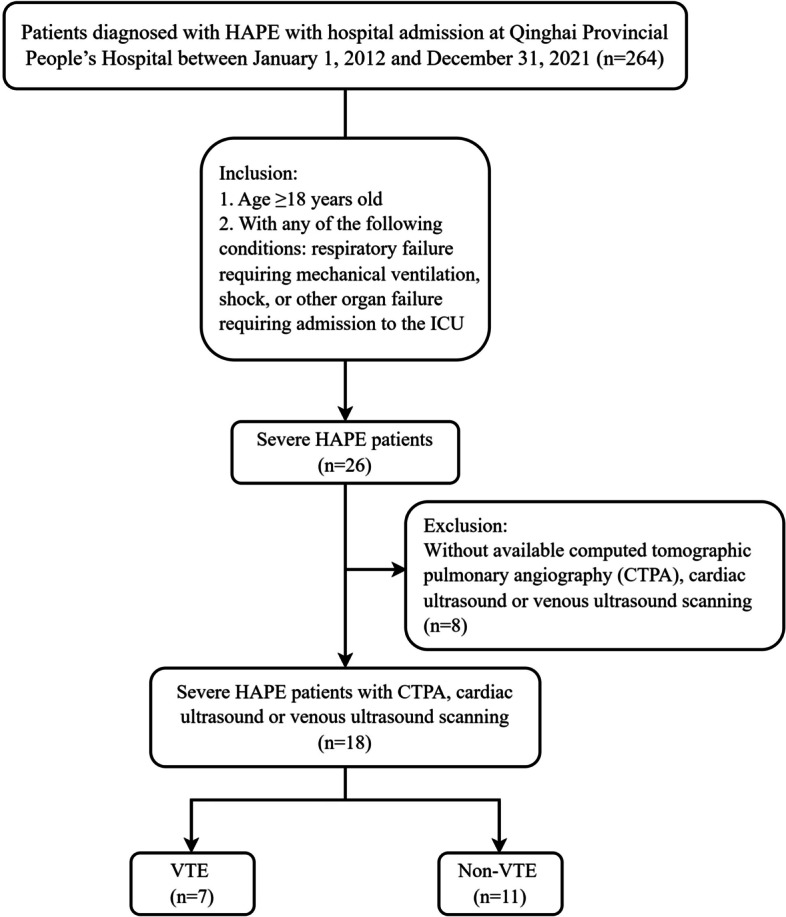
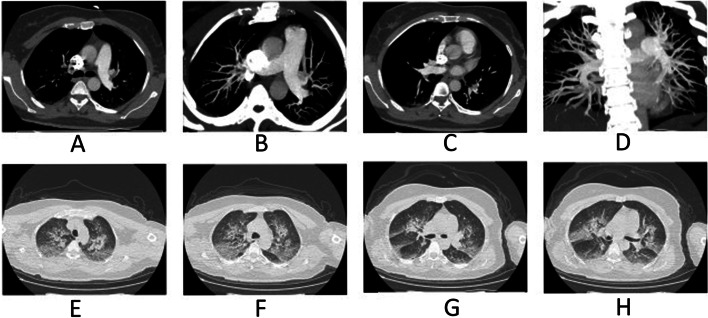
We studied a total of 18 patients with severe HAPE from January 1, 2012 to December 31, 2021. Demographic and clinical data, laboratory data, including ultrasound scans of the lower extremities and cardiac ultrasound, and computed tomographic pulmonary angiography (CTPA) variables were obtained, and comparisons were made between groups with and without VTE.
Of the 18 patients hospitalized with severe HAPE (age 43 (range, 34-54) years, 14 [77.8%] men), 7 patients developed VTE (38.9%), including 5 with deep vein thrombosis (DVT) and pulmonary embolism (PE), 2 of whom had DVT only. Eighteen patients are all firstly rapid ascent to high altitudes which the mean altitude was 3700 m (3656-4050 m). Compared with patients who did not have VTE, patients with VTE had a longer time in hospital (13 [11, 19] versus 9 [7, 12]; P = 0.027), respiratory failure (6 [85.7%] versus 2 [18.2%]; P = 0.013), the shortened APTT (21.50 [19.00, 27.50] versus 26.30 [24.80, 30.10]; P = 0.044) and the higher level of D-dimer (7.81 [4.62, 9.60] versus 2.90 [1.75, 3.37]; P = 0.003). The proportion of thromboprophylaxis is too low in our cohort which 2 of 18 (11.1%) patients were given VTE prophylaxis. There was no statistically significant difference between the VTE and non-VTE groups (0 [0.0%] versus 2 [18.2%]; P = 0.497).
The prevalence of VTE is high in hospitalized patients with severe high altitude pulmonary edema (HAPE). Prophylaxis for venous thromboembolism may be protective in severe HAPE patients after admission. Our data seem to suggest that VTE is probably an additional prognostic factors in patients with severe HAPE.
为了研究重度高原肺水肿(HAPE)住院患者的静脉血栓栓塞症(VTE),我们在高原地区的一个大型转诊和治疗中心进行了一项单中心回顾性研究,以评估其临床特征、预后及潜在的血栓预防策略。
我们研究了2012年1月1日至2021年12月31日期间共18例重度HAPE患者。获取了人口统计学和临床数据、实验室数据,包括下肢超声扫描和心脏超声,以及计算机断层肺动脉造影(CTPA)变量,并对有VTE和无VTE的两组患者进行了比较。
18例重度HAPE住院患者(年龄43岁(范围34 - 54岁),14例[77.8%]为男性)中,7例发生VTE(38.9%),其中5例有深静脉血栓形成(DVT)和肺栓塞(PE),2例仅有DVT。18例患者均为首次快速 ascent 到平均海拔3700米(3656 - 4050米)的高海拔地区。与未发生VTE的患者相比,发生VTE的患者住院时间更长(13天[11, 19天] vs 9天[7, 12天];P = 0.027)、呼吸衰竭发生率更高(6例[85.7%] vs 2例[18.2%];P = 0.013)、活化部分凝血活酶时间(APTT)缩短(21.50秒[19.00, 27.50秒] vs 26.30秒[24.80, 30.10秒];P = 0.044)以及D - 二聚体水平更高(7.81[4.62, 9.60] vs 2.90[1.75, 3.37];P = 0.003)。我们的队列中血栓预防的比例过低,18例患者中有2例(11.1%)接受了VTE预防。VTE组和非VTE组之间无统计学显著差异(0例[0.0%] vs 2例[18.2%];P = 0.497)。
重度高原肺水肿(HAPE)住院患者中VTE的患病率较高。入院后对重度HAPE患者进行静脉血栓栓塞预防可能具有保护作用。我们的数据似乎表明VTE可能是重度HAPE患者的一个额外预后因素。