Department of Mechanical and Aerospace Engineering, Jacob's School of Engineering, University of California San Diego, La Jolla, CA, USA.
Department of Cellular and Molecular Medicine, School of Medicine, University of California San Diego, La Jolla, CA, USA.
Mol Syst Biol. 2023 Apr 12;19(4):e11127. doi: 10.15252/msb.202211127. Epub 2023 Mar 1.
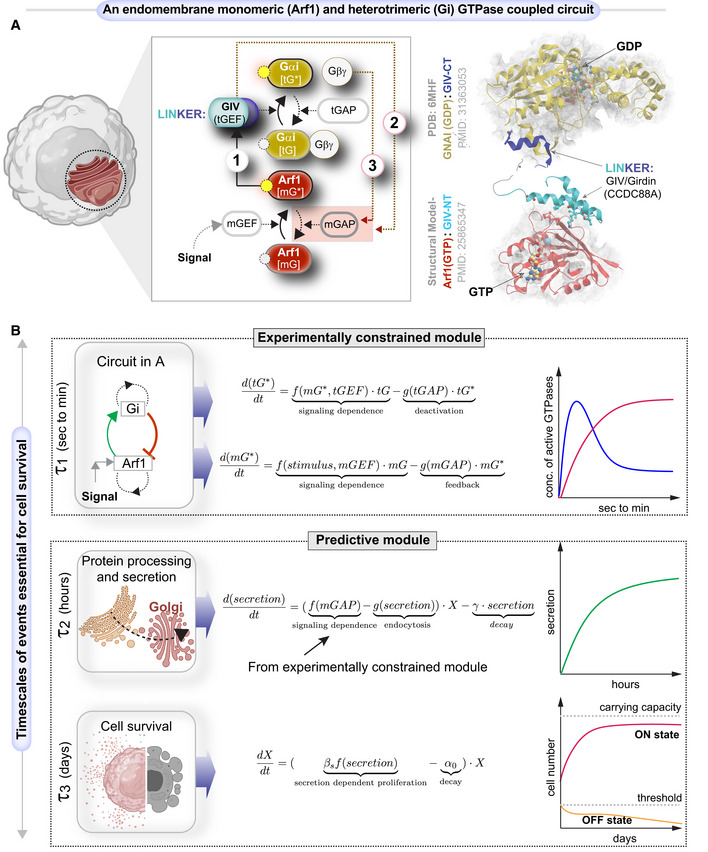
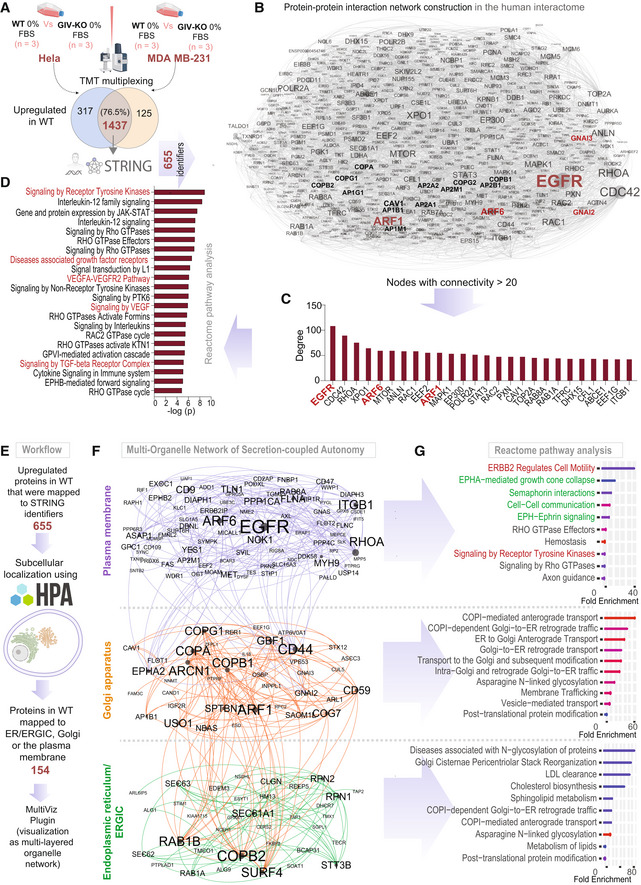
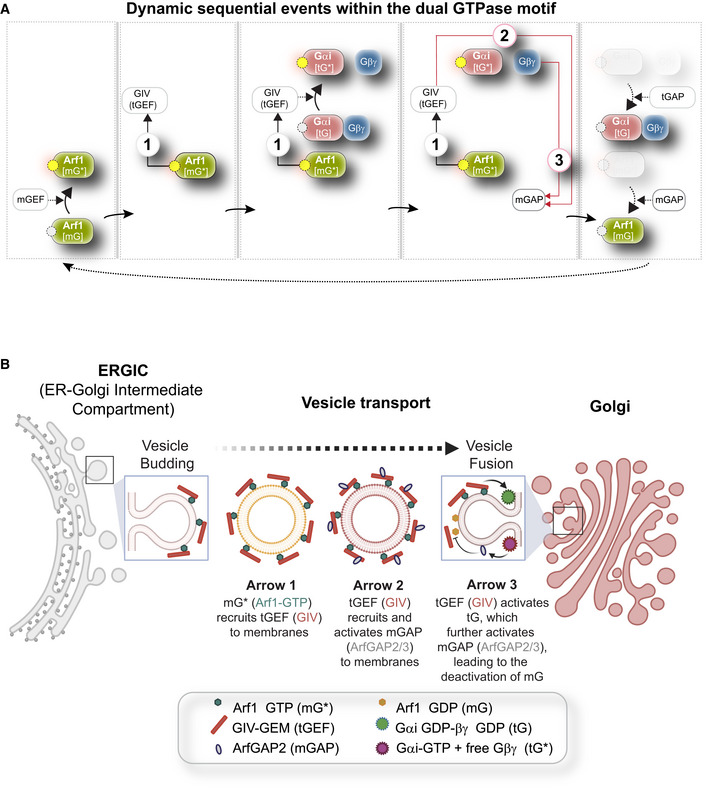
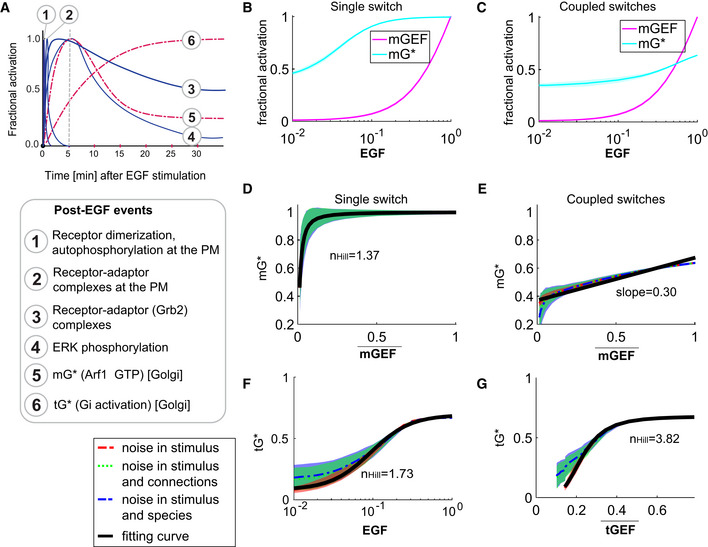
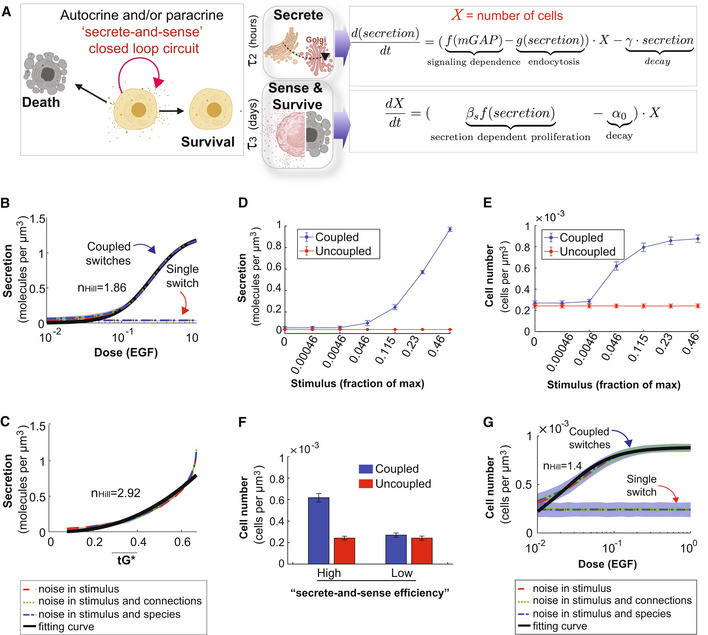
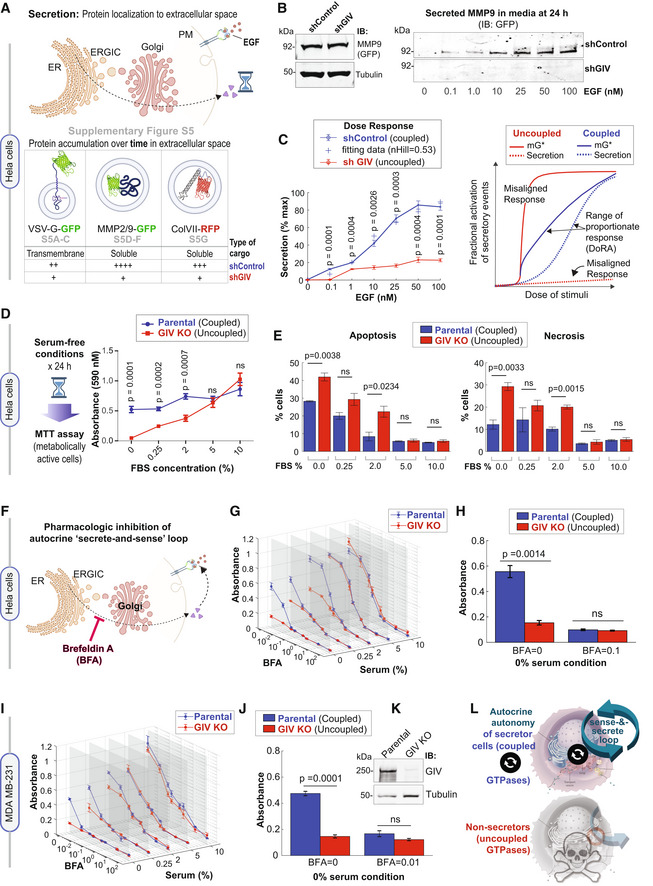
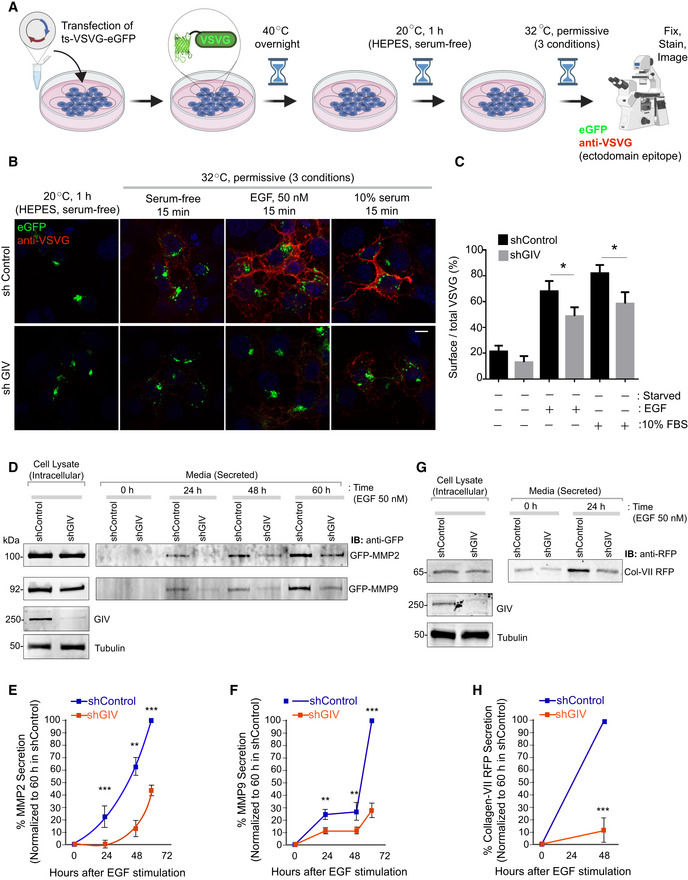
Cancers represent complex autonomous systems, displaying self-sufficiency in growth signaling. Autonomous growth is fueled by a cancer cell's ability to "secrete-and-sense" growth factors (GFs): a poorly understood phenomenon. Using an integrated computational and experimental approach, here we dissect the impact of a feedback-coupled GTPase circuit within the secretory pathway that imparts secretion-coupled autonomy. The circuit is assembled when the Ras-superfamily monomeric GTPase Arf1, and the heterotrimeric GTPase Giαβγ and their corresponding GAPs and GEFs are coupled by GIV/Girdin, a protein that is known to fuel aggressive traits in diverse cancers. One forward and two key negative feedback loops within the circuit create closed-loop control, allow the two GTPases to coregulate each other, and convert the expected switch-like behavior of Arf1-dependent secretion into an unexpected dose-response alignment behavior of sensing and secretion. Such behavior translates into cell survival that is self-sustained by stimulus-proportionate secretion. Proteomic studies and protein-protein interaction network analyses pinpoint GFs (e.g., the epidermal GF) as key stimuli for such self-sustenance. Findings highlight how the enhanced coupling of two biological switches in cancer cells is critical for multiscale feedback control to achieve secretion-coupled autonomy of growth factors.
癌症代表了复杂的自主系统,表现出自给自足的生长信号。自主生长是由癌细胞“分泌-感应”生长因子(GFs)的能力驱动的:这是一个尚未被充分理解的现象。本文采用综合计算和实验方法,剖析了分泌途径中反馈偶联 GTPase 回路对分泌偶联自主的影响。该回路由 Ras 家族单体 GTPase Arf1、异三聚体 GTPase Giαβγ 及其相应的 GAP 和 GEF 组装而成,GIV/Girdin 是一种已知能在多种癌症中促进侵袭性特征的蛋白质。回路中的一个正向和两个关键负反馈回路构成了闭环控制,允许两种 GTPase 相互调节,并将 Arf1 依赖性分泌的预期开关样行为转化为感应和分泌的意外剂量反应对准行为。这种行为转化为刺激比例分泌的自我维持的细胞存活。蛋白质组学研究和蛋白质-蛋白质相互作用网络分析指出,GFs(例如,表皮 GF)是这种自我维持的关键刺激物。研究结果强调了癌细胞中两个生物开关的增强偶联对于实现生长因子分泌偶联自主的多尺度反馈控制的重要性。