Biosafety, Air and Water Microbiology Group, United Kingdom Health Security Agency, Salisbury, United Kingdom.
Statistics, Modelling and Economics Department, United Kingdom Health Security Agency, United Kingdom.
Appl Environ Microbiol. 2023 Mar 29;89(3):e0174422. doi: 10.1128/aem.01744-22. Epub 2023 Mar 1.
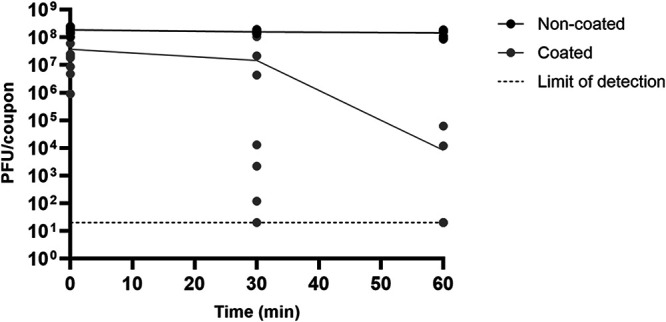
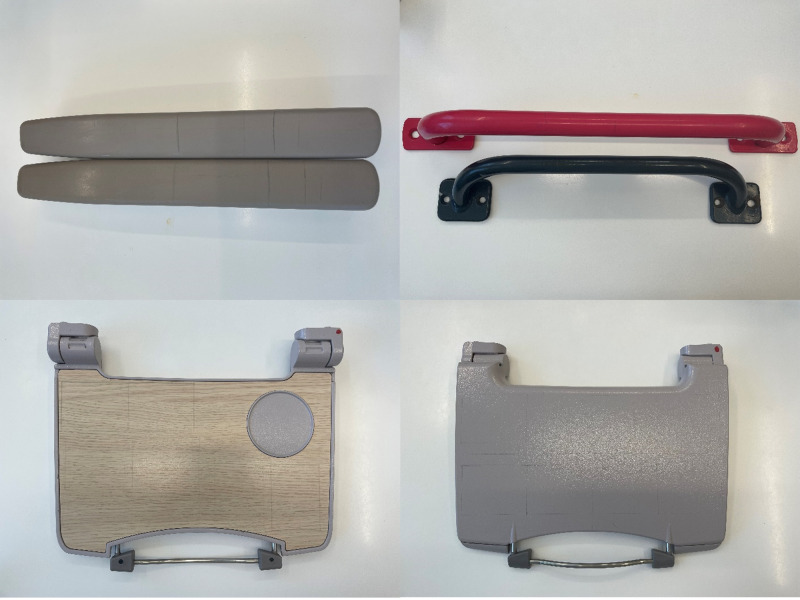
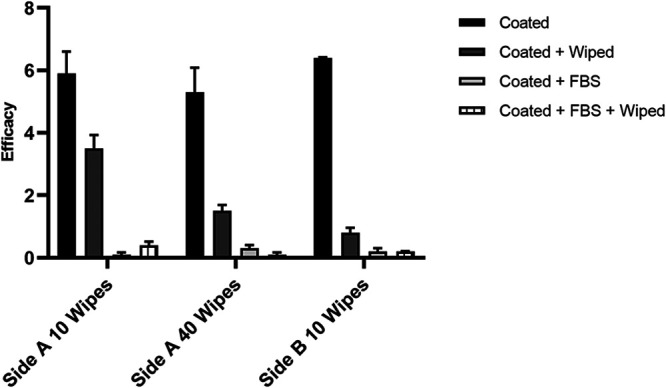
The virucidal activity of the Zoono Z71 Microbe Shield surface sanitizer and protectant, a quaternary ammonium compound (QAC)-based antimicrobial coating that was used by the United Kingdom rail industry during the COVID-19 pandemic, was evaluated, using the bacteriophage ɸ6 as a surrogate for SARS-CoV-2. Immediately after application and in the absence of interfering substances, the product effectively reduced (>3 log) the viability of ɸ6 on some materials that are typically used in rail carriages (stainless steel, high-pressure laminate, plastic). If, after the application of the product, these surfaces remained undisturbed, the antimicrobial coating retained its efficacy for at least 28 days. However, efficacy depended on the material being coated. The product provided inconsistent results when applied to glass surfaces and was ineffective (i.e., achieved <3 log reduction) when applied to a train arm rest that was made of Terluran 22. Regardless of the material that was coated or the time since application, the presence of organic debris (fetal bovine serum) significantly reduced the viricidal activity of the coating. Wiping the surface with a wetted cloth after the deposition of organic debris was not sufficient to restore efficacy. We conclude that the product is likely to be of limited effectiveness in a busy, multiuser environment, such as public transport. This study evaluated the performance of a commercially available antimicrobial coating that was used by the transport industry in the United Kingdom during the COVID-19 pandemic. While the product was effective against ɸ6, the efficacy of the coating depended upon the material to which it was applied. Similarly, and regardless of the surface material, the presence of organic debris severely impaired viricidal activity, and efficacy could not be recovered through wiping (cleaning) the surface. This highlights the importance of including relevant materials and conditions when evaluating antimicrobial coatings in the laboratory. Further efforts are required to identify suitable infection prevention and control practices for the transport industry.
Zoono Z71 微生物屏蔽表面消毒剂和保护剂的杀病毒活性进行了评估,该产品是一种季铵化合物 (QAC) 基抗菌涂层,在 COVID-19 大流行期间被英国铁路行业使用,使用噬菌体 ɸ6 作为 SARS-CoV-2 的替代物。在应用后立即且不存在干扰物质的情况下,该产品可有效降低(>3 对数)某些通常用于铁路车厢(不锈钢、高压层压板、塑料)的材料上 ɸ6 的存活率。如果产品应用后这些表面保持未被干扰,则抗菌涂层的功效至少可维持 28 天。然而,功效取决于被涂覆的材料。当应用于玻璃表面时,该产品的效果不一致,而当应用于由 Terluran 22 制成的火车扶手时,则无效(即,实现 <3 对数减少)。无论所涂覆的材料或应用后的时间如何,有机污垢(胎牛血清)的存在都会显著降低涂层的杀病毒活性。在有机污垢沉积后用湿布擦拭表面不足以恢复功效。我们得出结论,该产品在繁忙的多用户环境(如公共交通)中可能效果有限。本研究评估了一种在 COVID-19 大流行期间英国运输行业使用的市售抗菌涂层的性能。虽然该产品对 ɸ6 有效,但涂层的功效取决于所涂覆的材料。同样,无论表面材料如何,有机污垢的存在都会严重损害杀病毒活性,并且通过擦拭(清洁)表面无法恢复功效。这突出了在实验室评估抗菌涂层时包含相关材料和条件的重要性。需要进一步努力确定适合运输行业的感染预防和控制措施。