Department of Food, Bioprocessing and Nutrition Sciences, North Carolina State University, Raleigh, North Carolina, USA.
GOJO Industries, Inc., Akron, Ohio, USA.
Appl Environ Microbiol. 2022 Sep 13;88(17):e0080722. doi: 10.1128/aem.00807-22. Epub 2022 Aug 25.
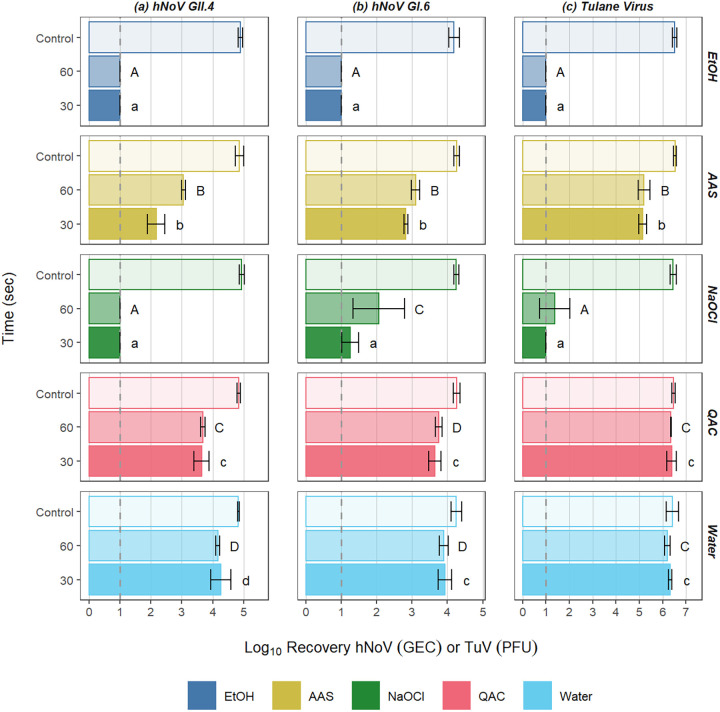
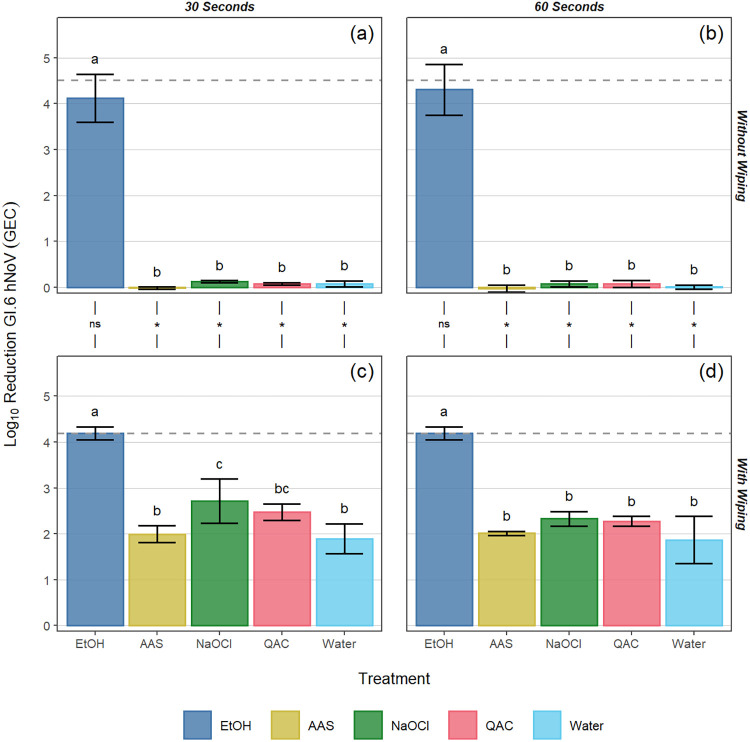
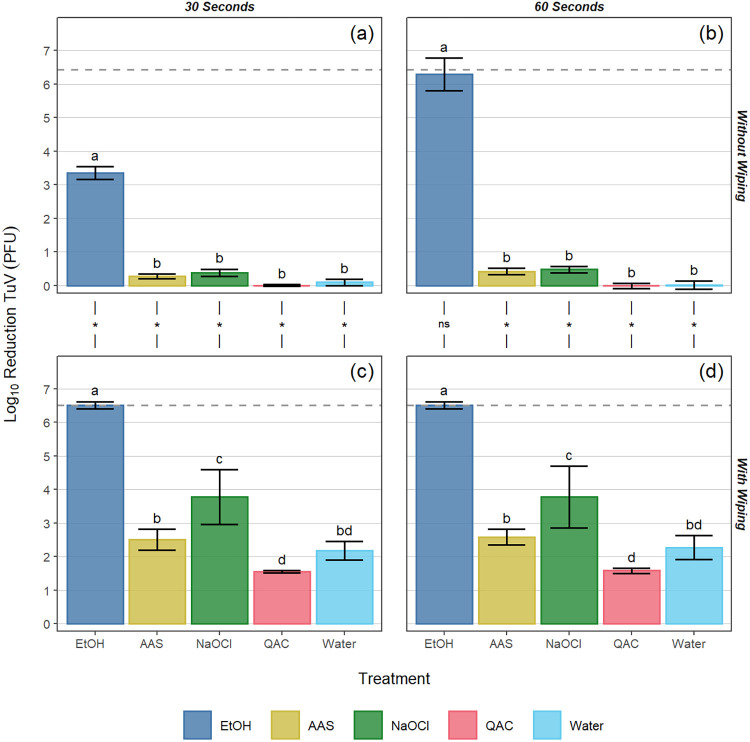
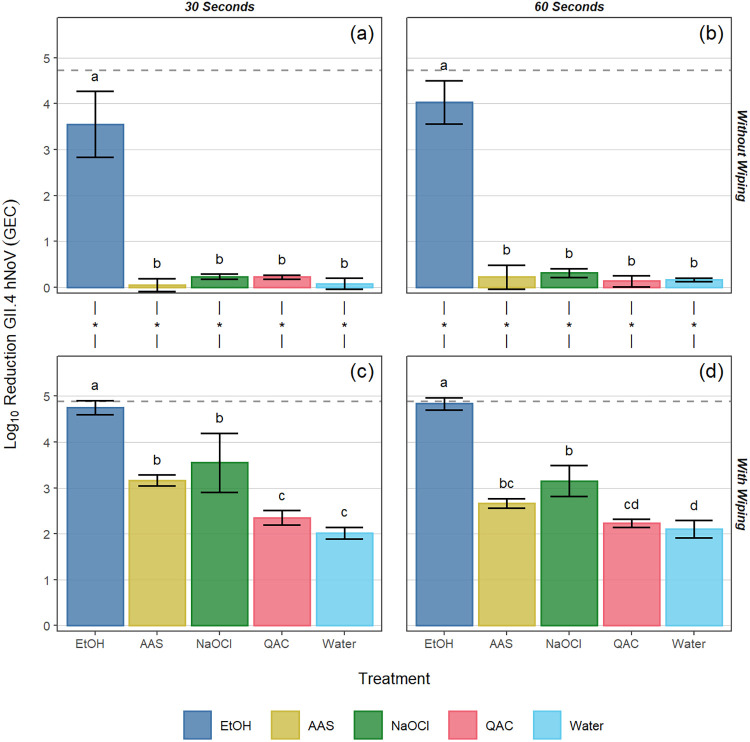
Commonly used surface sanitizers often lack activity against human noroviruses (hNoVs). The impact of inactivation versus removal when these products are applied via wiping is poorly characterized. The purpose of this work was to assess the anti-hNoV efficacy of various surface sanitizer chemistries, as applied to a laminate material commonly used for restaurant tabletops, using standard surface assays (ASTM E1053-11) and a newly developed wiping protocol. Four commercially available products with different active ingredient(s) (i.e., ethanol [EtOH], acid + anionic surfactant [AAS], quaternary ammonium compound [QAC], and sodium hypochlorite [NaOCl]) and a water control were evaluated against hNoV GII.4 Sydney, hNoV GI.6, and the cultivable surrogate Tulane virus (TuV). Virus concentration was evaluated using RNase-reverse transcriptase (RT)-quantitative PCR (qPCR) (hNoV) and infectivity assay (TuV). Only the EtOH-based product significantly reduced virus concentration (>3.5 log reduction [LR]) by surface assay, with all other products producing ≤0.5 LR. The inclusion of a wiping step enhanced the efficacy of all products, producing complete virus elimination for the EtOH-based product and 1.6 to 3.8 LR for the other chemistries. For hNoVs, no detectable residual virus could be recovered from paper towels used to wipe the EtOH-based product, while high concentrations of virus could be recovered from the used paper towel and the wiped coupon (1.5 to 2.5 log lower genome equivalent copies [GEC] compared to control) for the QAC- and AAS-based products and for water. These results illustrate the variability in anti-hNoV activity of representative surface sanitizers and highlights the value of wiping, the efficacy of which appears to be driven by a combination of virus inactivation and removal. Human noroviruses (hNoVs) are the leading cause of acute gastroenteritis and food-borne disease worldwide. Noroviruses are difficult to inactivate, being recalcitrant to sanitizers and disinfectants commonly used by the retail food sector. This comparative study demonstrates the variability in anti-hNoV activity of representative surface sanitizers, even those allowed to make label claims based on the cultivable surrogate, feline calicivirus (FCV). It also highlights the importance of wiping in the process of sanitization, which significantly improves product efficacy through the action of physical removal of surface microbes. There is a need for more and better product formulations with demonstrated efficacy against hNoVs, which will likely necessitate the use of alternative cultivable surrogates, such as Tulane virus (TuV). These findings help food safety professionals make informed decisions on sanitizing product selection and application methods in order to reduce the risk of hNoV contamination and transmission in their facilities.
常用的表面消毒剂通常缺乏对人类诺如病毒(hNoV)的活性。当这些产品通过擦拭应用时,其灭活与去除的影响特征描述较差。本研究的目的是评估各种表面消毒剂化学物质对常用于餐厅桌面的层压板材料的抗 hNoV 效果,使用标准表面分析(ASTM E1053-11)和新开发的擦拭方案。评估了四种市售的具有不同有效成分(即乙醇[EtOH]、酸+阴离子表面活性剂[AAS]、季铵化合物[QAC]和次氯酸钠[NaOCl])的产品以及水对照品对 hNoV GII.4 悉尼、hNoV GI.6 和可培养的替代物图兰病毒(TuV)的抗 hNoV 效果。使用 RNase-逆转录酶(RT)-定量 PCR(qPCR)(hNoV)和感染性测定(TuV)评估病毒浓度。仅基于 EtOH 的产品通过表面分析显著降低了病毒浓度(>3.5 对数减少[LR]),而其他所有产品的产量均≤0.5 LR。包含擦拭步骤可提高所有产品的功效,使基于 EtOH 的产品完全消除病毒,而其他化学物质的功效为 1.6 至 3.8 LR。对于 hNoVs,从用于擦拭基于 EtOH 的产品的纸巾中无法检测到残留的病毒,而从已使用的纸巾和擦拭券中可以回收高浓度的病毒(与对照相比,基因组当量拷贝[GEC]低 1.5 至 2.5 对数),对于基于 QAC 和 AAS 的产品和水也是如此。这些结果说明了代表性表面消毒剂抗 hNoV 活性的可变性,并强调了擦拭的重要性,其功效似乎是由病毒灭活和去除的共同作用驱动的。 人类诺如病毒(hNoVs)是全球急性胃肠炎和食源性疾病的主要原因。诺如病毒难以灭活,对零售食品行业常用的消毒剂和消毒剂具有抗药性。这项比较研究表明,即使是那些被允许根据可培养的替代物,猫杯状病毒(FCV),对标签声明的代表性表面消毒剂的抗 hNoV 活性也存在差异。它还强调了在消毒过程中擦拭的重要性,通过物理去除表面微生物,显著提高了产品功效。需要开发更多更好的产品配方,以证明其对 hNoVs 的功效,这可能需要使用替代的可培养替代品,例如图兰病毒(TuV)。这些发现有助于食品安全专业人员在选择和应用消毒产品时做出明智的决策,以降低其设施中 hNoV 污染和传播的风险。