Department of Obstetrics and Gynaecology, Amsterdam UMC, Vrije Universiteit Amsterdam, Amsterdam Reproduction & Development Research Institute, Amsterdam, the Netherlands.
Department of Obstetrics and Gynaecology, Amsterdam UMC, University of Amsterdam, Amsterdam Reproduction & Development Research Institute, Amsterdam, the Netherlands.
Hum Reprod Update. 2023 Jul 5;29(4):457-485. doi: 10.1093/humupd/dmad004.
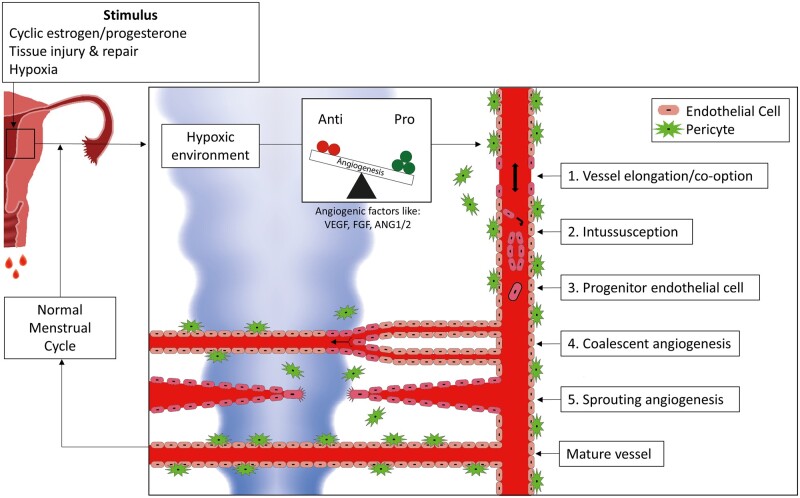
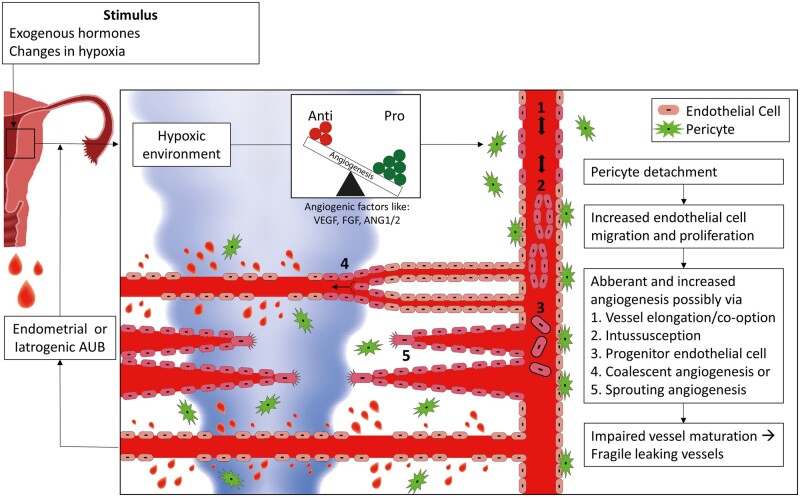
Abnormal uterine bleeding (AUB) has a significant socioeconomic impact since it considerably impacts quality of life. Therapeutic options are frequently based on trial and error and do not target disease aetiology. Pathophysiological insight in this disease is required for the development of novel treatment options. If no underlying cause is found for the AUB (e.g. fibroids, adenomyosis, polyps), endometrial-AUB (AUB-E) is usually caused by a primary endometrium disorder. When AUB is induced by prescribed (exogenous) hormones, it is classified as iatrogenic-AUB (AUB-I). Considering vascular modulation and function, AUB-E and AUB-I both could potentially result from abnormal vascularization in the endometrium due to alterations in the process of angiogenesis and vascular maturation.
We aim to investigate the fundamental role of angiogenesis and vascular maturation in patients with AUB and hypothesize that aberrant endometrial angiogenesis has an important role in the aetiology of both AUB-E and AUB-I, possibly through different mechanisms.
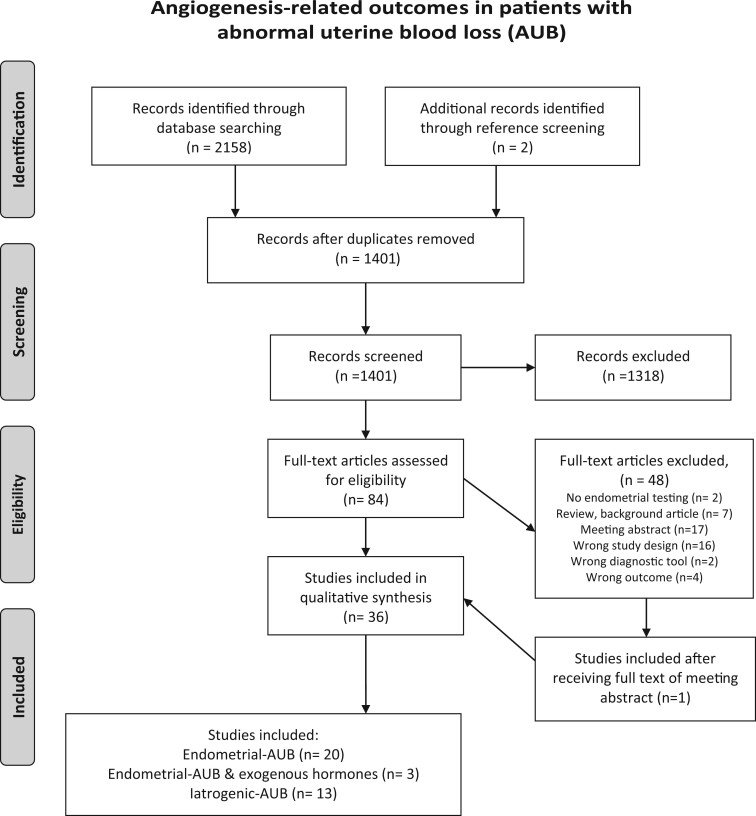
A systematic literature search was performed until September 2021 in the Cochrane Library Databases, Embase, PubMed, and Web of Science, with search terms such as angiogenesis and abnormal uterine bleeding. Included studies reported on angiogenesis in the endometrium of premenopausal women with AUB-E or AUB-I. Case reports, letters, reviews, editorial articles, and studies on AUB with causes classified by the International Federation of Gynecology and Obstetrics as myometrial, oncological, or infectious, were excluded. Study quality was assessed by risk of bias, using the Cochrane tool and the Newcastle-Ottawa Scale.
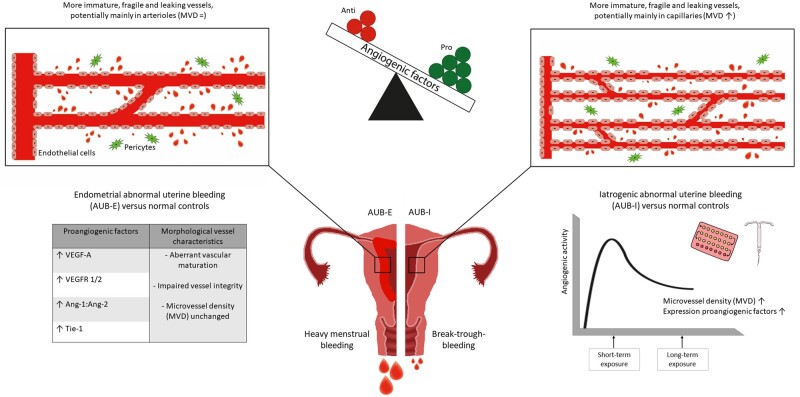
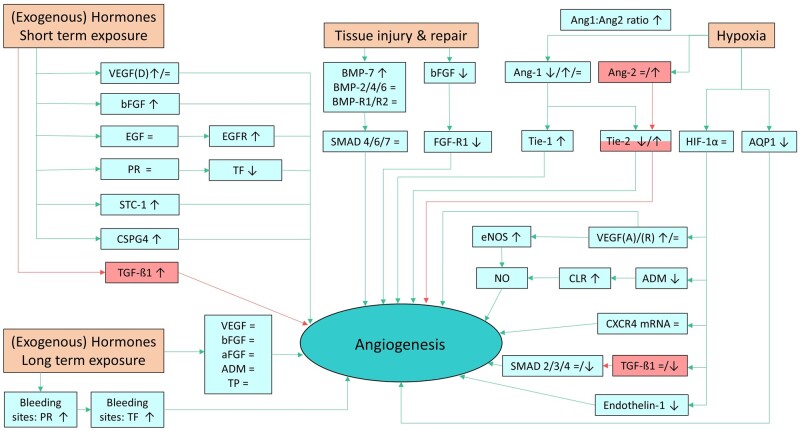
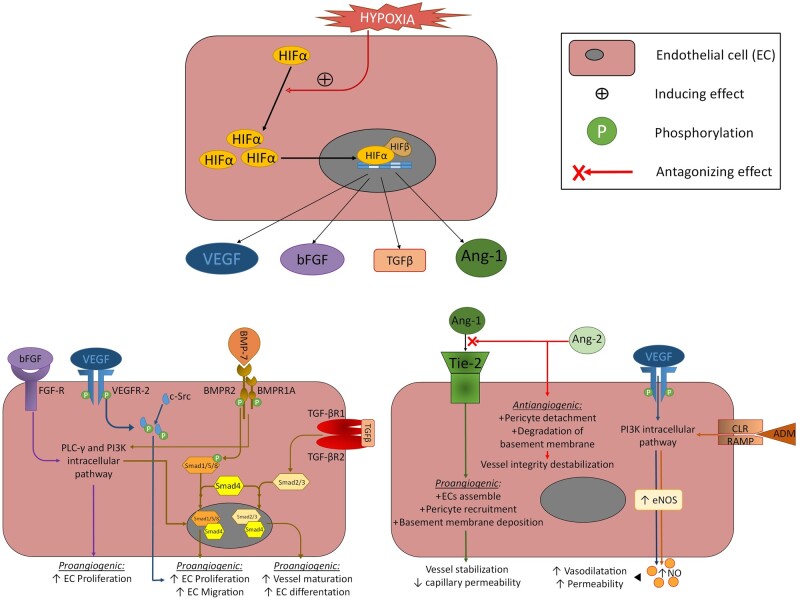
Thirty-five out of 2158 articles were included. In patients with AUB-E, vascular endothelial growth factor A and its receptors (1 and 2), as well as the angiopoietin-1:angiopoietin-2 ratio and Tie-1, were significantly increased. Several studies reported on the differential expression of other pro- and antiangiogenic factors in patients with AUB-E, suggesting aberrant vascular maturation and impaired vessel integrity. Overall, endometrial microvessel density (MVD) was comparable in patients with AUB-E and controls. Interestingly, patients with AUB-I showed a higher MVD and higher expression of proangiogenic factors when compared to controls, in particular after short-term hormone exposure. This effect was gradually lost after longer-term exposure, while alterations in vessel maturation were observed after both short- and long-term exposures.
AUB-E and AUB-I are most likely associated with aberrant endometrial angiogenesis and impaired vessel maturation. This review supports existing evidence that increased proangiogenic and decreased antiangiogenic factors cause impaired vessel maturation, resulting in more fragile and permeable vessels. This matches our hypothesis and these mechanisms appear to play an important role in the pathophysiology of AUB-E and AUB-I. Exploring the alterations in angiogenesis in these patients could provide treatment targets for AUB.
异常子宫出血(AUB)具有重大的社会经济影响,因为它极大地影响了生活质量。治疗选择通常基于反复试验,而不是针对疾病的病因。为了开发新的治疗方法,需要了解这种疾病的病理生理。如果找不到 AUB 的根本原因(例如肌瘤、腺肌病、息肉),通常是由子宫内膜 AUB(AUB-E)引起的,这是由原发性子宫内膜疾病引起的。当 AUB 由规定的(外源性)激素引起时,它被归类为医源性 AUB(AUB-I)。考虑到血管调节和功能,AUB-E 和 AUB-I 都可能由于血管生成和血管成熟过程的改变而导致子宫内膜异常血管化。
我们旨在研究血管生成和血管成熟在 AUB 患者中的基本作用,并假设异常子宫内膜血管生成在 AUB-E 和 AUB-I 的发病机制中都具有重要作用,可能通过不同的机制。
直到 2021 年 9 月,我们在 Cochrane 图书馆数据库、Embase、PubMed 和 Web of Science 中进行了系统的文献搜索,使用了血管生成和异常子宫出血等搜索词。纳入的研究报告了 AUB-E 或 AUB-I 绝经前妇女子宫内膜中的血管生成。排除了病例报告、信件、综述、社论文章和 AUB 研究,这些研究的病因分类为国际妇产科联合会的肌层、肿瘤或感染性。使用 Cochrane 工具和纽卡斯尔-渥太华量表评估研究质量。
从 2158 篇文章中筛选出 35 篇。在 AUB-E 患者中,血管内皮生长因子 A 及其受体(1 和 2)以及血管生成素-1:血管生成素-2 比值和 Tie-1 明显增加。一些研究报告了 AUB-E 患者中其他促血管生成和抗血管生成因子的差异表达,表明血管成熟异常和血管完整性受损。总体而言,AUB-E 患者和对照组的子宫内膜微血管密度(MVD)相似。有趣的是,与对照组相比,AUB-I 患者的 MVD 更高,促血管生成因子的表达更高,尤其是在短期激素暴露后。这种影响在长期暴露后逐渐消失,而在短期和长期暴露后都观察到血管成熟的改变。
AUB-E 和 AUB-I 很可能与异常的子宫内膜血管生成和血管成熟受损有关。本综述支持现有证据,即增加的促血管生成和减少的抗血管生成因子导致血管成熟受损,导致更脆弱和更具渗透性的血管。这与我们的假设相符,这些机制似乎在 AUB-E 和 AUB-I 的病理生理学中发挥了重要作用。探索这些患者中血管生成的改变可能为 AUB 提供治疗靶点。