Department of Epidemiology Research, Statens Serum Institut, Artillerivej 5, Copenhagen, Denmark.
BMC Neurol. 2023 Mar 1;23(1):90. doi: 10.1186/s12883-023-03108-7.
High parity and extremes of age at first birth have been linked with increased dementia risk in women, with exposure to pregnancy-associated physiological changes proposed as an explanation. However, confounding by socioeconomic and lifestyle factors could also produce such associations, whereby men would share similar patterns of association. We investigated whether these associations hold for both sexes.
In a cohort study including all women (N = 2,222,638) and men (N = 2,141,002) ≥ 40 years of age in 1994-2017 in Denmark, we used Cox regression to evaluate associations between number of children, age at first birth, and dementia risk separately for women and men.
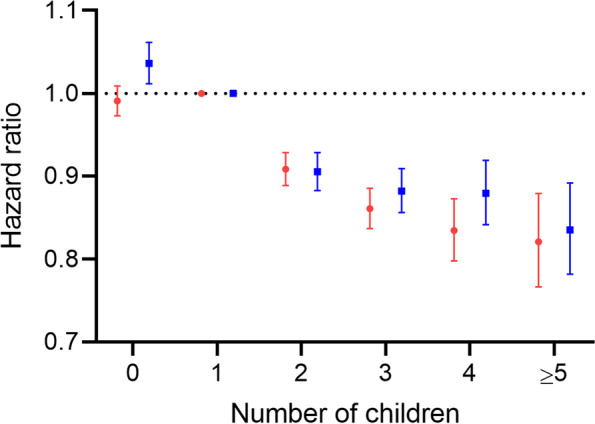
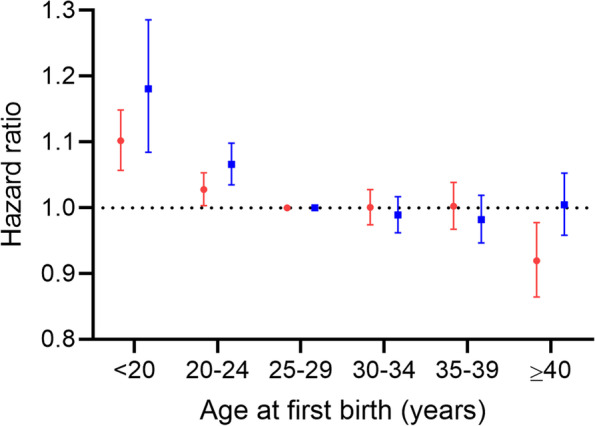
During follow-up, 81,413 women and 53,568 men (median age at diagnosis, 83.3 and 80.3 years, respectively) developed dementia. Compared with having one child, having two or more children was associated with modest decreases in overall dementia risk in both sexes (hazard ratio [HR] range 0.82-0.91, P = 0.07). Although the associations between childlessness and overall dementia risk differed statistically for men and women, the association magnitudes differed only slightly (HR 1.04, 95% confidence interval [CI] 1.01-1.06; HR 0.99, 95% CI 0.97-1.01; P = 0.002). Associations between age at becoming a parent and overall dementia were also similar for women and men, with the exception of older (≥ 40 years) first-time parents (HR 1.00, 95% CI 0.96-1.05; HR 0.92, 95% CI 0.86-0.98; P = 0.01). With few exceptions, sub-analyses by dementia subtype and timing of onset also revealed similar patterns and effect magnitudes for women and men.
Associations between number of children, age at becoming a parent, and dementia risk were similar for both sexes. Lifestyle and socioeconomic factors are more likely to explain the observed associations than normal pregnancy-related physiological changes.
初产年龄较高和极高的生育胎次与女性痴呆风险增加有关,据推测这与妊娠相关的生理变化有关。然而,社会经济和生活方式因素的混杂也可能产生这种关联,男性也会出现类似的关联模式。我们研究了这些关联是否同时适用于男性和女性。
在丹麦,我们对 1994 年至 2017 年期间所有年龄≥40 岁的女性(N=2222638 人)和男性(N=2141002 人)进行了队列研究,使用 Cox 回归分别评估了女性和男性的生育子女数、初产年龄与痴呆风险之间的关系。
在随访期间,81413 名女性和 53568 名男性(诊断时的中位年龄分别为 83.3 岁和 80.3 岁)患上了痴呆症。与生育一个子女相比,生育两个或更多子女与两性的总体痴呆风险适度降低相关(风险比范围为 0.82-0.91,P=0.07)。虽然无子女性和总体痴呆风险之间的关联在统计学上存在差异,但关联程度差异很小(风险比 1.04,95%置信区间为 1.01-1.06;风险比 0.99,95%置信区间为 0.97-1.01;P=0.002)。女性和男性的初产年龄与总体痴呆症之间的关联也相似,除了高龄(≥40 岁)初产妇外(风险比 1.00,95%置信区间为 0.96-1.05;风险比 0.92,95%置信区间为 0.86-0.98;P=0.01)。除了少数例外情况,痴呆症亚型和发病时间的亚组分析也揭示了女性和男性相似的模式和效应大小。
生育子女数、初产年龄与痴呆风险之间的关联在两性中相似。生活方式和社会经济因素更有可能解释观察到的关联,而不是正常妊娠相关的生理变化。