Benjoe Institute of Systems Bio-Engineering, High Technology Park, Xinbei District, Changzhou, 213022, Jiangsu, People's Republic of China.
Department of Health Management, Centre of General Practice, The Seventh Affiliated Hospital, Southern Medical University, No. 28, Desheng Road Section, Liguan Road, Lishui Town, Nanhai District, Foshan, 528000, Guangdong, People's Republic of China.
Mol Biotechnol. 2023 Oct;65(10):1565-1584. doi: 10.1007/s12033-023-00699-x. Epub 2023 Mar 1.
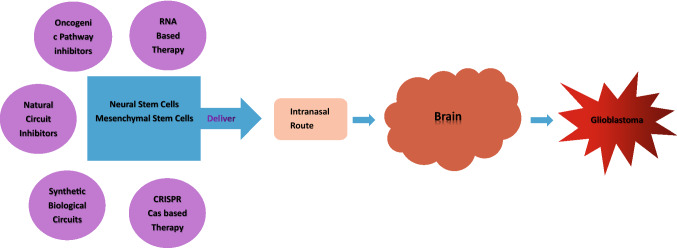
Glioblastoma (GBM) is a malignant cancer that is fatal even after standard therapy and the effects of current available therapeutics are not promising due its complex and evolving epigenetic and genetic profile. The mysteries that lead to GBM intratumoral heterogeneity and subtype transitions are not entirely clear. Systems medicine is an approach to view the patient in a whole picture integrating systems biology and synthetic biology along with computational techniques. Since the GBM oncogenesis involves genetic mutations, various therapies including gene therapeutics based on CRISPR-Cas technique, MicroRNAs, and implanted synthetic cells endowed with synthetic circuits against GBM with neural stem cells and mesenchymal stem cells acting as potential vehicles carrying therapeutics via the intranasal route, avoiding the risks of invasive methods in order to reach the GBM cells in the brain are discussed and proposed in this review. Systems medicine approach is a rather novel strategy, and since the GBM of a patient is complex and unique, thus to devise an individualized treatment strategy to tailor personalized multimodal treatments for the individual patient taking into account the phenotype of the GBM, the unique body health profile of the patient and individual responses according to the systems medicine concept might show potential to achieve optimum effects.
胶质母细胞瘤(GBM)是一种致命的癌症,即使在标准治疗后,目前可用的治疗方法的效果也并不理想,因为其具有复杂且不断演变的表观遗传和遗传特征。导致 GBM 肿瘤内异质性和亚型转变的奥秘尚不完全清楚。系统医学是一种将患者视为整体的方法,它整合了系统生物学和合成生物学以及计算技术。由于 GBM 的发生涉及基因突变,因此各种治疗方法,包括基于 CRISPR-Cas 技术的基因治疗、MicroRNAs 和植入具有合成回路的合成细胞,与神经干细胞和间充质干细胞一起针对 GBM 进行治疗,作为潜在的载体,通过鼻内途径携带治疗药物,避免了侵入性方法的风险,以便到达大脑中的 GBM 细胞,在这篇综述中进行了讨论和提出。系统医学方法是一种相当新颖的策略,由于患者的 GBM 是复杂且独特的,因此制定个体化治疗策略,根据系统医学概念为个体患者量身定制多模式个性化治疗,考虑到 GBM 的表型、患者独特的身体健康状况和个体反应,可能有潜力达到最佳效果。