
与多发性硬化症相关的炎症细胞因子直接诱导人神经元细胞结构的改变。
Inflammatory Cytokines Associated with Multiple Sclerosis Directly Induce Alterations of Neuronal Cytoarchitecture in Human Neurons.
机构信息
Experimental and Clinical Research Center (ECRC), Charité - Universitätsmedizin Berlin und Max Delbrück Center for Molecular Medicine in the Helmholtz Association Berlin, Lindenberger Weg 80, 13125, Berlin, Germany.
Department of Neurology, Charité - Universitätsmedizin Berlin, corporate member of Freie Universität Berlin, Humbolt-Universität Zu Berlin, and Berlin Institute of Health, 10117, Berlin, Germany.
出版信息
J Neuroimmune Pharmacol. 2023 Jun;18(1-2):145-159. doi: 10.1007/s11481-023-10059-w. Epub 2023 Mar 2.
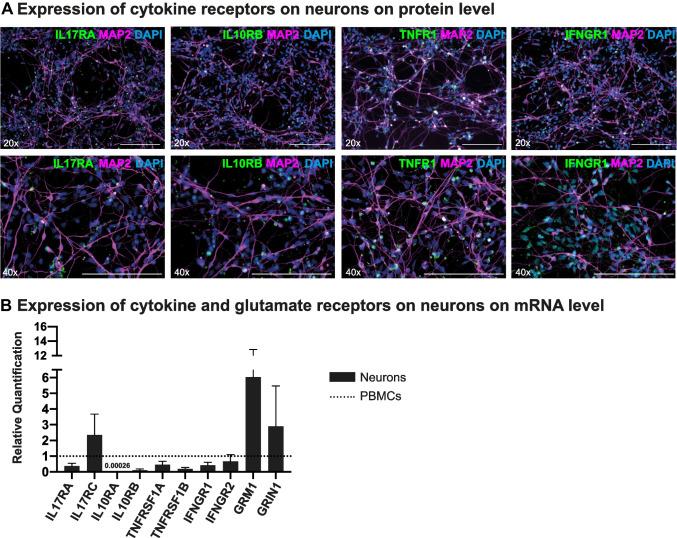
Multiple sclerosis (MS) is a chronic inflammatory disease of the central nervous system (CNS) coined by inflammation and neurodegeneration. The actual cause of the neurodegenerative component of the disease is however unclear. We investigated here the direct and differential effects of inflammatory mediators on human neurons. We used embryonic stem cell-derived (H9) human neuronal stem cells (hNSC) to generate neuronal cultures. Neurons were subsequently treated with tumour necrosis factor alpha (TNFα), interferon gamma (IFNγ), granulocyte-macrophage colony-stimulating factor (GM-CSF), interleukin 17A (IL-17A) and interleukin 10 (IL-10) separately or in combination. Immunofluorescence staining and quantitative polymerase chain reaction (qPCR) were used to assess cytokine receptor expression, cell integrity and transcriptomic changes upon treatment. H9-hNSC-derived neurons expressed cytokine receptors for IFNγ, TNFα, IL-10 and IL-17A. Neuronal exposure to these cytokines resulted in differential effects on neurite integrity parameters with a clear decrease for TNFα- and GM-CSF-treated neurons. The combinatorial treatment with IL-17A/IFNγ or IL-17A/TNFα induced a more pronounced effect on neurite integrity. Furthermore, combinatorial treatments with two cytokines induced several key signalling pathways, i.e. NFκB-, hedgehog and oxidative stress signalling, stronger than any of the cytokines alone. This work supports the idea of immune-neuronal crosstalk and the need to focus on the potential role of inflammatory cytokines on neuronal cytoarchitecture and function.
多发性硬化症(MS)是一种中枢神经系统(CNS)的慢性炎症性疾病,由炎症和神经退行性变引起。然而,这种疾病神经退行性成分的确切原因尚不清楚。我们在这里研究了炎症介质对人神经元的直接和差异影响。我们使用胚胎干细胞衍生的(H9)人神经干细胞(hNSC)生成神经元培养物。随后用肿瘤坏死因子 alpha(TNFα)、干扰素 gamma(IFNγ)、粒细胞-巨噬细胞集落刺激因子(GM-CSF)、白细胞介素 17A(IL-17A)和白细胞介素 10(IL-10)分别或联合处理神经元。免疫荧光染色和定量聚合酶链反应(qPCR)用于评估细胞因子受体表达、细胞完整性和处理后的转录组变化。H9-hNSC 衍生的神经元表达 IFNγ、TNFα、IL-10 和 IL-17A 的细胞因子受体。神经元暴露于这些细胞因子会导致神经突完整性参数的差异,TNFα 和 GM-CSF 处理的神经元明显减少。IL-17A/IFNγ 或 IL-17A/TNFα 的联合处理对神经突完整性的影响更为明显。此外,两种细胞因子的联合处理诱导了几个关键信号通路,即 NFκB、 hedgehog 和氧化应激信号通路,比任何一种细胞因子单独处理都要强。这项工作支持免疫-神经元相互作用的观点,并需要关注炎症细胞因子对神经元细胞结构和功能的潜在作用。




 Zotero 插件