Department of Civil, Construction and Environmental Engineering North Dakota State University, Fargo, ND 58108, United States of America.
Biofabrication. 2023 Mar 17;15(2):025017. doi: 10.1088/1758-5090/acc09a.
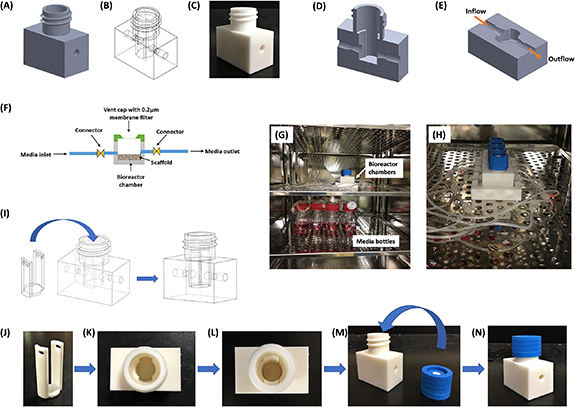
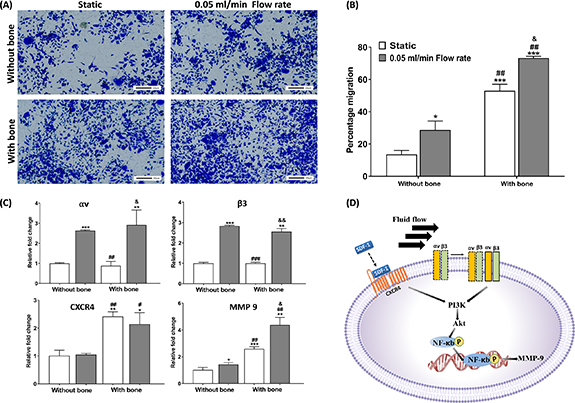
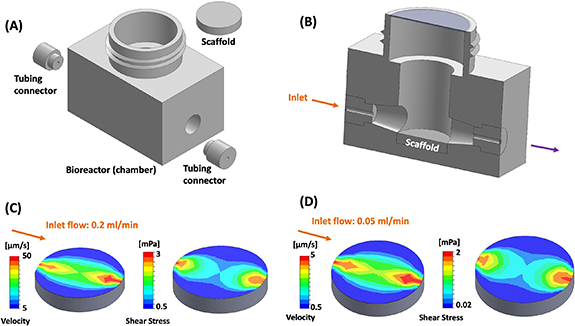
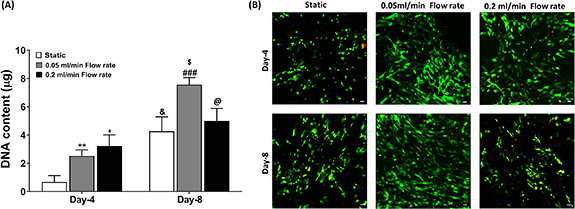
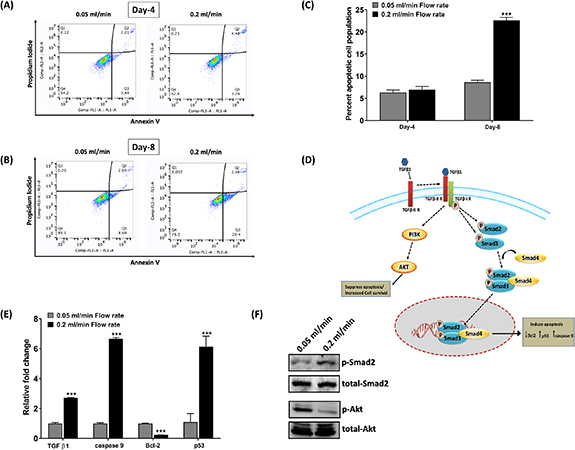
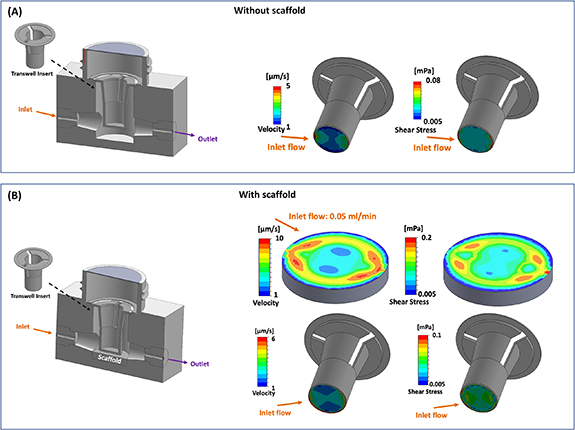
Prostate cancer bone metastasis is the leading cause of cancer-related mortality in men in the United States, causing severe damage to skeletal tissue. The treatment of advanced-stage prostate cancer is always challenging due to limited drug treatment options, resulting in low survival rates. There is a scarcity of knowledge regarding the mechanisms associated with the effects of biomechanical cues by the interstitial fluid flow on prostate cancer cell growth and migration. We have designed a novel bioreactor system to demonstrate the impact of interstitial fluid flow on the migration of prostate cancer cells to the bone during extravasation. First, we demonstrated that a high flow rate induces apoptosis in PC3 cells via TGF-1 mediated signaling; thus, physiological flow rate conditions are optimum for cell growth. Next, to understand the role of interstitial fluid flow in prostate cancer migration, we evaluated the migration rate of cells under static and dynamic conditions in the presence or absence of bone. We report that CXCR4 levels were not significantly changed under static and dynamic conditions, indicating that CXCR4 activation in PC3 cells is not influenced by flow conditions but by the bone, where CXCR4 levels were upregulated. The bone-upregulated CXCR4 levels led to increased MMP-9 levels resulting in a high migration rate in the presence of bone. In addition, upregulated levels ofintegrins under fluid flow conditions contributed to an overall increase in the migration rate of PC3 cells. Overall, this study demonstrates the potential role of interstitial fluid flow in prostate cancer invasion. Understanding the critical role of interstitial fluid flow in promoting prostate cancer cell progression will enhance current therapies for advanced-stage prostate cancer and provide improved treatment options for patients.
前列腺癌骨转移是导致美国男性癌症相关死亡的主要原因,会对骨骼组织造成严重破坏。晚期前列腺癌的治疗一直具有挑战性,因为药物治疗选择有限,导致生存率较低。对于间质液流动对前列腺癌细胞生长和迁移的生物力学线索的影响相关机制,我们的了解还很有限。我们设计了一种新型生物反应器系统,以证明间质液流动在前列腺癌细胞外渗过程中向骨骼迁移的影响。首先,我们证明了高流速通过 TGF-β1 介导的信号诱导 PC3 细胞凋亡;因此,生理流速条件最有利于细胞生长。接下来,为了了解间质液流动在前列腺癌迁移中的作用,我们评估了在存在或不存在骨骼的情况下,静态和动态条件下细胞的迁移率。我们报告说,静态和动态条件下 CXCR4 水平没有明显变化,表明 CXCR4 在 PC3 细胞中的激活不受流动条件的影响,而是受骨骼的影响,骨骼中 CXCR4 水平上调。骨上调的 CXCR4 水平导致 MMP-9 水平升高,从而在存在骨骼的情况下导致迁移率升高。此外,在流体流动条件下整合素水平的上调导致 PC3 细胞迁移率总体增加。总的来说,这项研究表明间质液流动在前列腺癌侵袭中的潜在作用。了解间质液流动在促进前列腺癌细胞进展中的关键作用将增强晚期前列腺癌的现有治疗方法,并为患者提供更好的治疗选择。