Department of Psychology, University of East London, London, E15 4LZ, UK.
LPNC/CNRS, Grenoble Alpes University, Grenoble, France.
Sci Rep. 2023 Mar 2;13(1):3555. doi: 10.1038/s41598-023-28988-0.
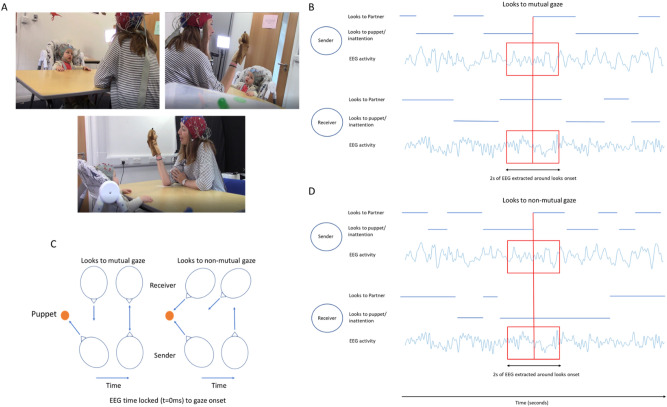
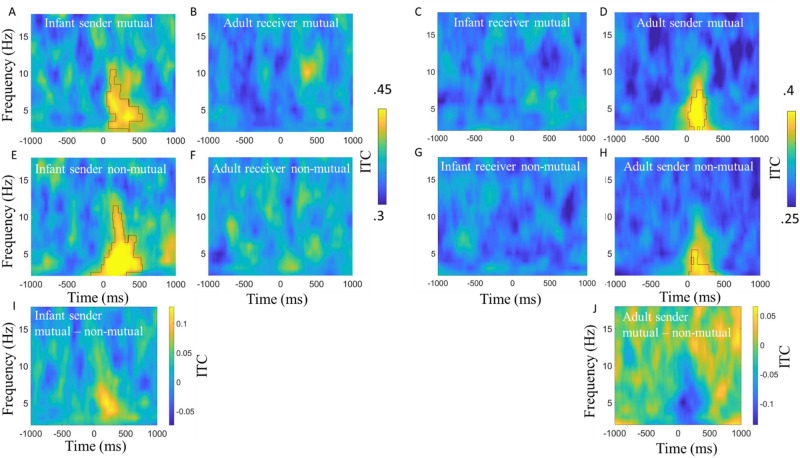
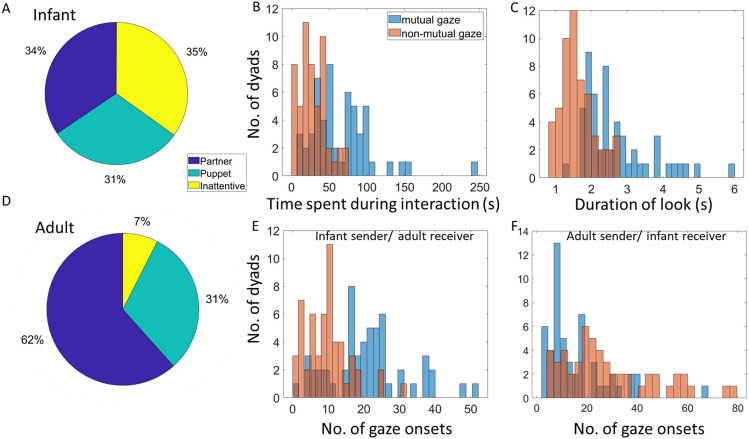
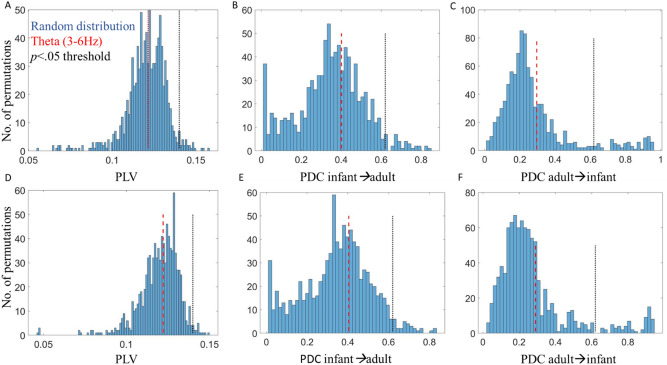
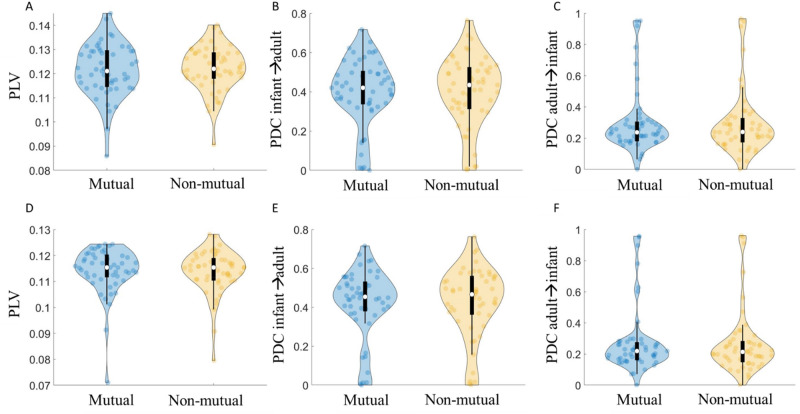
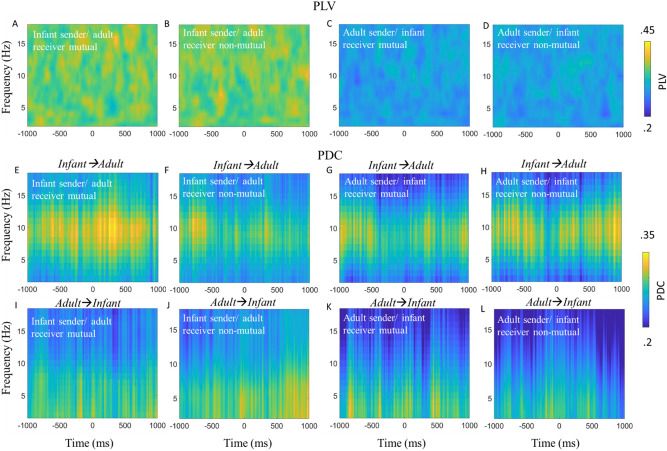
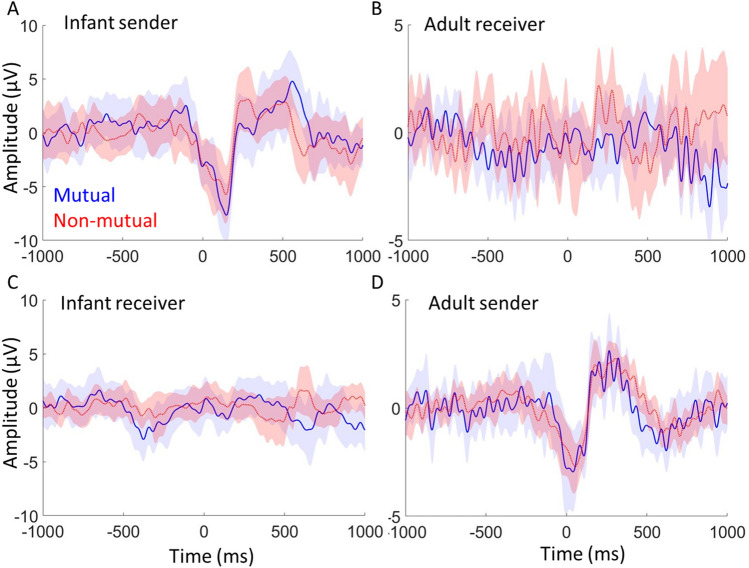
Temporal coordination during infant-caregiver social interaction is thought to be crucial for supporting early language acquisition and cognitive development. Despite a growing prevalence of theories suggesting that increased inter-brain synchrony associates with many key aspects of social interactions such as mutual gaze, little is known about how this arises during development. Here, we investigated the role of mutual gaze onsets as a potential driver of inter-brain synchrony. We extracted dual EEG activity around naturally occurring gaze onsets during infant-caregiver social interactions in N = 55 dyads (mean age 12 months). We differentiated between two types of gaze onset, depending on each partners' role. 'Sender' gaze onsets were defined at a time when either the adult or the infant made a gaze shift towards their partner at a time when their partner was either already looking at them (mutual) or not looking at them (non-mutual). 'Receiver' gaze onsets were defined at a time when their partner made a gaze shift towards them at a time when either the adult or the infant was already looking at their partner (mutual) or not (non-mutual). Contrary to our hypothesis we found that, during a naturalistic interaction, both mutual and non-mutual gaze onsets were associated with changes in the sender, but not the receiver's brain activity and were not associated with increases in inter-brain synchrony above baseline. Further, we found that mutual, compared to non-mutual gaze onsets were not associated with increased inter brain synchrony. Overall, our results suggest that the effects of mutual gaze are strongest at the intra-brain level, in the 'sender' but not the 'receiver' of the mutual gaze.
在婴儿-照顾者的社会互动中,时间协调被认为对支持早期语言习得和认知发展至关重要。尽管越来越多的理论表明,大脑间同步增加与许多关键的社会互动方面有关,如相互注视,但人们对这种同步如何在发展过程中产生知之甚少。在这里,我们研究了相互注视的开始作为大脑间同步的潜在驱动因素的作用。我们从 55 对(平均年龄 12 个月)婴儿-照顾者社会互动中自然发生的注视开始时提取了双 EEG 活动。我们根据每个参与者的角色,将注视开始分为两种类型。“发送者”注视开始是指在成人或婴儿向其伙伴转移目光时,其伙伴要么已经在看他们(相互),要么没有看他们(非相互)。“接收者”注视开始是指当他们的伙伴向他们转移目光时,他们的伙伴要么已经在看他们(相互),要么没有看他们(非相互)。与我们的假设相反,我们发现,在自然互动中,无论是相互还是非相互的注视开始都与发送者的大脑活动变化有关,而与接收者的大脑活动变化无关,也与大脑间同步的增加无关。此外,我们发现,与非相互的注视开始相比,相互的注视开始与大脑间同步的增加无关。总的来说,我们的结果表明,相互注视的影响在大脑内部的“发送者”,而不是“接收者”,最强。