Acquier Mathieu, Zabala Arnaud, de Précigout Valérie, Delmas Yahsou, Dubois Véronique, de la Faille Renaud, Rubin Sébastien, Combe Christian, M'Zali Fatima, Kaminski Hannah
Service de Néphrologie-Transplantation-Dialyse-Aphérèses, Hôpital Pellegrin, CHU de Bordeaux, Bordeaux, France.
UMR 5234 CNRS, Université de Bordeaux, Bordeaux, France.
Clin Kidney J. 2022 Oct 29;16(3):494-500. doi: 10.1093/ckj/sfac242. eCollection 2023 Mar.
Catheter-related bloodstream infections (CRBIs) remain a major cause of mortality in haemodialysis (HD) patients with central venous catheters (CVCs), especially because of the non-specific symptomatology and the delay in microbiological diagnosis with possible use of non-optimal empiric antibiotics. Moreover, empiric broad-spectrum antibiotics increase antibiotic resistance development. This study aims to evaluate the diagnostic performance of real-time polymerase chain reaction (rt-PCR) in suspected HD CRBIs compared with blood cultures.
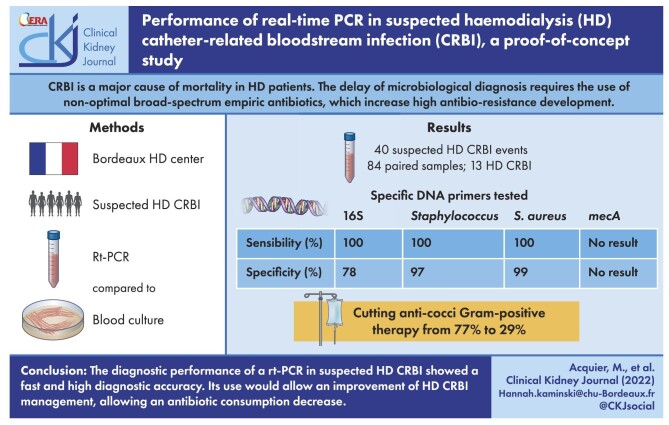
A blood sample for rt-PCR was collected simultaneously with each pair of blood cultures for suspected HD CRBI. The rt-PCR was performed on the whole blood, without any enrichment stage and with specific DNA primers: 16S (universal bacterial), spp., and . Each successive patient with a suspected HD CRBI in the HD centre of Bordeaux University Hospital was included. Performance tests were used to compare the result obtained in each rt-PCR assay with its corresponding routine blood culture.
Eighty-four paired samples were collected and compared for 40 suspected HD CRBI events in 37 patients. Among these, 13 (32.5%) were diagnosed as HD CRBI. All rt-PCRs except (insufficient number of positive samples) showed high diagnostic performances within 3.5 h: 16S (sensitivity 100%, specificity 78%), spp. (sensitivity 100%, specificity 97%), (sensitivity 100%, specificity 99%). Based on the rt-PCR results, antibiotics could be more appropriately targeted, thus cutting anti-cocci Gram-positive therapy from 77% to 29%.
The performance of rt-PCR in suspected HD CRBI events showed fast and high diagnostic accuracy. Its use would improve HD CRBI management with an antibiotic consumption decrease.
导管相关血流感染(CRBIs)仍然是接受中心静脉导管(CVCs)的血液透析(HD)患者死亡的主要原因,特别是由于症状不具特异性以及微生物诊断延迟,可能导致使用非最佳经验性抗生素。此外,经验性广谱抗生素会增加抗生素耐药性的产生。本研究旨在评估实时聚合酶链反应(rt-PCR)在疑似血液透析CRBIs中的诊断性能,并与血培养进行比较。
对于疑似血液透析CRBI,在采集每对血培养样本的同时采集一份用于rt-PCR的血样。rt-PCR在全血上进行,无需任何富集阶段,并使用特异性DNA引物:16S(通用细菌)、 属、 和 。波尔多大学医院血液透析中心每例疑似血液透析CRBI的连续患者均纳入研究。使用性能测试将每个rt-PCR检测结果与其相应的常规血培养结果进行比较。
共采集了84对样本,对37例患者中的40起疑似血液透析CRBI事件进行了比较。其中,13例(32.5%)被诊断为血液透析CRBI。除 (阳性样本数量不足)外,所有rt-PCR在3.5小时内均显示出高诊断性能:16S(敏感性100%,特异性78%)、 属(敏感性100%,特异性97%)、 (敏感性100%,特异性99%)。根据rt-PCR结果,可以更合理地使用抗生素,从而将抗革兰氏阳性球菌治疗从77%降至29%。
rt-PCR在疑似血液透析CRBI事件中的表现显示出快速且高的诊断准确性。其应用将改善血液透析CRBI的管理并减少抗生素使用。