Herrera-Añazco Percy, Mougenot Benoit, Benites-Meza Jerry K, Barturén-Alvarado Luz C, Zumarán-Nuñez Carlos J, Boyd-Gamarra Maria A, Runzer-Colmenares Fernando M, Benites-Zapata Vicente A
Facultad de Ciencias de la Salud, Universidad Privada del Norte, Trujillo, Peru.
Red Internacional en Salud Colectiva y Salud Intercultural, Mexico City, Mexico.
Can Geriatr J. 2023 Mar 1;26(1):187-199. doi: 10.5770/cgj.26.631. eCollection 2023 Mar.
Older adults are a particularly vulnerable group to drug use and self-medication. The aim of the study was to evaluate self-medication as a factor associated with the purchase of brand-name and over-the-counter (OTC) drugs in older adults in Peru.
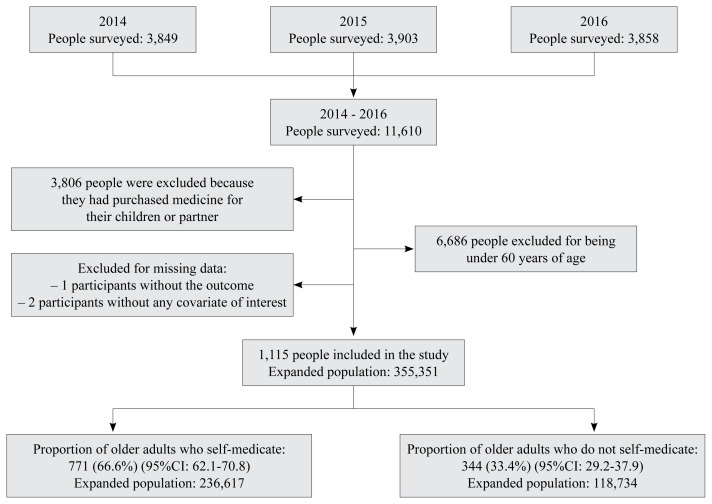
A secondary analysis was performed using an analytical cross-sectional design of data from a nationally representative survey from 2014 to 2016. The exposure variable was self-medication, defined as the purchase of medicines without a prescription. The dependent variables were purchases of brand-name and OTC drugs, both as a dichotomous response (yes/no). Information of sociodemographic variables, health insurance, and the types of drugs purchased by the participants was collected. Crude prevalence ratios (PR) were calculated and adjusted using generalized linear models of the Poisson family, considering the complex sample of the survey.
In this study, 1,115 respondents were evaluated, with a mean age of 63.8 years and a male proportion of 48.2%. The prevalence of self-medication was 66.6%, while the proportions of purchases of brand-name and OTC drugs were 62.4% and 23.6%, respectively. The adjusted Poisson regression analysis revealed an association between self-medication and the purchase of brand-name drugs (adjusted PR [aPR]=1.09; 95% confidence interval [CI]: 1.01-1.19). Likewise, self-medication was associated with the purchase of OTC medications (aPR=1.97; 95%CI: 1.55-2.51).
This study evidenced a high prevalence of self-medication in Peruvian older adults. Two-thirds of the surveyed people bought brand-name drugs, whereas one-quarter bought OTC drugs. Self-medication was associated with a greater likelihood of buying brand-name and OTC drugs.
老年人是药物使用和自我药疗的特别脆弱群体。本研究的目的是评估自我药疗作为秘鲁老年人购买品牌药和非处方药相关因素的情况。
采用2014年至2016年全国代表性调查数据的分析性横断面设计进行二次分析。暴露变量为自我药疗,定义为无处方购买药品。因变量为品牌药和非处方药的购买情况,均为二分反应(是/否)。收集了社会人口学变量、健康保险以及参与者购买药品类型的信息。计算粗患病率比(PR),并使用泊松族广义线性模型进行调整,同时考虑调查的复杂样本。
本研究共评估了1115名受访者,平均年龄63.8岁,男性比例为48.2%。自我药疗的患病率为66.6%,而购买品牌药和非处方药的比例分别为62.4%和23.6%。调整后的泊松回归分析显示,自我药疗与品牌药购买之间存在关联(调整后PR [aPR]=1.09;95%置信区间[CI]:1.01 - 1.19)。同样,自我药疗与非处方药购买也有关联(aPR=1.97;95%CI:1.55 - 2.51)。
本研究证明秘鲁老年人自我药疗的患病率很高。三分之二的受访者购买品牌药,四分之一的受访者购买非处方药。自我药疗与购买品牌药和非处方药的可能性更大有关。