Unità Operativa UO Immunologia, IRCCS Ospedale Policlinico San Martino, Genova, Italy.
Divisione di Ematologia e Immunologia Clinica, Dipartimento di Medicina, Ospedale Santa Maria della Misericordia, Università di Perugia, Perugia, Italy.
Front Immunol. 2023 Feb 14;14:1111419. doi: 10.3389/fimmu.2023.1111419. eCollection 2023.
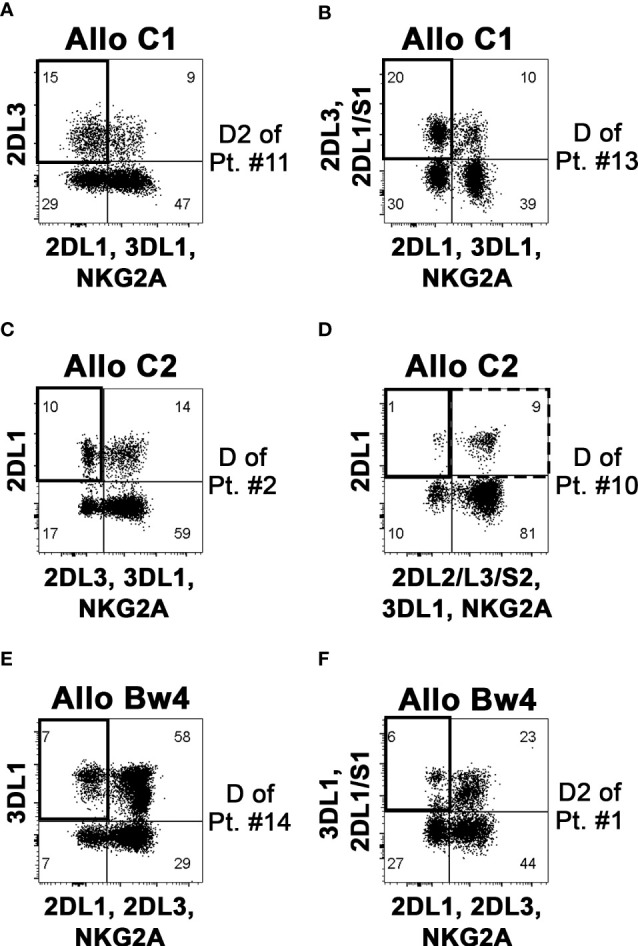
Natural killer (NK) cell-based adoptive immunotherapy in leukemia patients is an emerging field of interest based on clinical evidence of efficacy and safety. Elderly acute myeloid leukemia (AML) patients have been successfully treated with NK cells from HLA-haploidentical donors, especially when high amounts of alloreactive NK cells were infused. The aim of this study was comparing two approaches to define the size of alloreactive NK cells in haploidentical donors for AML patients recruited in two clinical trials with the acronym "NK-AML" (NCT03955848), and "MRD-NK". The standard methodology was based on the frequency of NK cell clones capable of lysing the related patient-derived cells. The alternative approach consisted of the phenotypic identification of freshly derived NK cells expressing, as inhibitory receptors, only the inhibitory KIR(s) specific for the mismatched KIR-Ligand(s) (HLA-C1, HLA-C2, HLA-Bw4). However, in KIR2DS2 donors and HLA-C1 patients, the unavailability of reagents staining only the inhibitory counterpart (KIR2DL2/L3) may lead to an underestimated identification of the alloreactive NK cell subset. Conversely, in the case of HLA-C1 mismatch, the alloreactive NK cell subset could be overestimated due to the ability of KIR2DL2/L3 to recognize with low-affinity also HLA-C2. Especially in this context, the additional exclusion of LIR1-expressing cells might be relevant to refine the size of the alloreactive NK cell subset. We could also associate degranulation assays, using as effector cells IL-2 activated donor peripheral blood mononuclear cells (PBMC) or NK cells upon co-culture with the related patient target cells. The donor alloreactive NK cell subset always displayed the highest functional activity, confirming its identification accuracy by flow cytometry. Despite the phenotypic limitations and considering the proposed corrective actions, a good correlation was shown by the comparison of the two investigated approaches. In addition, the characterization of receptor expression on a fraction of NK cell clones revealed expected but also few unexpected patterns. Thus, in most instances, the quantification of phenotypically defined alloreactive NK cells from PBMC can provide data similar to the analysis of lytic clones, with several advantages, such as a shorter time to achieve the results and, perhaps, higher reproducibility/feasibility in many laboratories.
基于 NK 细胞过继免疫治疗在白血病患者中具有疗效和安全性的临床证据,基于 NK 细胞的过继免疫治疗已成为白血病治疗的一个新兴领域。老年急性髓系白血病(AML)患者已成功接受来自 HLA 单倍体相合供者的 NK 细胞治疗,尤其是当输注大量同种反应性 NK 细胞时。本研究的目的是比较两种方法来确定在两项以首字母缩写为“NK-AML”(NCT03955848)和“MRD-NK”的临床试验中招募的 AML 患者的 HLA 单倍体相合供者中同种反应性 NK 细胞的大小。标准方法基于能够裂解相关患者来源细胞的 NK 细胞克隆的频率。替代方法包括表型鉴定新鲜分离的 NK 细胞,这些 NK 细胞仅表达与错配的 KIR 配体(HLA-C1、HLA-C2、HLA-Bw4)特异性的抑制性 KIR(抑制性受体)。然而,在 KIR2DS2 供者和 HLA-C1 患者中,由于缺乏仅染色抑制性对应物(KIR2DL2/L3)的试剂,可能会导致同种反应性 NK 细胞亚群的鉴定被低估。相反,在 HLA-C1 错配的情况下,由于 KIR2DL2/L3 能够以低亲和力识别 HLA-C2,同种反应性 NK 细胞亚群可能会被高估。特别是在这种情况下,排除表达 LIR1 的细胞可能有助于细化同种反应性 NK 细胞亚群的大小。我们还可以使用作为效应细胞的 IL-2 激活的供者外周血单核细胞(PBMC)或 NK 细胞,在与相关患者靶细胞共培养后进行脱颗粒测定,来评估 NK 细胞的功能活性。供者同种反应性 NK 细胞亚群始终表现出最高的功能活性,通过流式细胞术确认其鉴定的准确性。尽管存在表型限制,并考虑到所提出的纠正措施,但两种研究方法的比较显示出良好的相关性。此外,对 NK 细胞克隆的一部分的受体表达进行特征描述,揭示了预期但也有一些意外的模式。因此,在大多数情况下,从 PBMC 中定量表型定义的同种反应性 NK 细胞可以提供与裂解克隆分析相似的数据,具有几个优点,例如获得结果的时间更短,并且在许多实验室中可能具有更高的重现性/可行性。