Lin Yu-Li, Hsu Bang-Gee
Division of Nephrology, Hualien Tzu Chi Hospital, Buddhist Tzu Chi Medical Foundation, Hualien, Taiwan.
School of Medicine, Tzu Chi University, Hualien, Taiwan.
Tzu Chi Med J. 2022 Jul 26;35(1):44-50. doi: 10.4103/tcmj.tcmj_100_22. eCollection 2023 Jan-Mar.
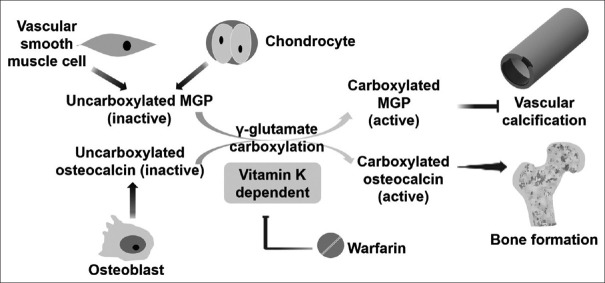
Vascular calcification, characterized by calcium deposition in the intimal and medial layers of the arterial wall, is frequently encountered in patients with chronic kidney disease (CKD) and leads to an enhanced risk of adverse cardiovascular (CV) outcomes. However, the underlying complex pathophysiology remains incompletely understood. Recently, Vitamin K supplementation aimed at correcting Vitamin K deficiency highly prevalent in CKD holds great promise to mitigate the progression of vascular calcification. This article discusses the functional Vitamin K status in CKD, the pathophysiology linking Vitamin K deficiency and vascular calcification, and reviews current literature from animal models, observational studies, and clinical trials across the different spectrum of CKD. While favorable effects of Vitamin K on vascular calcification and CV outcomes are suggested in animal and observational studies, most recently published clinical trials investigating the effects of Vitamin K on vascular health failed to support the beneficial role of Vitamin K supplementation, despite improving the functional status of Vitamin K. We address the potential reasons for these discrepancies and provide further perspective on Vitamin K research in CKD.
血管钙化的特征是钙在动脉壁内膜和中膜层沉积,在慢性肾脏病(CKD)患者中经常出现,并导致不良心血管(CV)结局的风险增加。然而,其潜在的复杂病理生理学仍未完全了解。最近,旨在纠正CKD中高度普遍存在的维生素K缺乏的维生素K补充疗法,有望减轻血管钙化的进展。本文讨论了CKD中功能性维生素K状态、维生素K缺乏与血管钙化之间的病理生理学联系,并综述了来自动物模型、观察性研究以及不同阶段CKD临床试验的现有文献。虽然动物和观察性研究表明维生素K对血管钙化和CV结局有有利影响,但最近发表的调查维生素K对血管健康影响的临床试验,尽管改善了维生素K的功能状态,却未能支持补充维生素K的有益作用。我们探讨了这些差异的潜在原因,并对CKD中维生素K的研究提供了进一步的观点。