Roumeliotis Stefanos, Dounousi Evangelia, Salmas Marios, Eleftheriadis Theodoros, Liakopoulos Vassilios
Department of Internal Medicine, School of Medicine, Aristotle University of Thessaloniki, Thessaloniki, Greece.
Department of Nephrology, Faculty of Medicine, School of Health Sciences, University of Ioannina, Ioannina, Greece.
Front Med (Lausanne). 2020 Apr 24;7:154. doi: 10.3389/fmed.2020.00154. eCollection 2020.
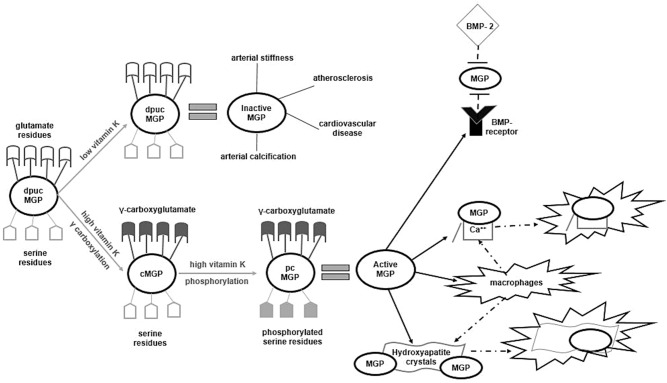
Arterial calcification is highly prevalent in chronic kidney disease (CKD) patients and is associated with cardiovascular (CV) morbidity and mortality. Patients at early CKD stages are more likely to suffer a fatal CV event than to develop end-stage renal disease and require hemodialysis treatment. The heavy CV burden of these patients cannot be solely explained by traditional calcification risk factors. Moreover, the pathophysiologic mechanisms underlying this association are complex and yet not fully understood. Although vascular calcification was regarded as a passive degenerative process for over a century, this theory changed by recent evidence that pointed toward an active process, where calcification promoters and inhibitors were involved. Matrix Gla Protein (MGP) has been established as a strong inhibitor of calcification both and . Not only it prevents mineralization of the arterial wall, but it is the only factor that can actually reverse it. To become fully active, MGP must undergo carboxylation of specific protein bound glutamate residues, a process fully dependent on the availability of vitamin K. Low vitamin K status leads to inactive, uncarboxylated forms of MGP and has been repeatedly associated with accelerated vascular calcification. Aim of this review is to present the pathophysiologic mechanisms underlying the activation and function of MGP and review the existing, accumulating data regarding the association between vitamin K, MGP and vascular calcification/CV disease in CKD patients.
动脉钙化在慢性肾脏病(CKD)患者中极为普遍,且与心血管(CV)疾病的发病率和死亡率相关。处于CKD早期阶段的患者发生致命性心血管事件的可能性高于发展为终末期肾病并需要接受血液透析治疗的可能性。这些患者沉重的心血管负担不能仅仅用传统的钙化危险因素来解释。此外,这种关联背后的病理生理机制很复杂,尚未完全明确。尽管一个多世纪以来血管钙化一直被视为一种被动的退行性过程,但最近的证据表明这是一个涉及钙化促进因子和抑制因子的主动过程,这一理论因此发生了改变。基质Gla蛋白(MGP)已被确认为体内外钙化的强力抑制剂。它不仅能防止动脉壁矿化,而且是唯一能实际逆转矿化的因子。要完全激活,MGP必须使特定的蛋白结合谷氨酸残基发生羧化,这一过程完全依赖于维生素K的供应。低维生素K状态会导致无活性的、未羧化形式的MGP,并且反复与加速的血管钙化相关。本综述的目的是阐述MGP激活和功能背后的病理生理机制,并综述现有的、关于维生素K、MGP与CKD患者血管钙化/CV疾病之间关联的累积数据。