Department of Child and Adolescent Psychiatry and Psychotherapy, Central Institute of Mental Health, Medical Faculty Mannheim/Heidelberg University, J5, 68159, Mannheim, Germany.
Department of Biostatistics, Central Institute of Mental Health, Medical Faculty Mannheim/Heidelberg University, J5, 68159, Mannheim, Germany.
Sci Rep. 2023 Mar 4;13(1):3675. doi: 10.1038/s41598-023-30803-9.
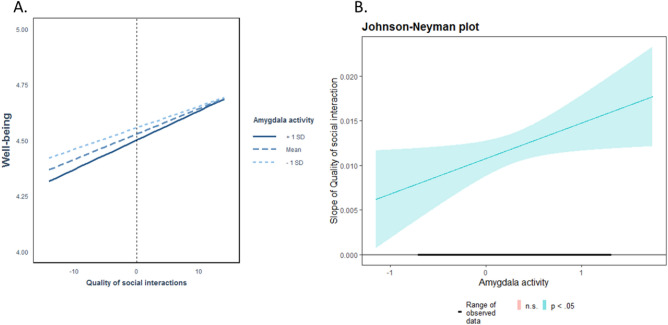
The coronavirus pandemic has brought about dramatic restrictions to real-life social interactions and a shift towards more online social encounters. Positive social interactions have been highlighted as an important protective factor, with previous studies suggesting an involvement of the amygdala in the relationship between social embeddedness and well-being. The present study investigated the effect of the quality of real-life and online social interactions on mood, and explored whether this association is affected by an individual's amygdala activity. Sixty-two participants of a longitudinal study took part in a one-week ecological momentary assessment (EMA) during the first lockdown, reporting their momentary well-being and their engagement in real-life and online social interactions eight times per day (N ~ 3000 observations). Amygdala activity was assessed before the pandemic during an emotion-processing task. Mixed models were calculated to estimate the association between social interactions and well-being, including two-way interactions to test for the moderating effect of amygdala activity. We found a positive relationship between real-life interactions and momentary well-being. In contrast, online interactions had no effect on well-being. Moreover, positive real-life social interactions augmented this social affective benefit, especially in individuals with higher amygdala being more sensitive to the interaction quality. Our findings demonstrate a mood-lifting effect of positive real-life social interactions during the pandemic, which was dependent on amygdala activity before the pandemic. As no corresponding effect was found between online social interactions and well-being, it can be concluded that increased online social interactions may not compensate for the absence of real-life social interactions.
冠状病毒大流行给现实生活中的社交互动带来了巨大的限制,并促使人们更多地进行线上社交。积极的社交互动已被强调为一个重要的保护因素,先前的研究表明,杏仁核与社交融入度和幸福感之间存在关联。本研究调查了现实生活和线上社交互动的质量对情绪的影响,并探讨了这种关联是否受到个体杏仁核活动的影响。62 名参加纵向研究的参与者在第一次封锁期间参与了为期一周的生态瞬时评估(EMA),每天报告 8 次他们的即时幸福感和现实生活及线上社交互动情况(N~3000 次观察)。在进行情绪处理任务之前,评估了杏仁核的活动。计算混合模型以估计社交互动和幸福感之间的关联,包括双向交互作用,以测试杏仁核活动的调节作用。我们发现现实生活中的互动与即时幸福感呈正相关。相比之下,线上互动对幸福感没有影响。此外,积极的现实生活中的社交互动增强了这种社交情感上的好处,特别是在杏仁核活动较高的个体中,他们对互动质量更敏感。我们的研究结果表明,在大流行期间,积极的现实生活中的社交互动具有提升情绪的作用,这取决于大流行前杏仁核的活动。由于在线社交互动和幸福感之间没有发现相应的关联,因此可以得出结论,增加在线社交互动可能无法弥补现实生活中社交互动的缺失。